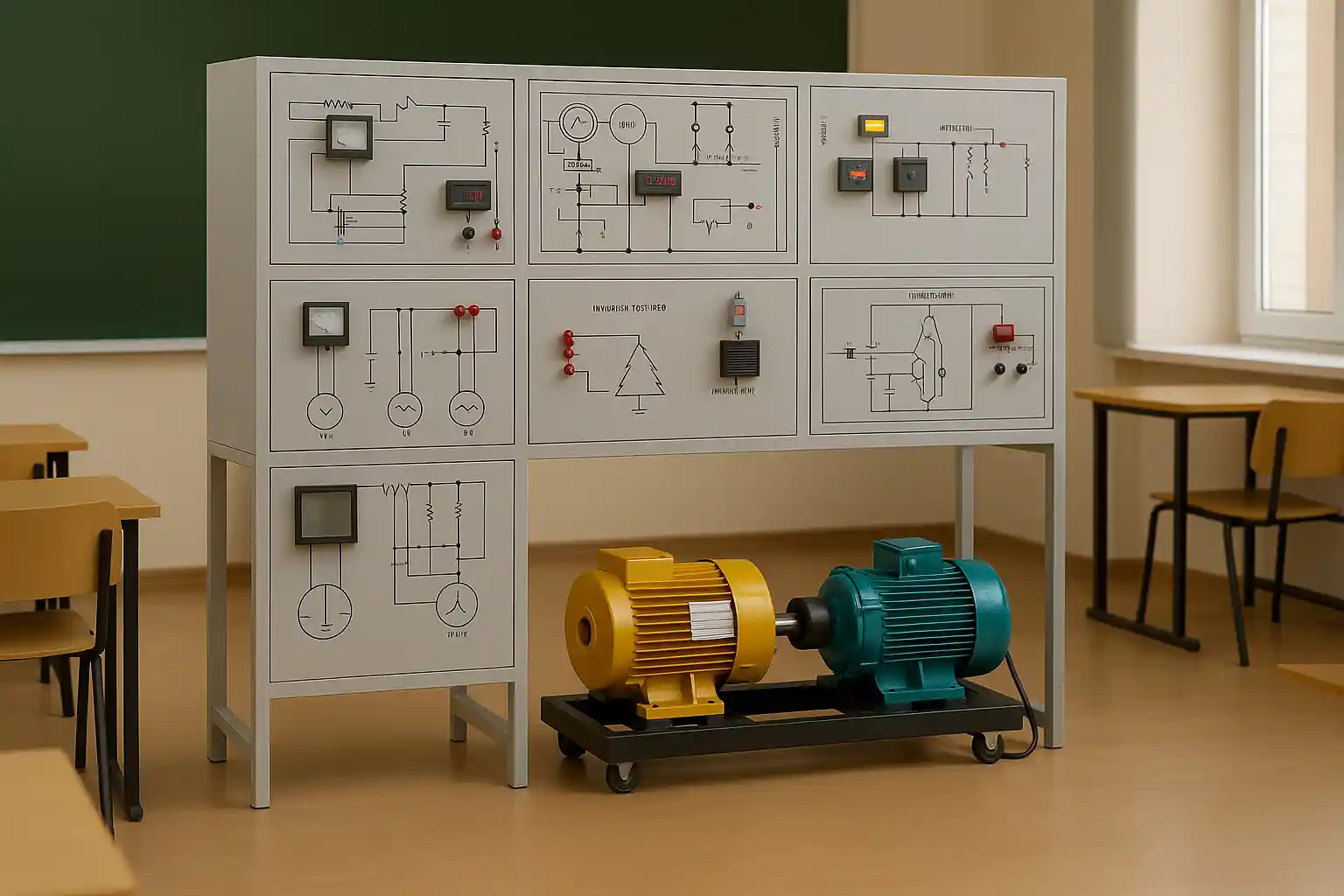
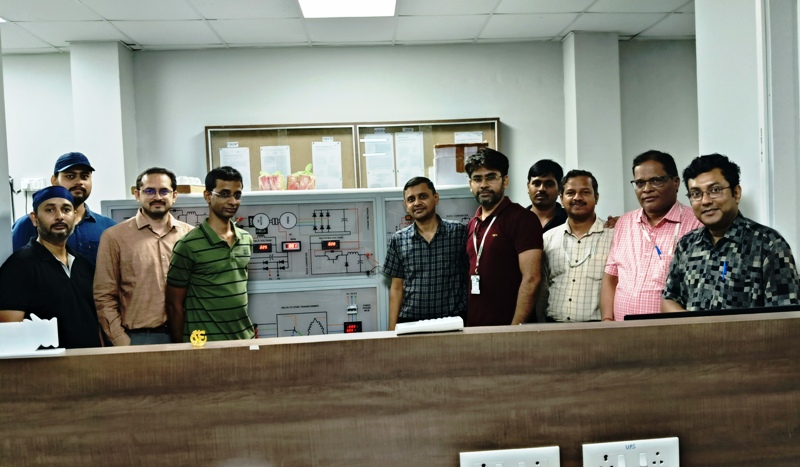
The Ecosense Ocean Wave Simulator is a laboratory-scale experimental platform that emulates the mechanical behaviour of ocean waves and demonstrates how wave motion can be converted into electrical energy. Instead of relying on real sea waves, the system uses a controlled mechanical arrangement to reproduce wave-like motion, making experiments repeatable, measurable, and safe.
The simulator allows students to study the complete wave-energy conversion chain—from mechanical motion to electrical output—under controlled conditions.
1. Wave Motion Simulation : At the core of the system is a mechanical wave-generation mechanism that replicates the up-and-down or oscillatory motion experienced by wave energy devices in the ocean. The system allows variation of key wave parameters such as:
• Wave frequency
• Wave amplitude (height)
• Mechanical oscillation speed
By changing these parameters, students can simulate calm seas, moderate wave conditions, or high-energy wave scenarios. This helps learners understand how real ocean waves differ in energy content and how wave characteristics influence power generation.
2. Mechanical Energy Conversion: The simulated wave motion is transferred to a mechanical energy conversion mechanism, similar to those used in real wave-energy converters such as oscillating bodies or point absorbers. Students can observe:
• Conversion of linear or oscillatory motion into rotational motion
• Mechanical losses and system inertia
• Effect of wave frequency on mechanical output
This stage helps learners connect concepts from fluid mechanics and dynamics with real energy-harvesting mechanisms.
3. Electrical Power Generation: The mechanical motion drives an electrical generator, converting mechanical energy into electrical power. Students can measure:
• Generator voltage and current
• Electrical power output under varying wave conditions
• Effect of mechanical speed on electrical generation
This enables clear understanding of how wave motion translates into electrical energy and why generator selection and coupling are critical in wave-energy systems.
4. Power Conditioning and Load Analysis: The generated electrical power is supplied to DC or AC loads through appropriate power conditioning circuits. Students can study:
• Power variation with load changes
• Electrical efficiency of the system
• Stability of output under fluctuating wave input
• Energy dissipation and utilization patterns
This stage links wave energy systems with broader renewable-energy and power-electronics concepts.
5. Data Monitoring and Experimentation: The simulator includes instrumentation for real-time monitoring of mechanical and electrical parameters. Students can record data, plot graphs, and analyze system performance under different simulated sea states.
Using this data, learners can:
• Compare power output at different wave frequencies
• Study system efficiency trends
• Identify optimal operating conditions
• Perform experimental validation for projects and research
Learn Ocean Energy Without the Ocean
The Ocean Wave Simulator Lab allows institutions to introduce marine renewable energy education in a controlled, scalable manner. Students can start with basic experiments on wave motion and progress to advanced studies on energy conversion efficiency and system optimization.
The system is independent, compact, and expandable, making it suitable for teaching, training, and research in one of the most promising renewable energy domains.