Carbon Capture Lab

Learning Module

Integrated Platform for Carbon Capture and Utilization

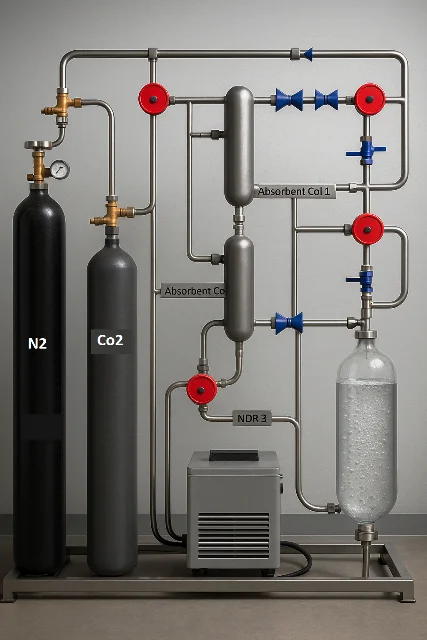
The Integrated Platform for Carbon Capture and Utilization is a comprehensive, hands-on educational system designed to bring real-world carbon capture utilization and storage processes into academic laboratories. Developed for engineering and science institutions, this lab-scale setup enables students and researchers to study the complete CCUS workflow—from simulated carbon emissions and selective adsorption to controlled desorption and final mineralization into stable compounds such as CaCO₃. By combining precision gas handling, advanced sensing, and PID-based control, the platform enables practical understanding of carbon capture and storage under controlled and repeatable laboratory conditions. Its IoT-enabled data acquisition system supports both foundational teaching and advanced experimental research.

Know More

What is Carbon Capture Lab

A Carbon Capture Lab is an experimental platform designed to study the capture, utilization, and storage of carbon dioxide (CO₂) emissions.

It enables users to simulate industrial emissions, capture CO₂ using adsorption techniques, and convert it into stable compounds like calcium carbonate. These labs help in understanding carbon reduction technologies and climate mitigation strategies.

Why Choose Carbon Capture Lab

  • Hands-on learning in carbon capture and utilization: The Carbon Capture Lab equips students and researchers with practical, experiment-based understanding of CO₂ capture, absorption, monitoring, conversion, and storage — core technologies at the heart of climate mitigation and industrial decarbonization efforts.
  • Designed for clean-energy and sustainability education: Instead of only providing theoretical knowledge, this lab blends real experimental modules with foundational clean-energy principles, strengthening skills needed for careers in environmental engineering, energy systems, and climate technology research.
  • Ideal for multidisciplinary engineering programs: The lab is suitable for mechanical, chemical, environmental, and energy engineering curricula — enabling practical experiments in gas absorption, CO₂ transformation, emission monitoring, and capture efficiency analysis, all of which are key to modern carbon reduction strategies.
  • Supports research and innovation in carbon capture technologies: With well-instrumented modules that allow real CO₂ capture and utilization experiments, institutions can use this lab for undergraduate courses, postgraduate research projects, and faculty-led sustainability R&D initiatives.
  • Prepares students for emerging climate-tech careers: As nations and industries adopt carbon capture, utilisation and storage (CCUS) systems to achieve net-zero goals, graduates with hands-on experience in CO₂ capture processes are highly sought after in sectors such as energy, environmental consultancy, and industrial decarbonization. 

How the Carbon Capture Lab Works

The Carbon Capture Lab is an integrated platform that allows students and researchers to explore CO₂ capture, monitoring, processing, and utilization through real experiments. Instead of focusing solely on simulations or theoretical exercises, the lab is engineered to perform practical, measurable experiments that reveal the behaviour of carbon capture processes under controlled conditions.
 
At its core, the lab enables learners to understand how carbon dioxide — a major greenhouse gas — can be separated from gas streams, quantified, stored, and processed into stable forms. The lab brings together multiple modules that together create a complete experimental workflow for carbon capture technologies.

1. Gas Flow and CO₂ Introduction: The lab begins with a controlled source of carbon dioxide or CO₂-rich gas, allowing learners to introduce CO₂ into the experimental setup at desired flow rates. Instruments monitor gas composition, flow rate, and pressure, enabling students to study how CO₂ behaves in flowing streams and under different operational conditions.

2. Absorption and Capture Mechanisms: One of the key functionalities of the lab is its gas absorption module, where CO₂ is captured from a gas stream using absorbents or capture media. Students can measure how variables like flow rate, temperature, and absorbent concentration affect the capture efficiency. This hands-on work demonstrates the principles behind industrial carbon capture technologies, such as solvent or sorbent-based capture systems, where CO₂ is selectively removed from flue gases or air.

3. Monitoring and Instrumentation: The lab is equipped with real-time gas sensors and analytical instruments that monitor CO₂ concentration before and after capture. Students can observe how capture efficiency changes with process conditions, and they can plot and analyze capture performance curves. These measurements help solidify understanding of capture kinetics and process optimization.

4. Conversion and Utilization Experiments: Beyond capture, the lab enables experimentation on carbon utilization pathways — such as converting captured CO₂ into stable compounds like carbonates (e.g., converting CO₂ to CaCO₃) or feeding CO₂ into processes where it can be further used as a feedstock. This module introduces learners to carbon utilization (CCU) concepts, which are increasingly applied in sustainable materials and carbon-neutral production processes. 

5. Data Analysis and Research Applications: All experiments come with comprehensive data acquisition and visualization tools, allowing learners to collect, plot, and interpret results. Students can correlate variables like absorbent type, operating temperature, and gas concentration with capture performance, enabling research-level experiments, optimization studies, and comparative analysis.

What You Can Do in the Lab

In this lab, learners can:

  • Perform CO₂ capture experiments with varying flow rates and absorbents
  • Analyze capture efficiency and process parameters
  • Monitor gas composition in real time
  • Explore conversion of CO₂ into stable forms
  • Collect experimental data for research and reports
  • Compare different carbon capture techniques
  • Apply learnings to industrial and climate-technology contexts

Why It Matters

As global efforts intensify to reduce atmospheric carbon dioxide and meet climate targets, understanding carbon capture and utilization technologies has become a critical skill in engineering and environmental science. The Ecosense Carbon Capture Lab translates these emerging technologies from industrial settings into classroom-scale, hands-on learning platforms — helping the next generation of engineers and researchers develop real, applicable expertise. 

 

Frequently Asked Questions

The Carbon Capture Lab is designed to help students and researchers understand how CO₂ can be captured from gas streams, measured, processed, and converted into stable compounds. It provides hands-on experience with real carbon capture processes rather than relying only on theoretical learning.

Students can perform CO₂ absorption experiments, measure capture efficiency, study the effect of flow rate and temperature, monitor CO₂ concentration using sensors, and explore CO₂ utilization pathways such as converting CO₂ into carbonates (e.g., CaCO₃). These experiments strengthen understanding of industrial CCUS processes.

Yes. The lab is ideal for chemical, mechanical, environmental, and energy engineering programs, as well as sustainability and climate-technology courses. It supports both undergraduate teaching and postgraduate research in emissions reduction and clean-technology development.

Yes. The Carbon Capture Lab is equipped with gas sensors, flow meters, and analytical instruments that provide real-time measurement of CO₂ concentration before and after the capture process. This allows students to analyze performance and validate capture efficiency with accurate data.

Absolutely. The lab supports detailed data logging, parameter variation, and performance analysis, making it suitable for M.Tech dissertations, PhD research, faculty projects, and innovation in carbon capture and utilization technologies.

Ecosense serves educational institutions, research centers, and training organizations worldwide. Our lab solutions are deployed across Asia, the Middle East (UAE, Saudi Arabia and Oman), Europe, Africa, and the Americas, supporting universities, polytechnics, and R&D facilities.

Yes. Ecosense provides lab design, equipment supply, and turnkey lab solutions outside India. We regularly support international projects through direct exports, local partners, and on-site coordination based on project scope.

Absolutely. All Ecosense lab solutions can be customized to meet country-specific academic curricula, electrical standards, safety regulations, voltage/frequency norms, and certification requirements. Customization also extends to documentation, experiments, and software interfaces.