The Fuel Cell Lab consists of two independent systems, each designed to address a specific area of fuel cell education—fundamental fuel cell behaviour and fuel-cell-based vehicle drivetrain operation. Institutions may deploy either system independently or combine both for a comprehensive hydrogen and fuel cell learning experience.
1. Fuel Cell Training System: The Fuel Cell Training System is designed to teach the electrical characteristics and performance behaviour of PEM fuel cells. The system includes a fuel cell stack, controlled hydrogen supply interface, fuel cell controller, charge controller, inverter, load bank, and measurement panel that allow students to perform detailed characterization experiments.
Students begin by studying how a fuel cell converts hydrogen and oxygen into electricity and heat. They measure and analyse:
- Voltage-current (V–I) characteristics
- Polarization curves
- Power output at different loads
- Fuel utilization efficiency
- Temperature effects on output performance
- Stack response under transient loading
This hands-on work helps students understand real-world challenges such as voltage drop, stack heating, water management, and limitations of fuel cell efficiency. Using the load bank and monitoring tools, they can simulate practical operating conditions and observe how performance varies during steady-state and dynamic operation.The system also allows exploration of:
- Constant current vs constant power modes
- Effects of air flow and hydrogen flow rate
- Stack degradation indicators
- Electrical integration with DC loads or storage elements
Overall, the Fuel Cell Training System serves as the foundation of hydrogen energy education, preparing learners for advanced fuel cell applications.
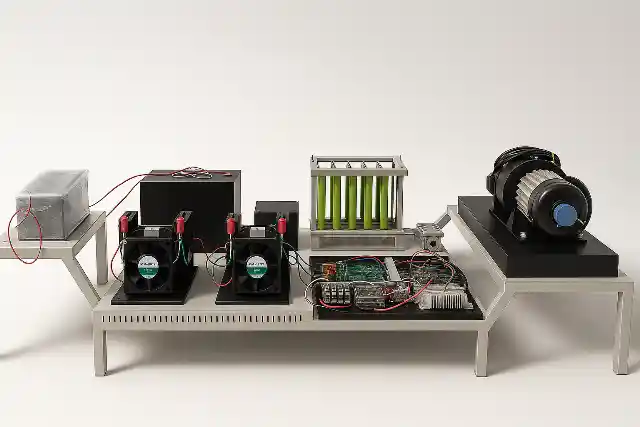
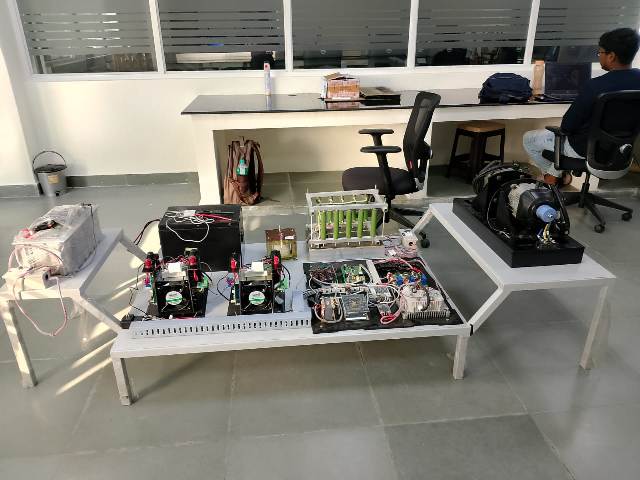
2. Fuel Cell Drive Train: The Fuel Cell Drive Train system takes learning beyond characterization and introduces students to real fuel-cell-powered electric drive systems. This platform integrates a PEM fuel cell stack with a DC-DC converter, energy storage (battery or ultracapacitor), inverter, and electric motor—replicating the core architecture of fuel-cell electric vehicles (FCEVs).
Students can explore:
- How fuel cells power electric motors
- Role of DC-DC converters in voltage regulation
- Hybrid operation with battery support
- Torque-speed characteristics under fuel cell supply
- Drive cycle simulations (Indian Drive Cycle)
- Transient response under acceleration and deceleration
- Power sharing between fuel cell and storage
- Efficiency mapping of the drivetrain
The Drive Train system enables analysis of real automotive engineering concepts, such as:
- Hybrid fuel cell–battery operation
- Regenerative braking and energy recovery
- Load-following vs power-following control strategies
- Drive cycle optimization and hydrogen consumption modelling
Because the system uses real hardware and power electronics, students gain practical insight into fuel-cell vehicle operation, control algorithms, and system integration challenges.
This makes the Fuel Cell Drive Train ideal for:
- Automotive engineering labs
- Hydrogen mobility courses
- Power-electronics and control research
- Industry-oriented EV/FCEV training
Start Anywhere — Learn Everything
Both systems in the Fuel Cell Lab are independent and complete. Institutions can begin with the Fuel Cell Training System for fundamental understanding, or directly adopt the Fuel Cell Drive Train for advanced vehicle-level experiments. When combined, these systems create a full hydrogen-to-mobility learning ecosystem, covering everything from fuel cell basics to complete drivetrain behaviour.