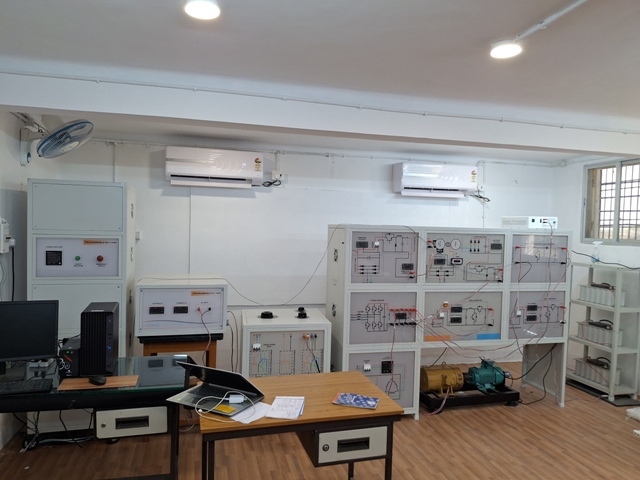
Microgrid Lab

Learning Module

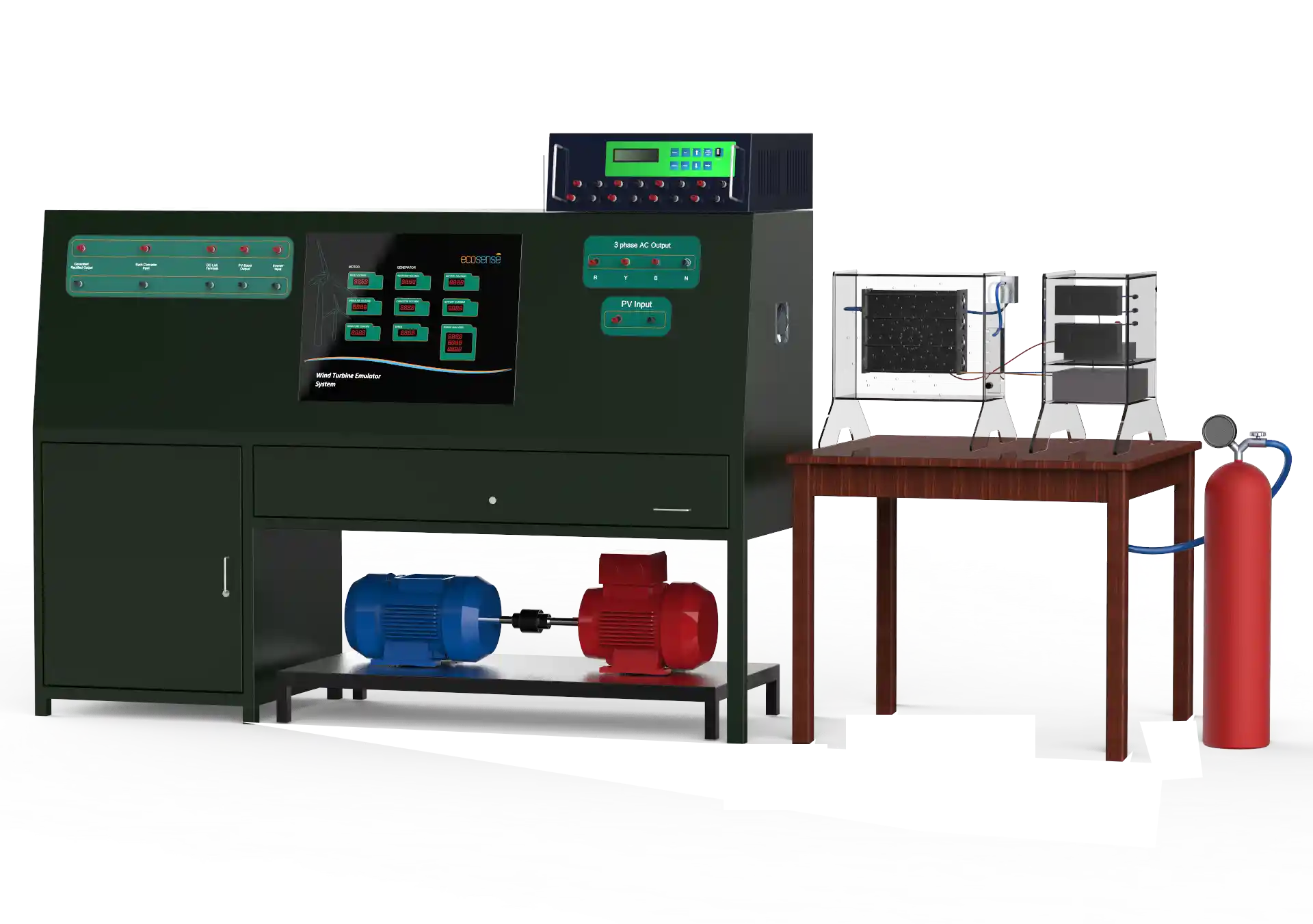
Wind Turbine Emulator-PV Emulator-Fuel Cell Microgrid

The Wind Turbine Emulator-Solar PV Emulator-Fuel Cell Microgrid is a tri-source, fully integrated hybrid energy training platform that combines Wind Turbine Emulator (WTE), PV Emulator (PVE), and PEM Fuel Cell systems to simulate a real-world microgrid environment. It offers users the ability to model, control, and analyze complex interactions among renewable sources and storage units, with applications in smart grid control, distributed generation, and hybrid energy management. This advanced lab-scale system enables real-time source coordination, dynamic load response, and grid interfacing, making it ideal for universities, technical research labs, and training centers focused on sustainable energy systems. The platform supports integration with battery banks, supercapacitors, and programmable loads, while also offering a fully open-source control software environment for custom experimentation.

Know More
Learning Module

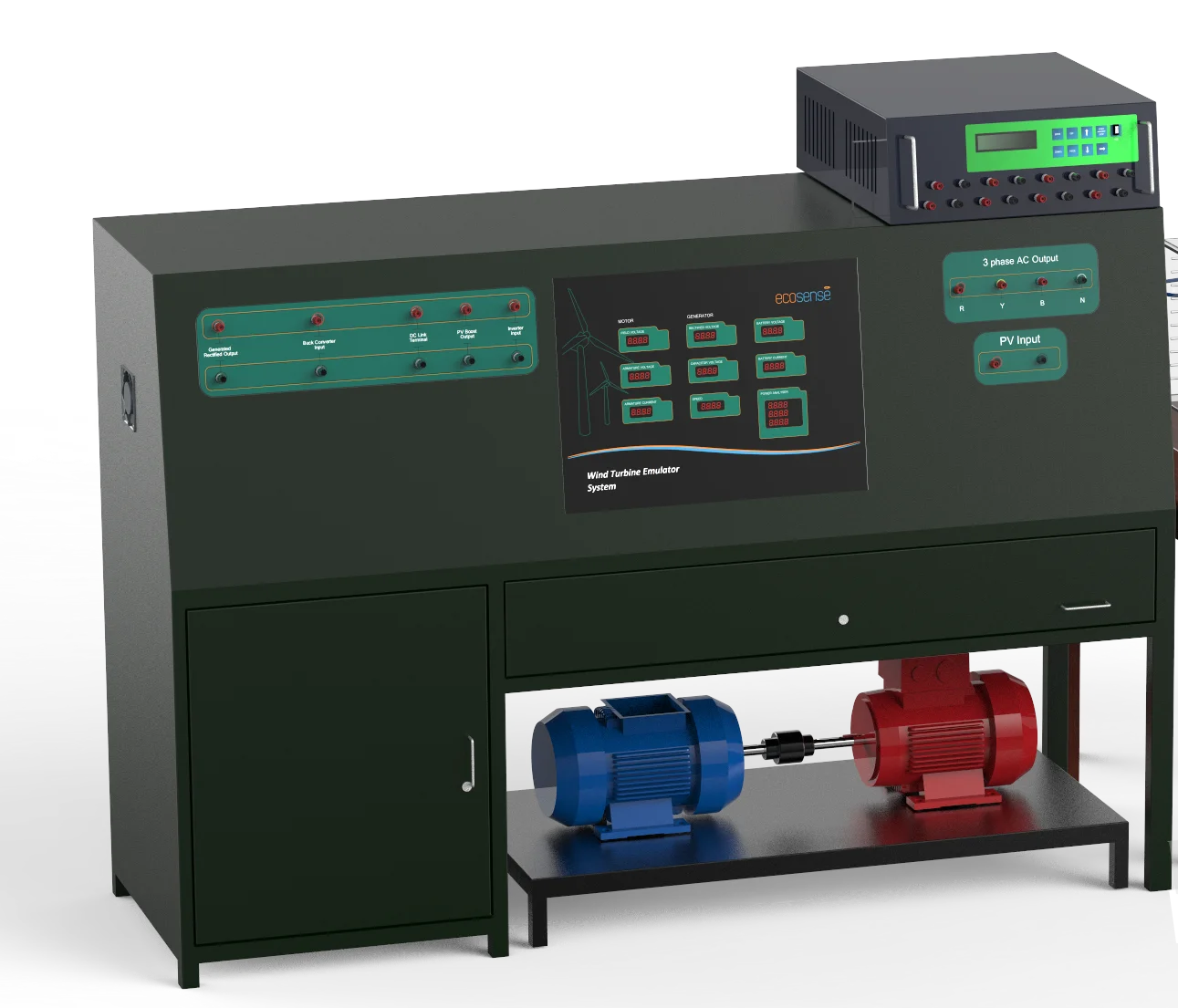
Wind Turbine Emulator-PV Emulator Microgrid

The Wind Turbine Emulator and PV Emulator (WTE-PVE) Microgrid is a comprehensive, lab-scale microgrid system developed for training, experimentation, and research in sustainable power systems. It simulates both wind and solar power generation and allows users to understand, design, and test hybrid energy systems under realistic environmental and load conditions. The system comprises two primary subsystems: the Wind Turbine Emulator (WTE) and the PV Emulator (PVE). Each operates independently but can also be integrated at a common DC link to form a combined hybrid system. The platform supports bidirectional power flow with energy storage, programmable loads, and inverter-based AC output, making it suitable for microgrid studies, control algorithm development, and grid synchronization.

Know More
Learning Module

Wind Turbine Emulator - Fuel Cell Microgrid

The WTE-FC Microgrid is an advanced hybrid energy training and research platform that integrates a Wind Turbine Emulator (WTE) with a Proton Exchange Membrane (PEM) Fuel Cell system. Designed to explore power continuity and backup energy strategies in microgrids, this system enables users to simulate and analyze the interplay between intermittent renewable generation and steady hydrogen-based power supply. The platform mirrors real-world microgrid operation, where wind energy serves as the primary variable source and hydrogen fuel cells provide reliability during low-wind scenarios. This system is ideal for developing skills in microgrid design, renewable backup strategies, energy security analysis, and grid-independent operation.

Know More

Why Choose the Microgrid Lab

  • True multi-source, multi-storage, multi-load architecture: The Ecosense Microgrid Lab is not a fixed system. It is a configurable platform that can integrate multiple generation sources, multiple energy storage systems, and multiple AC/DC loads—mirroring real-world microgrids used in campuses, industries, defense, islands, and smart cities.
  • Designed for customization, not limitation: Every Microgrid Lab is designed based on the customer’s academic, research, or demonstration requirements. Institutions can choose the type, rating, and number of sources, storage technologies, converters, and loads—ensuring the lab matches curriculum depth and future expansion plans.
  • Hands-on learning of modern power systems: Students do not just observe microgrid behavior; they actively control power flow, manage storage, prioritize loads, and test operating scenarios such as islanding, reconnection, and black start using real hardware.
  • Covers both AC and DC microgrid architectures: The lab supports AC microgrids, DC microgrids, and hybrid AC–DC microgrids, enabling learners to study advantages, limitations, and power-flow behavior of each architecture under real operating conditions.
  • Research-ready energy management system (EMS): The Microgrid Lab includes an editable and programmable Energy Management System, allowing students and researchers to implement their own dispatch logic, scheduling algorithms, optimization strategies, and protection schemes.
  • Ideal for interdisciplinary programs and Centres of Excellence: The lab supports electrical engineering, power systems, renewable energy, energy storage, hydrogen systems, EV integration, and smart grid education—making it ideal for Centres of Excellence and funded research projects.
  • Future-proof and expandable: New energy sources, storage technologies, EV chargers, hydrogen systems, or advanced controllers can be added later without redesigning the core system—protecting institutional investment.

How the Ecosense Microgrid Lab Works

The Ecosense Microgrid Lab is a modular energy ecosystem that replicates the operation of real-world microgrids at laboratory scale. It allows users to generate energy, store energy, distribute power, manage loads, and control grid interaction through a centralized control and energy management framework.

The lab is built around four configurable layers:

  • Multiple Energy Sources
  • Multiple Energy Storage Systems
  • Multiple Loads (AC & DC)
  • Central Energy Management & Control System

Each layer can be independently configured and later expanded.

1. Multiple Energy Sources: The Microgrid Lab can integrate one or more of the following energy sources, depending on user requirements:

  • Solar PV arrays or Solar PV Emulators
  • Wind Energy Systems or Wind Turbine Emulators
  • Fuel Cell systems (hydrogen-based generation)
  • Diesel Generator or Grid Emulator
  • Utility grid interface

Students can study:

  • Renewable intermittency and variability
  • Power sharing between sources
  • Source prioritization strategies
  • MPPT behavior and source dynamics
  • Hybrid generation scenarios

Energy sources can feed common DC buses, AC buses, or hybrid AC–DC networks, depending on the microgrid architecture.

2. Multiple Energy Storage Systems: Energy storage is a critical element of microgrids. The lab supports multiple storage technologies, such as:

  • Battery Energy Storage Systems (BESS)
  • Ultracapacitors
  • Hydrogen storage (via fuel cell systems)
  • Hybrid storage combinations

Students can perform experiments on:

  • Charging and discharging cycles
  • State-of-charge (SoC) based dispatch
  • Load leveling and peak shaving
  • Backup power during outages
  • Storage coordination in hybrid systems

The lab demonstrates how storage stabilizes microgrids and enables high renewable penetration.

3. Multiple Loads (AC & DC): The Microgrid Lab includes configurable AC and DC loads, which can be resistive, inductive, non-linear, or programmable.

Students can analyze:

  • Load prioritization and shedding
  • Demand response strategies
  • Impact of load type on power quality
  • Load behavior during islanded operation
  • Critical vs non-critical load management

Smart switching and load control allow realistic simulation of residential, commercial, and industrial microgrid scenarios.

4. Central Energy Management System (EMS): The EMS is the brain of the microgrid. It monitors generation, storage, grid status, and loads in real time and makes decisions based on predefined or user-developed logic.

EMS capabilities include:

  • Real-time monitoring of voltage, current, power, frequency, and SoC
  • Power flow control between sources, storage, grid, and loads
  • Automatic islanding and grid reconnection
  • Black start operation
  • Load priority and shedding logic
  • Renewable maximization strategies
  • Cost and efficiency optimization
  • Manual, automatic, and remote operation

The EMS software is editable and programmable, allowing students and researchers to implement custom algorithms and validate them on real hardware.

Configurations That Can Be Built

Using the same Microgrid Lab platform, institutions can configure:

  • Standalone renewable microgrid
  • Grid-tied microgrid with export/import
  • Hybrid PV–Wind–Battery microgrid
  • PV + Fuel Cell + Battery microgrid
  • AC–DC hybrid microgrid
  • EV-integrated microgrid (V2G/V2H ready)
  • Research microgrid for EMS and optimization studies

What Students and Researchers Learn

  • Distributed generation behavior
  • Energy storage coordination
  • Microgrid stability and protection
  • Islanding and synchronization
  • EMS algorithm development
  • Renewable integration challenges
  • Smart grid and future power systems
Frequently Asked Questions

The Microgrid Lab is fully customizable. The number and type of energy sources, storage systems, loads, and control architecture are configured based on institutional requirements.

Yes. The lab supports grid-connected, islanded, and hybrid operation, including seamless transition between modes.

Yes. The system can be configured as an AC microgrid, DC microgrid, or hybrid AC–DC microgrid.

Yes. The EMS includes editable control logic and software, allowing students to implement and test custom energy management algorithms.

The Microgrid Lab is ideal for engineering colleges, universities, research centres, Centres of Excellence, and training institutes working on renewable energy, smart grids, EV integration, and advanced power systems.

Ecosense serves educational institutions, research centers, and training organizations worldwide. Our lab solutions are deployed across Asia, the Middle East (UAE, Saudi Arabia and Oman), Europe, Africa, and the Americas, supporting universities, polytechnics, and R&D facilities.

Yes. Ecosense provides lab design, equipment supply, and turnkey lab solutions outside India. We regularly support international projects through direct exports, local partners, and on-site coordination based on project scope.

Absolutely. All Ecosense lab solutions can be customized to meet country-specific academic curricula, electrical standards, safety regulations, voltage/frequency norms, and certification requirements. Customization also extends to documentation, experiments, and software interfaces.