Customized Lab Solutions

Learning Module

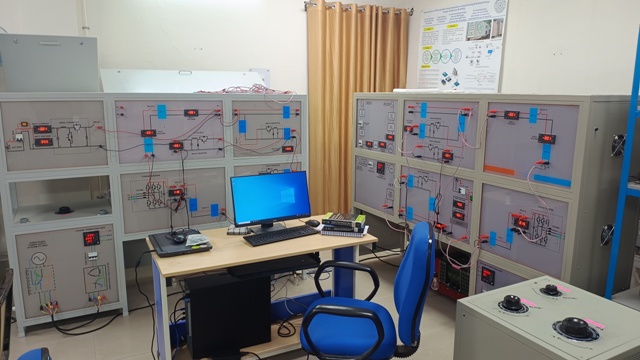
Zonal DC Microgrid

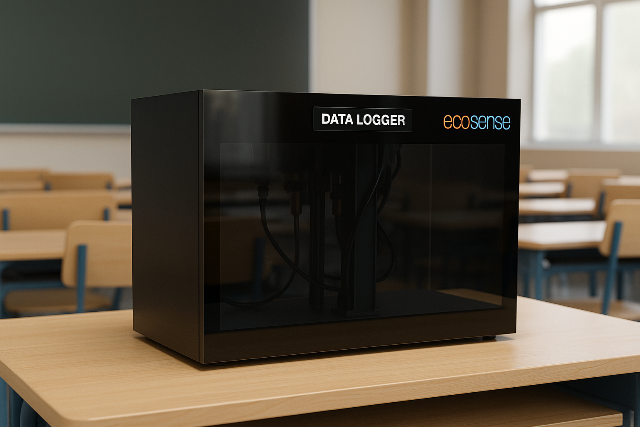
The Zonal DC Microgrid is a next generation educational and research platform that replicates a 2 zone, distributed DC power system capable of simulating real world fault handling, isolation, and resilience strategies. Installed at IIT Roorkee, this system is equipped with multiple DC buses, adjustable voltage levels, and independent load/source configurations in each zone. The platform allows students and researchers to generate faults intentionally in one zone and observe how the other zone remains unaffected, paving the way for smart grid and resilient infrastructure training.

Know More
Learning Module

Universal Datalogger

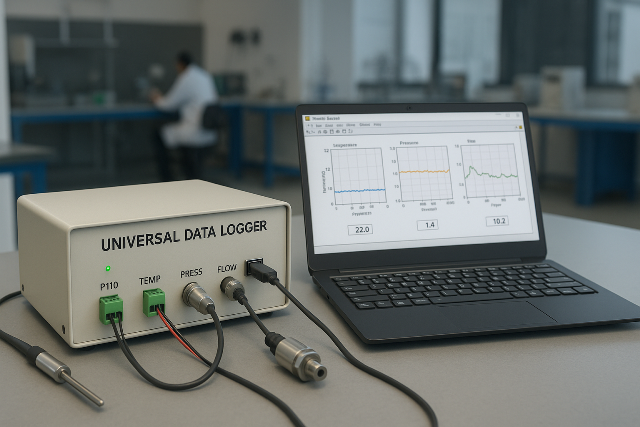
The Universal Data Logger System is a highly adaptable platform designed to acquire, display, and log real-time data from multiple sensor types including temperature (RTDs, thermocouples), pressure, and flow sensors. Ideal for multidisciplinary labs, the system supports a wide range of input types and allows students and researchers to perform comprehensive measurements and data analysis across various energy, fluid, and thermal systems. Its modular design and LabVIEW-based GUI make it perfect for educational institutions and industrial training centers that require accurate, flexible, and scalable data acquisition systems.

Know More
Learning Module

Grid-Connected Battery Energy Storage System

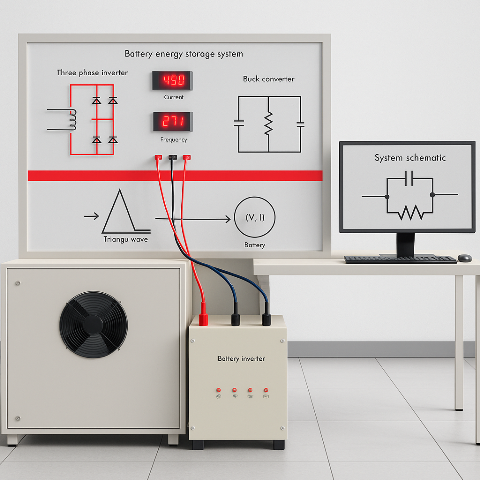
The Grid-Connected BESS is a fully functional battery energy storage lab system that simulates real-time grid interaction, renewable buffering, and demand-side energy control. It enables experimentation on peak shaving, frequency response, and bidirectional energy exchange. The system combines a battery bank, inverter, smart controller, and energy monitoring software to form a modular and programmable BESS ideal for both educational and pilot-scale smart grid implementations.

Know More
Learning Module

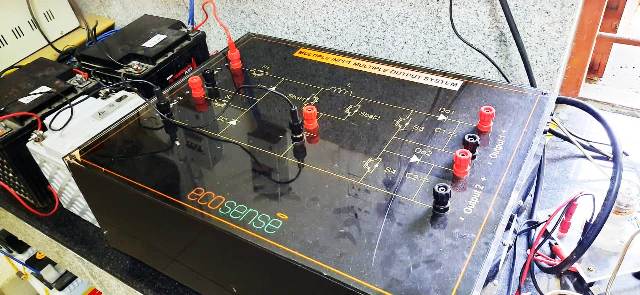
Multiple Input Multiple Output (MIMO) Converter

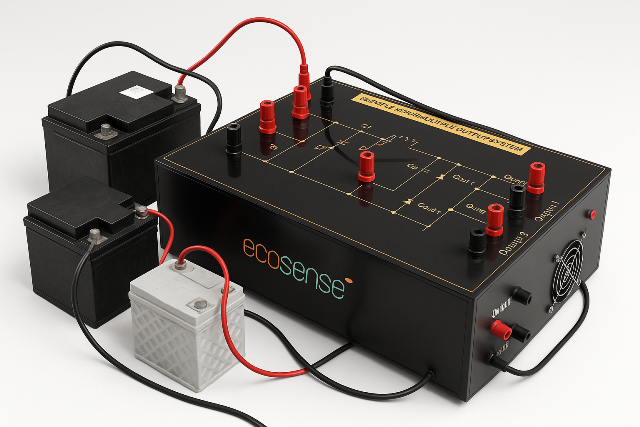
The MIMO DC-DC Converter is a robust and intelligent energy management system capable of handling multiple energy sources and storage systems simultaneously. Developed for use in research-oriented microgrid and hybrid system labs, the converter features multiple isolated input/output ports, each programmable for source or sink operation. This platform allows researchers and students to study MPPT, power balancing, energy routing, and converter control strategies between combinations of solar PV, batteries, fuel cells, and supercapacitors.

Know More

Why Customized Lab Solutions

  • Labs built around your curriculum, not templates: Ecosense Customized Lab Solutions are designed from the ground up based on your academic syllabus, research focus, and learning outcomes. Instead of forcing institutes to adapt to fixed products, we engineer laboratories that align precisely with your teaching and research objectives.
  • One platform for teaching, research, and industry collaboration: Our customized labs support undergraduate teaching, postgraduate research, faculty projects, sponsored research, and industry training—making them ideal for Centres of Excellence and long-term institutional growth.
  • Multi-domain expertise under one roof: Ecosense combines expertise across renewable energy, power electronics, electric mobility, hydrogen, microgrids, energy storage, and smart systems. This allows us to design interdisciplinary labs that reflect real-world engineering ecosystems.
  • Scalable and future-ready architectures: Customized labs are designed with expansion in mind. Institutes can start with a basic configuration and later add sources, loads, storage, controllers, or software modules without redesigning the entire system.
  • Open, editable, and research-oriented systems: Wherever applicable, we provide open and editable software, programmable controllers, and accessible power electronics—empowering students and researchers to implement their own algorithms, control strategies, and experimental logic.
  • Proven execution across leading institutions: Ecosense has successfully delivered customized labs to IITs, universities, research centres, and national training institutes. Our experience ensures reliable execution, clear documentation, and long-term usability.

How Ecosense Customized Lab Solutions Work

Ecosense follows a structured, engineering-driven approach to design and deliver customized laboratory solutions. Each project is treated as a unique system design exercise rather than a product sale.

1. Requirement Mapping & Academic Alignment: The process begins with detailed discussions with faculty members, researchers, and institutional stakeholders. We understand:

  • Course structure and learning outcomes
  • Research focus areas (fundamental, applied, or industry-oriented)
  • Student level (diploma, UG, PG, PhD)
  • Available space, power, and safety constraints
  • Budget and expansion roadmap

Based on this, we translate academic needs into technical system requirements.

2. System Architecture & Configuration Design :Once requirements are finalized, Ecosense engineers design a custom lab architecture, which may include:

  • Multiple energy sources (solar, wind, fuel cell, grid, emulators)
  • Multiple storage technologies (battery, ultracapacitor, hydrogen, thermal storage)
  • Multiple load types (AC, DC, dynamic, priority-based loads)
  • Power electronics (DC-DC, DC-AC, AC-DC, bidirectional converters)
  • Control systems (EMS, VCU, BMS, inverter control, microgrid control)

Each lab is designed to support multiple operating modes, such as standalone, grid-connected, hybrid, or research mode.

3. Hardware, Software & Control Integration : Customized labs integrate:

  • Industry-grade hardware with academic safety design
  • Real-time measurement and data acquisition
  • Graphical user interfaces (GUI) for monitoring and control
  • Open or semi-open control logic where research is required

Students and researchers can interact with real systems, modify parameters, write control logic, and validate performance under controlled conditions.

4. Fabrication, Testing & Safety Validation: Before delivery, every customized lab undergoes:

  • Electrical and functional testing
  • Protection and interlock validation
  • Sensor and measurement calibration
  • Load and fault condition verification

Safety is embedded at both hardware and software levels, making the systems suitable for classroom and lab environments.

5. Installation, Training & Documentation: Ecosense provides:

  • On-site installation and commissioning
  • Faculty and student training sessions
  • Illustrated experiment manuals
  • System documentation and wiring diagrams

This ensures that institutes can immediately start using the lab without dependence on external support.

Types of Customized Labs We Deliver

Ecosense regularly designs customized labs across domains such as:

  • Customized Microgrid Labs (multi-source, multi-storage, multi-load)
  • Electric Vehicle Development & Validation Labs
  • Hydrogen & Fuel Cell Research Labs
  • Advanced Power Electronics & Converter Labs
  • Energy Management & Smart Grid Labs
  • Hybrid Renewable Energy Labs
  • Industry-specific Training Labs

Each solution is engineered to balance educational clarity, research depth, and real-world relevance.

Who Should Opt for Customized Lab Solutions

  • Engineering colleges upgrading curriculum to next-generation technologies
  • Universities setting up Centres of Excellence
  • Research institutions working on funded projects
  • Skill development and industry training centres
  • Institutions seeking differentiation through advanced infrastructure
  • Build Exactly What You Teach and Research

Customized Lab Solutions from Ecosense ensure that your laboratory reflects your academic vision, not a catalog constraint. Whether you want a focused research setup or a broad multidisciplinary platform, Ecosense delivers labs that grow with your institution.

Frequently Asked Questions

Customized Lab Solutions are tailor-made laboratory systems designed to meet the specific academic, research, or training requirements of an institution. Instead of a fixed product, Ecosense designs labs based on curriculum needs, available space, budget, and learning outcomes—covering renewable energy, electric mobility, microgrids, hydrogen, power electronics, and smart energy systems.

Customization can include selection of energy sources, storage technologies, power ratings, control architecture, software logic, experiments, safety features, and physical layout. Labs can be configured for standalone, grid-connected, or hybrid operation and scaled from basic teaching setups to advanced research platforms.

Customized Lab Solutions are ideal for institutions building Centres of Excellence, research-focused universities, skill-development centers, and industry-academia collaboration programs where standard lab configurations may not fully meet learning or research objectives.

Yes. Ecosense specializes in multi-domain integration, allowing customized labs to combine technologies such as solar PV, wind, batteries, hydrogen systems, fuel cells, EV charging, programmable loads, and microgrid EMS into a single, unified experimental platform.

Absolutely. Ecosense provides end-to-end support, including requirement analysis, system design, manufacturing, installation, commissioning, faculty training, experiment manuals, and long-term technical support—ensuring smooth adoption and effective utilization of the customized lab.

Yes. Ecosense offers international installation support, faculty training, and technical assistance through a combination of on-site visits, remote commissioning, and virtual training sessions. Long-term support is provided via digital manuals, online troubleshooting, and scheduled technical reviews.

Ecosense serves educational institutions, research centers, and training organizations worldwide. Our lab solutions are deployed across Asia, the Middle East (UAE, Saudi Arabia and Oman), Europe, Africa, and the Americas, supporting universities, polytechnics, and R&D facilities.

Absolutely. All Ecosense lab solutions can be customized to meet country-specific academic curricula, electrical standards, safety regulations, voltage/frequency norms, and certification requirements. Customization also extends to documentation, experiments, and software interfaces.