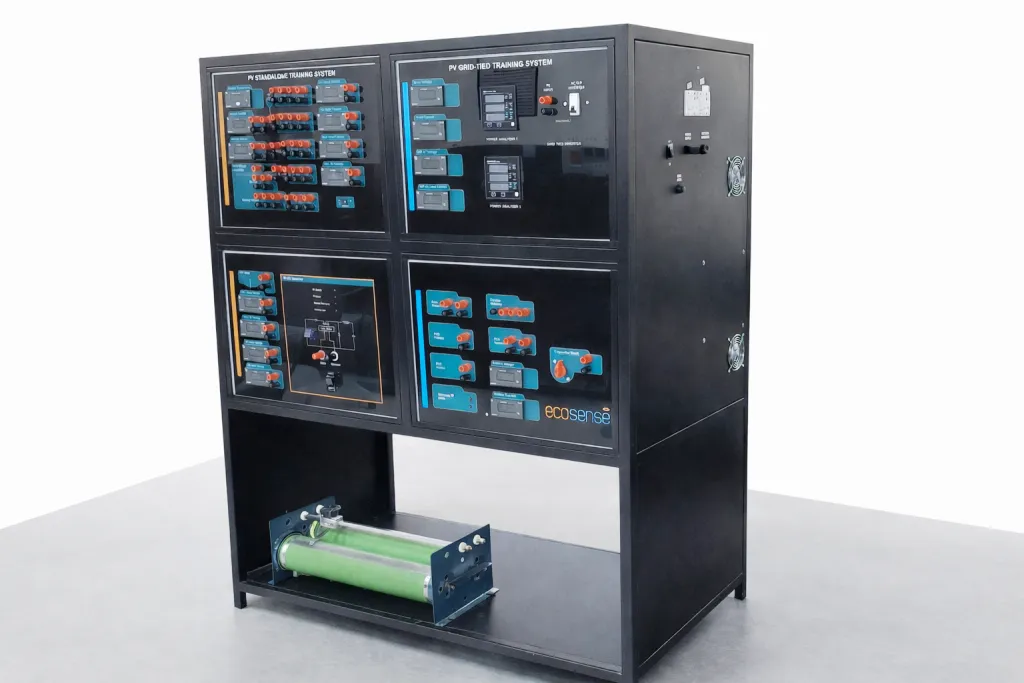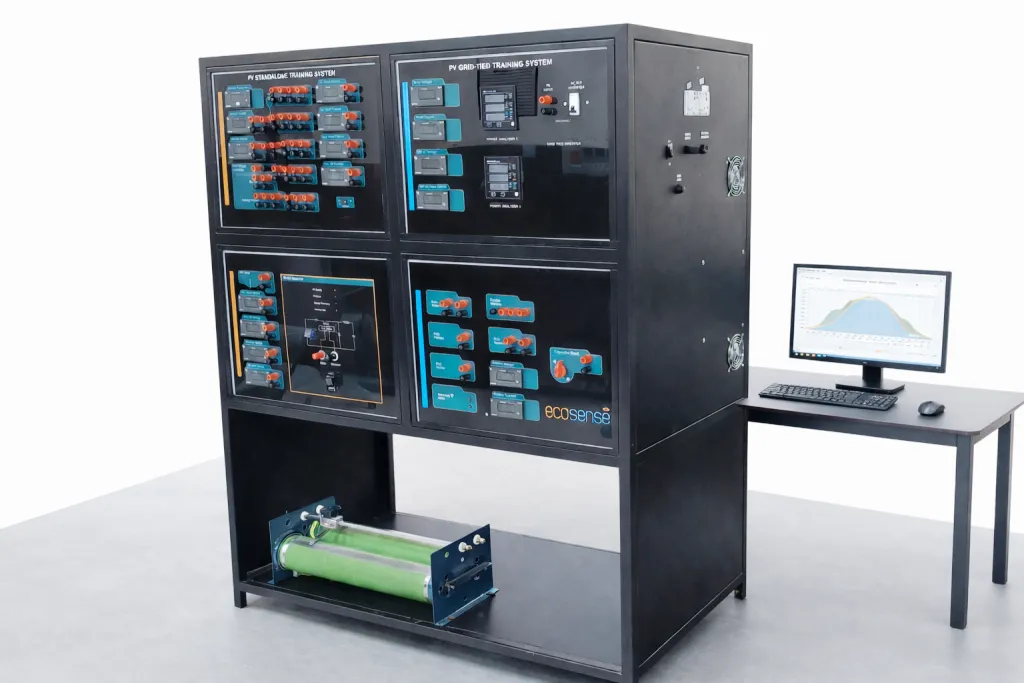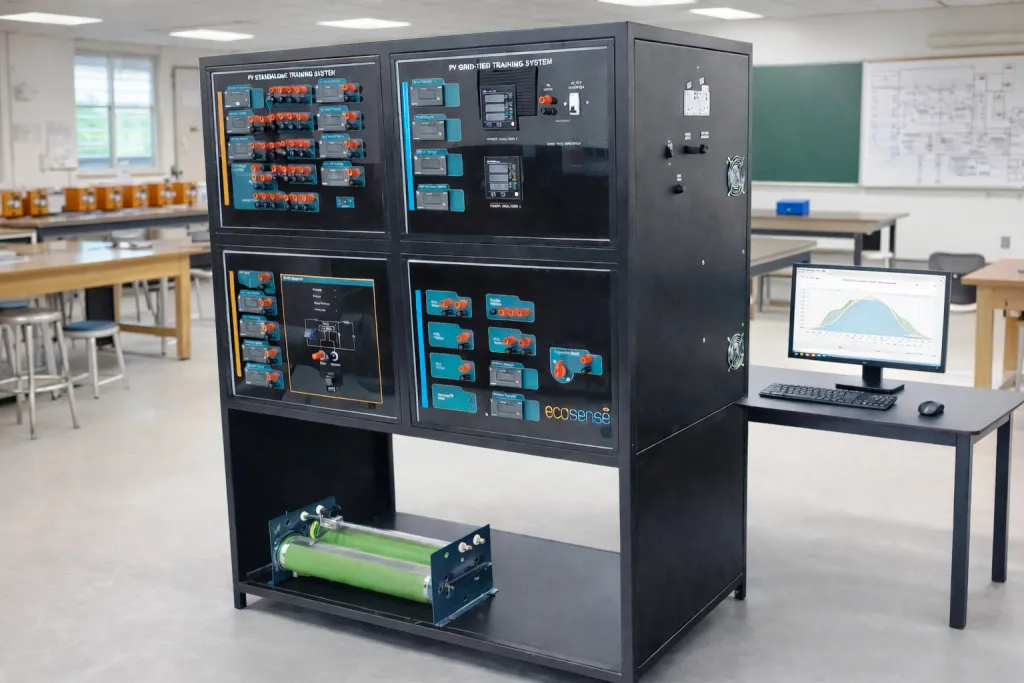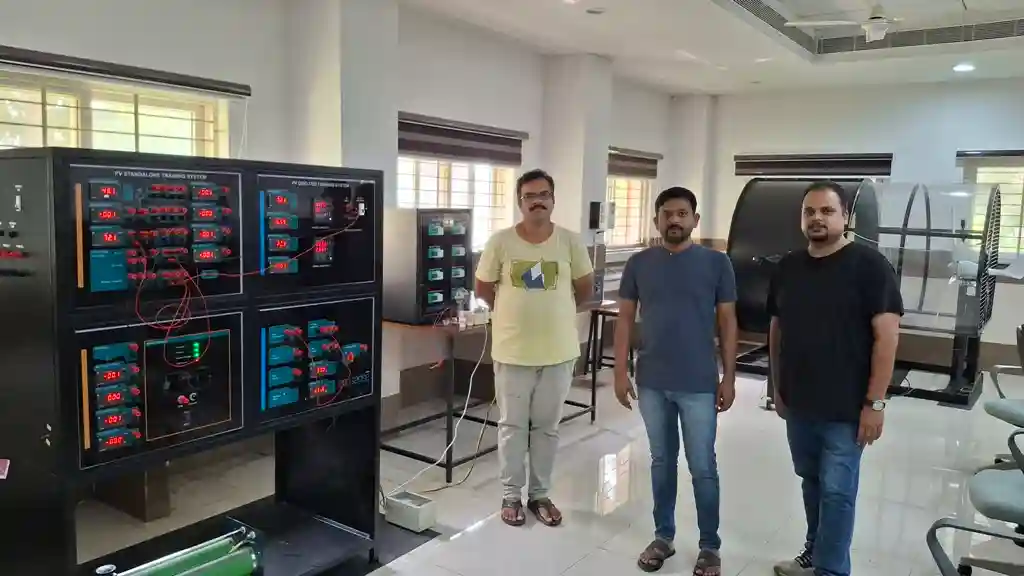
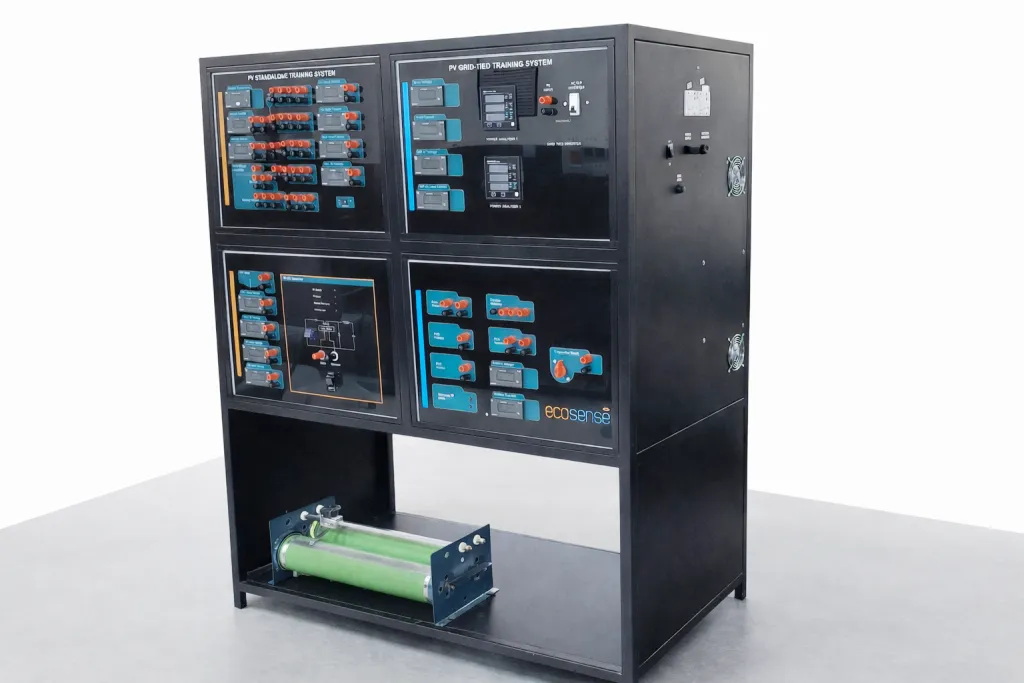
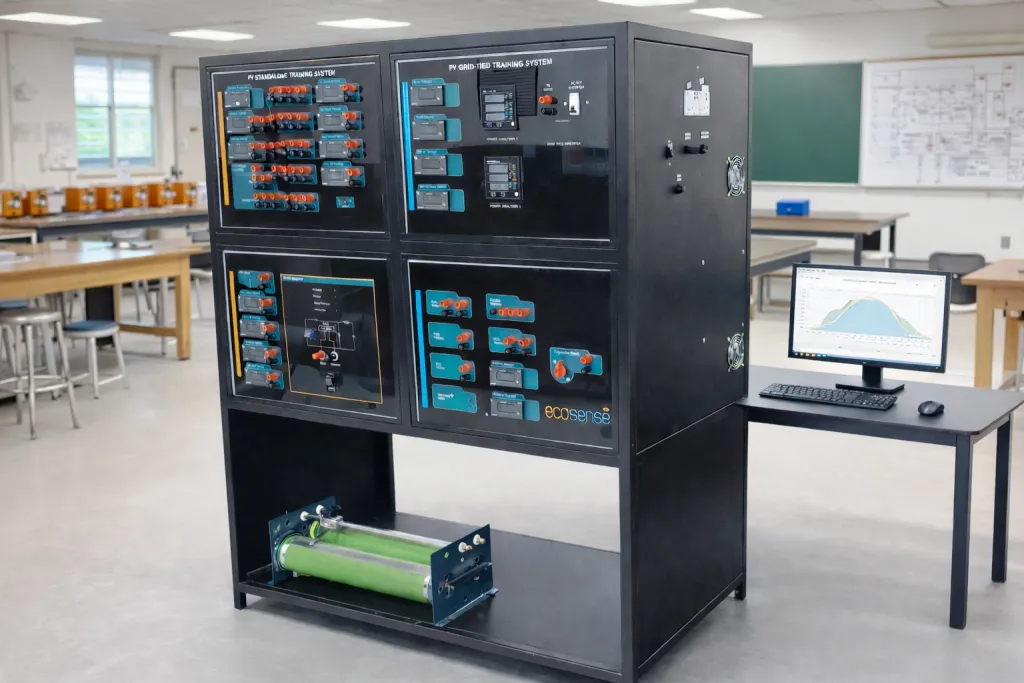
Solar PV Offgrid/Ongrid Training System 

The Solar PV Off Grid / Ongrid Training System is an advanced experimental and research platform designed for academic solar labs. The platform supports both offgrid solar PV system and grid connected solar PV system configurations, allowing users to analyze standalone performance, grid synchronization, power flow, and net metering within a controlled grid connected solar system environment. A key research highlight is the configurable DC-DC converter with Auto and Manual modes. It allows external gate signal injection and external MPPT signal access, enabling researchers to vary duty cycle, implement custom control strategies, and validate their own MPPT algorithms for advanced experimentation and performance optimization. 
Key Features

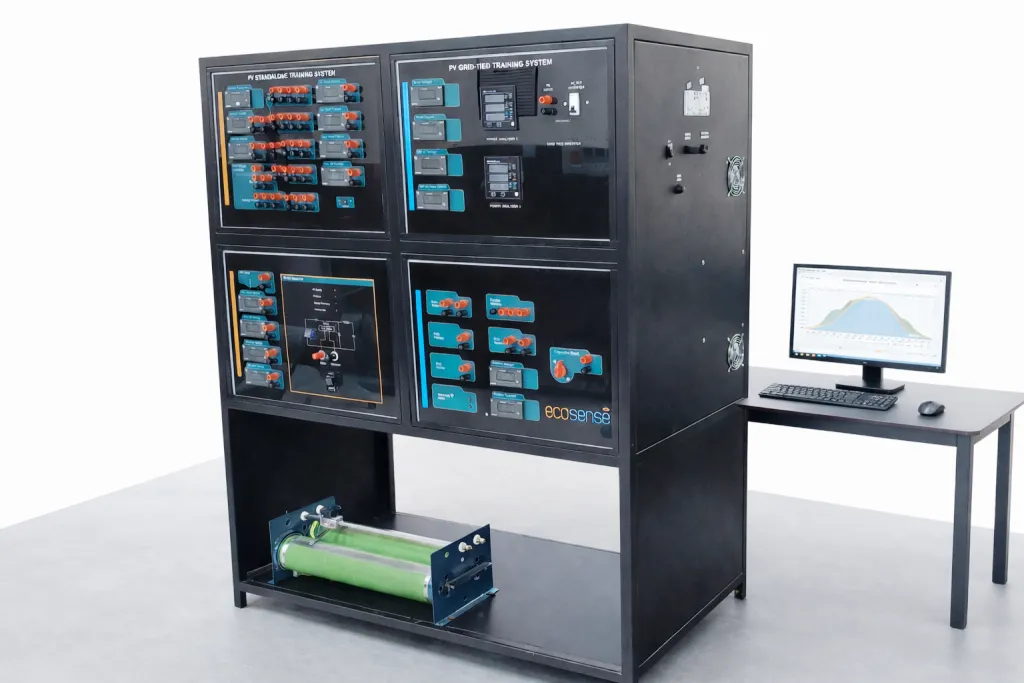
  • Complete Solar PV Experimental Platform: Compact, modular system replicating a real solar power plant for hands-on experimentation in both offgrid solar PV system and grid connected solar PV system configurations.
  • Solar PV Panel Series & Parallel Configuration: Panels can be connected in series to increase voltage or in parallel to increase current, enabling detailed study of electrical scaling, performance variation, and array design principles.
  • 12V / 24V Battery Configuration Flexibility: Battery bank supports both 12V and 24V configurations through series and parallel connections, allowing practical understanding of voltage scaling, current sharing, and system integration.
  • Dual-Mode Operation (Offgrid & Ongrid): Seamlessly switch between standalone offgrid solar PV system operation and grid connected solar system studies within the same platform.
  • Integrated Virtual Grid: Built-in 1000 VA virtual grid (230V AC, pure sine wave) enables safe indoor experimentation, inverter synchronization studies, and controlled grid simulation without dependence on utility supply.
  • Advanced Measurement & Power Analysis: Active measurement panel with multi-point voltage, current, temperature monitoring, and power analyzer at PCC for real-time system diagnostics.
  • Dedicated Offgrid Solar PV System Module: Includes DC-DC converter, charge controller, battery bank, inverter, AC/DC loads, and protection systems for complete standalone system evaluation.
  • Grid Connected Solar PV System Integration: 1500W grid-tied inverter with wide MPPT range, synchronization capability, and adjustable export control for real-world grid studies.
  • Research-Oriented DC-DC Converter Unit: Buck topology converter (Auto & Manual modes) supporting duty-cycle variation, external gate signal input, and MPPT experimentation.
  • Custom MPPT Development Capability: Built-in Perturb & Observe algorithm with provision to test user-defined MPPT strategies for research validation.
  • Power Quality & Reactive Compensation Studies: Variable capacitor and inductor banks enable harmonic analysis, power factor correction, and voltage regulation studies at PCC.
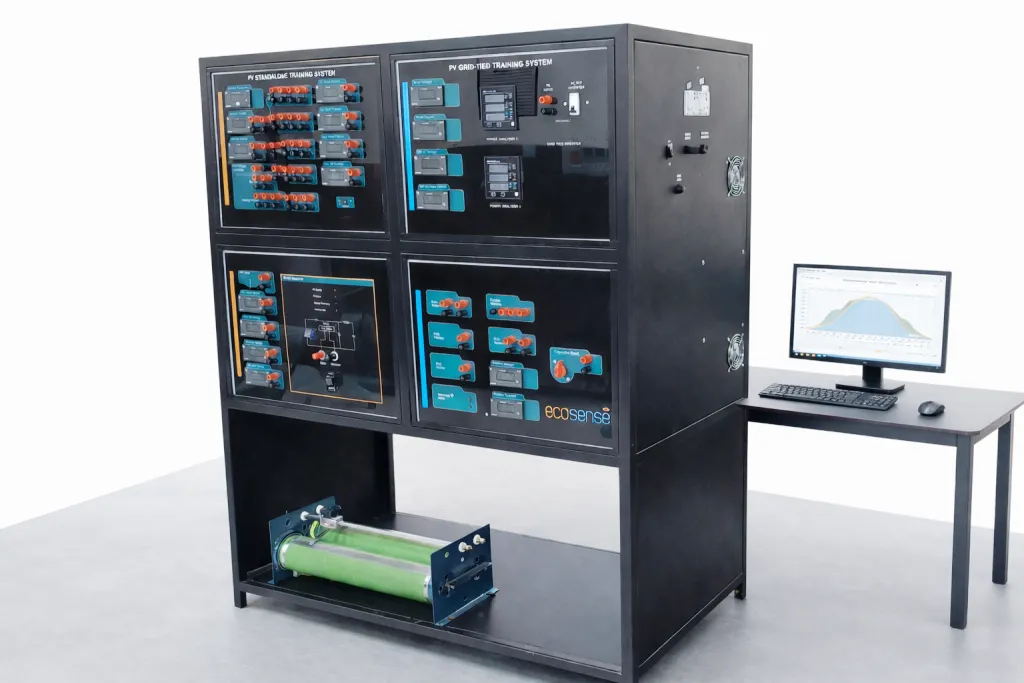
  • Real-Time Data Logging & Visualization: Proprietary software supports live I-V, P-V, V-time, I-time plotting with CSV export and graph image saving.
  • Designed for Academic & Research Solar Labs: Ideal for undergraduate training, postgraduate experimentation, and advanced research in both offgrid solar PV system and grid connected solar PV system applications.
Ecosense

Learning Modules 

Ecosense

Solar PV Characteristics & Fundamentals

  • Study of I-V and P-V characteristics under varying radiation levels
  • Effect of temperature variation on module performance
  • Series and parallel interconnection of solar panels
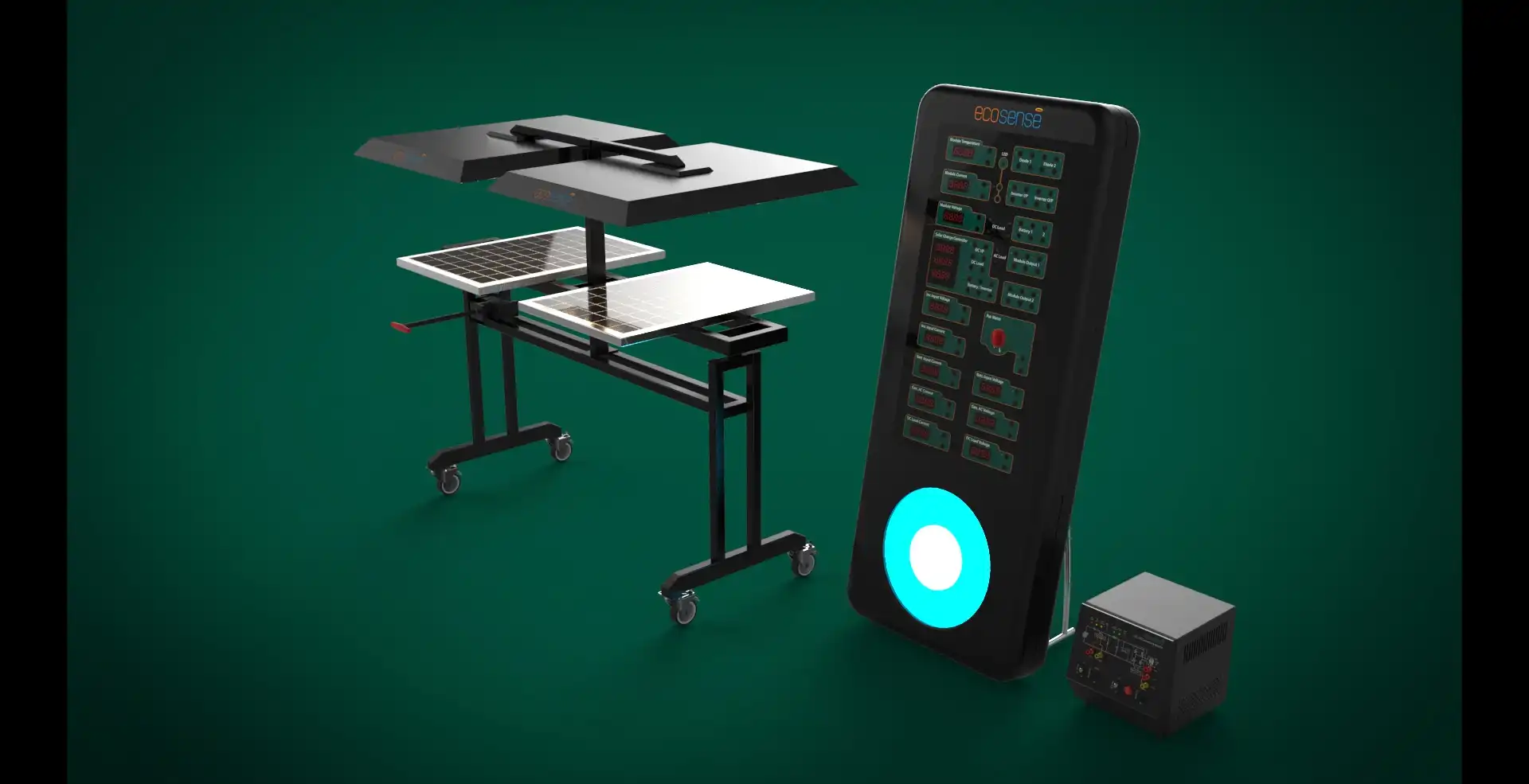
  • Effect of tilt angle on power output
  • Shading impact analysis using shading blades
  • Study of bypass and blocking diode operation
  • Manual Maximum Power Point (MPP) identification using resistive loading

Offgrid Solar PV System & Research Module

  • Configuration and wiring of a complete offgrid solar PV system
  • Power flow analysis for DC load with battery
  • Power flow analysis for AC load with battery
  • Combined AC & DC load operation with battery storage
  • Battery charging and discharging characteristic analysis
  • DC-DC converter operation in Auto and Manual modes
  • Duty cycle variation to track MPP
  • Built-in Perturb & Observe MPPT study
  • External MPPT signal injection for algorithm validation
  • Custom MPPT algorithm testing and performance comparison
  • Standalone system efficiency evaluation and optimization studies

Grid Connected Solar PV System Studies

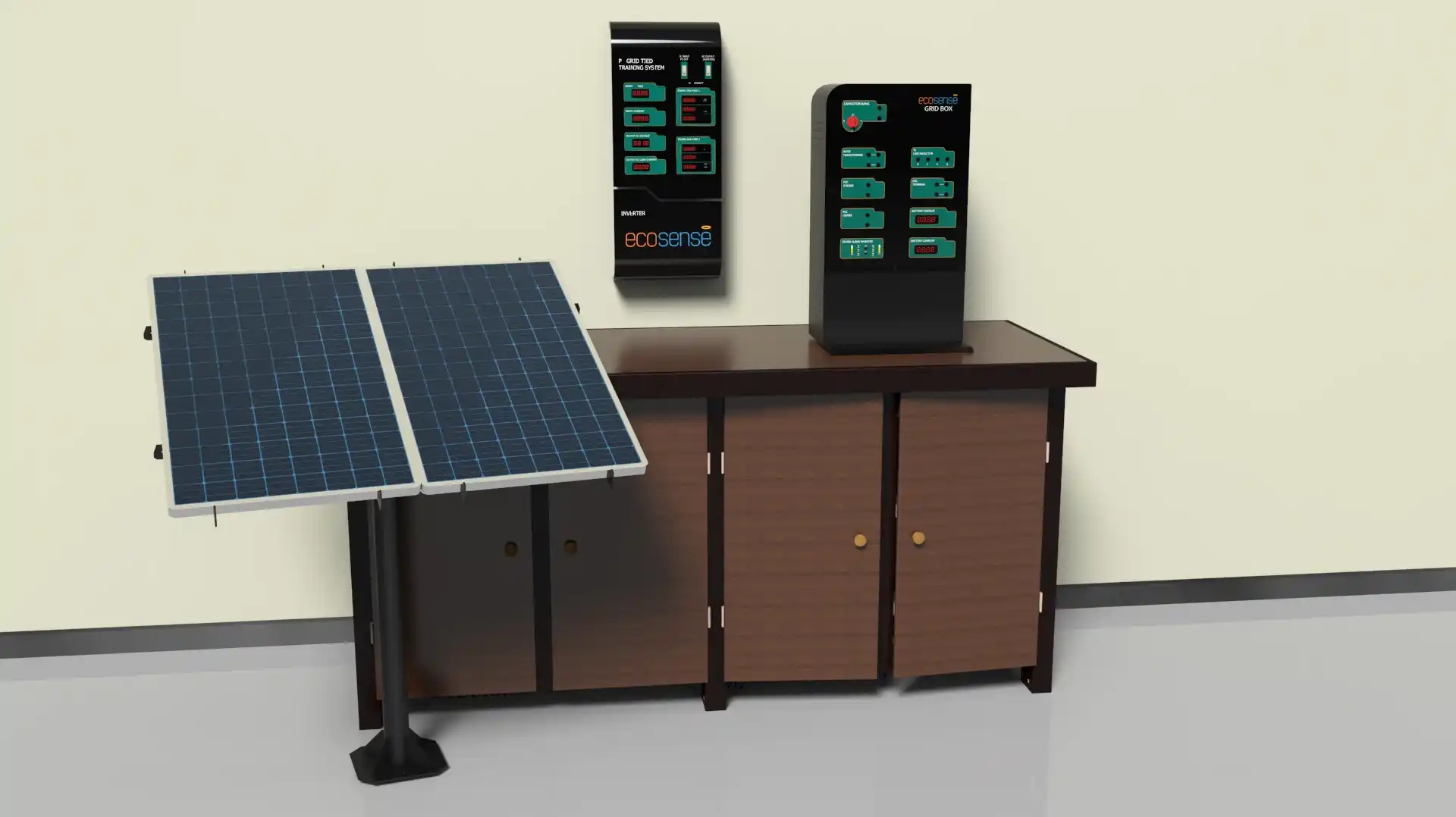
  • Installation and configuration of a grid connected solar PV system
  • Grid synchronization of solar inverter
  • Active, reactive, and apparent power flow analysis
  • Net metering concept demonstration
  • Power factor improvement using capacitor bank
  • Impact of transmission line inductance at PCC
  • Harmonics and power quality analysis
  • Performance evaluation of a complete grid connected solar system under varying load conditions

Technical Description

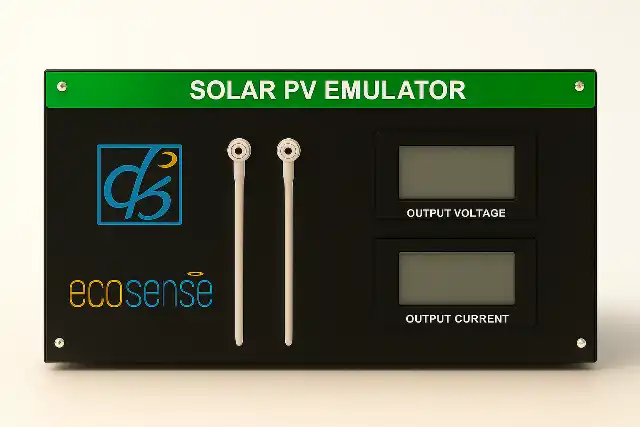
  • Solar PV Generation: Two 515 Wp polycrystalline solar panels convert solar irradiance into DC electrical power, serving as the primary energy source of the system.
  • Solar PV Panel Series & Parallel Configuration: Panels can be connected in series to increase voltage or in parallel to increase current. This enables detailed study of voltage-current scaling, power variation, and system behavior under different electrical configurations.
  • DC Junction & Measurement Stage: The generated DC power is routed through the measurement panel where module voltage, current, temperature, and key electrical parameters are continuously monitored.
  • Operating Mode Selection (Offgrid & Ongrid): The system allows users to select between standalone offgrid solar PV system operation and grid connected solar PV system operation for comparative analysis.
  • Offgrid Power Conditioning: In standalone mode, the DC-DC converter regulates panel output using MPPT control. Power is directed either to charge the battery bank or supply DC loads.
  • Battery Series & Parallel Configuration (12V & 24V): The battery bank can be configured in series or parallel to operate at 12V or 24V levels. This enables students to study voltage scaling, current sharing, and system performance under different battery configurations.
  • Battery Energy Storage & Analysis: The 4 × 12V, 42Ah lead-acid batteries store solar energy, allowing experiments on charging, discharging characteristics, SOC behavior, backup operation, and load management.
  • DC to AC Conversion (Offgrid Mode): The 1350W inverter converts stored DC power into 220V AC, supplying AC loads and simulating a real standalone solar installation.
  • Grid Synchronization (Ongrid Mode): In grid connected solar system mode, the 1500W grid-tied inverter synchronizes the PV output with the utility grid, ensuring voltage and frequency matching.
  • Power Flow & Net Metering Study: The system enables evaluation of power exchange between solar panels, loads, and grid, including export control and net metering operation.
  • Power Quality & Reactive Compensation: Variable capacitor and inductor banks facilitate study of reactive power compensation, harmonics, and voltage quality at the Point of Common Coupling (PCC).
  • Research & MPPT Experimentation: The DC-DC converter operates in Auto (P&O MPPT) and Manual modes, supporting duty-cycle variation and external MPPT signal injection for advanced research.
  • Real-Time Data Logging & Visualization: Proprietary Ecosense software records PV voltage, PV current, and MPPT signals, enabling live I-V, P-V, and time-domain performance analysis with CSV export functionality.
Ecosense

Technical Specifications 

Ecosense

Power Generating Unit


ParametersSpecifications
Solar PanelsMinimum 2, Polycrystalline
Electrical Ratings1000 Wp
ConfigurationSeries and Parallel PV Array Connection
DataloggingAvailable


Offgrid Solar PV System & Research Unit


ParametersSpecifications
Battery Bank4 × 12V, 42Ah Lead Acid (12V / 24V Series-Parallel Configurable)
DC-DC Converter35–100V Input, 1kW, Buck Topology (Auto & Manual MPPT Modes)
Inverter1350W, 24V DC Input, 220V AC Output
Load & Protection100W AC Load, 100W DC Load, Integrated Protection Fuses


Grid Connected Solar PV System & Measurement Unit


ParametersSpecifications
Grid-Tied Inverter1500W, Max DC Input 500V, MPPT Range 100–500V
Virtual Grid1000 VA, 230V AC, Pure Sine Wave
Power Quality ControlVariable Inductor, Variable Capacitor
Measurement & LoggingMulti-point Voltage/Current Monitoring, Power Analyzer at PCC, Proprietary Software with CSV & Graph Export


Related Products

Frequently Asked Questions

The system includes a configurable DC-DC converter with external gate signal input and MPPT access, enabling researchers to test custom algorithms. Real-time data logging, open wiring architecture, and configurable battery and panel connections support advanced experimentation and performance optimization studies.

Yes, the platform supports complete offgrid solar PV system configuration with battery storage and standalone loads, along with grid connected solar PV system operation including synchronization, power export control, and net metering analysis within a controlled laboratory environment.

The converter operates in automatic P&O MPPT mode or manual duty-cycle control mode. Users can inject external gate signals and implement custom MPPT algorithms, allowing detailed evaluation of tracking accuracy, efficiency improvement, and transient response behavior.

Yes, solar panels can be connected in series or parallel to study voltage and current scaling. The battery bank also supports 12V and 24V configurations through series-parallel connections, enabling practical analysis of system design flexibility.

Yes, it includes a grid-tied inverter, virtual grid, power analyzer at PCC, and variable capacitor and inductor banks. This allows study of harmonics, reactive power compensation, voltage regulation, and overall performance of a grid connected solar system.

Get in Touch

Ready to transform your labs?

Contact Now