Renewable Energy Lab installation at NIT, AP
Renewable Energy Lab installed at NIT, AP enabling students and researchers to study Solar PV, Wind Energy and Fuel Cell Technology through hand-on lab experiments.

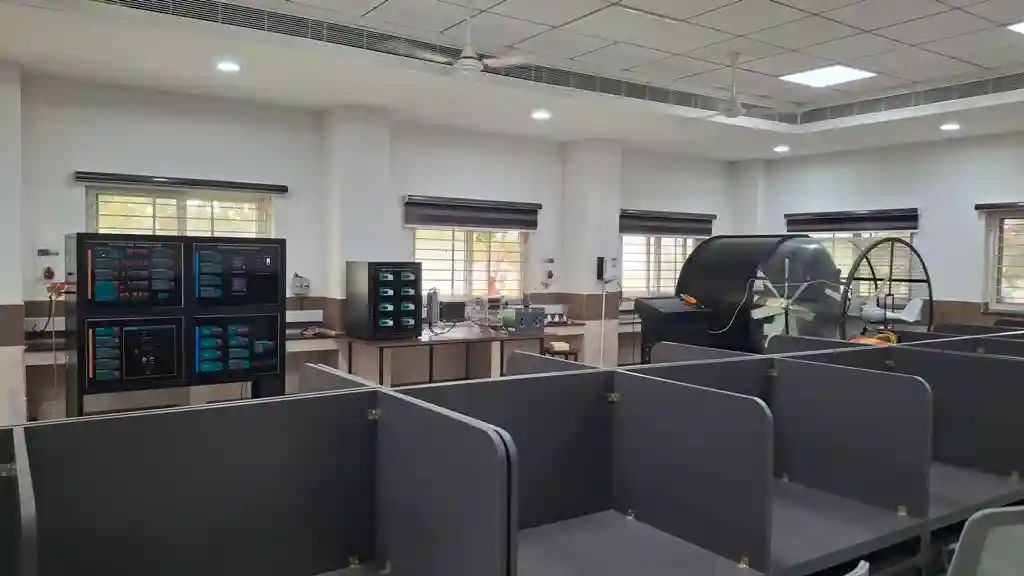
Renewable Energy Lab installed at NIT, AP enabling students and researchers to study Solar PV, Wind Energy and Fuel Cell Technology through hand-on lab experiments.
Ecosense Sustainable Solutions has successfully installed a comprehensive Renewable Energy Lab Facility at National Institute of Technology Andhra Pradesh.
The installation reflects a strong institutional commitment toward clean energy education, applied research, and future-ready engineering training.
The laboratory integrates three critical renewable and emerging energy technologies—Solar PV On-Grid/Off-Grid Systems, Wind Energy Training System, and Fuel Cell Training System. Each system is designed as an independent experimental platform, enabling focused learning without operational overlap. This structure ensures clarity of concepts, repeatability of experiments, and flexibility in academic planning.
The Renewable Energy Lab at NIT Andhra Pradesh has been developed to support undergraduate instruction, postgraduate specialization, doctoral research, and faculty-led innovation. The installation follows a modular and scalable design philosophy, allowing the institute to expand capabilities in the future without disrupting existing infrastructure.
Each training system mirrors real-world energy systems used in industry. Students interact with actual operating parameters rather than simplified demonstrations. This approach strengthens analytical thinking, system-level understanding, and practical competence in renewable power engineering.
The lab also aligns with national and global clean energy goals, preparing students to contribute meaningfully to sectors such as solar power, wind energy, hydrogen systems, electric vehicles, and smart grids.
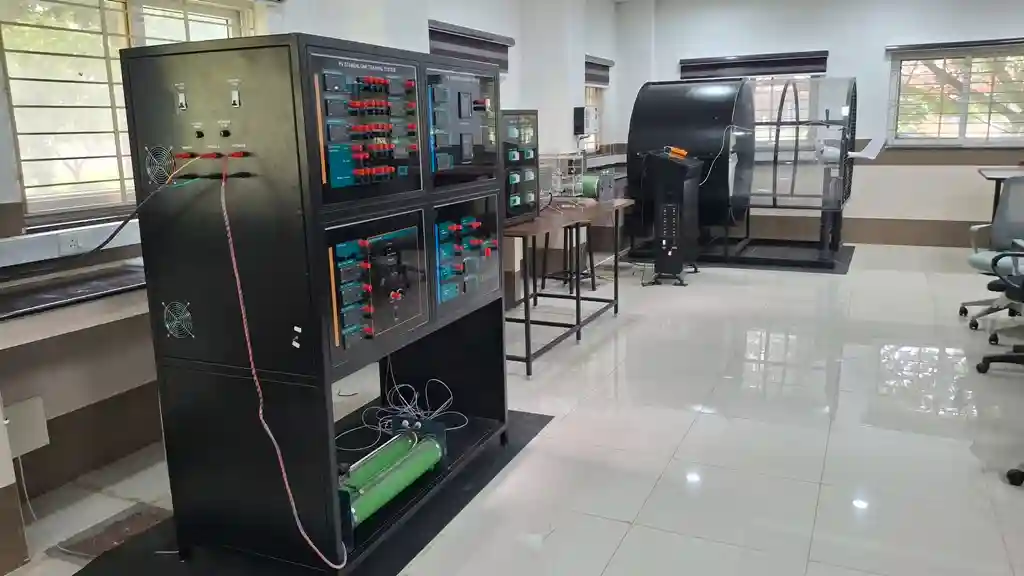
The Renewable Energy Lab supports a wide range of academic and research activities at NIT Andhra Pradesh. Undergraduate students benefit from structured laboratory experiments that reinforce theoretical coursework. Postgraduate students can explore advanced system behavior, optimization techniques, and hybrid configurations.
For doctoral research, the lab offers a platform for experimentation in renewable integration, power electronics, energy storage, and hydrogen technologies. Faculty members can use the facility for sponsored research, prototype development, and interdisciplinary collaboration.
The independent nature of each system allows multiple research activities to occur simultaneously, maximizing lab utilization and academic output.
This installation significantly enhances the institute’s renewable energy infrastructure. Students graduate with hands-on experience in solar, wind, and fuel cell technologies, improving their readiness for industry and research careers.
The lab strengthens the institute’s position as a center for clean energy education. It supports curriculum modernization, promotes innovation, and enables collaboration with industry and research organizations. The facility also contributes to sustainability initiatives by embedding clean energy awareness into engineering education.
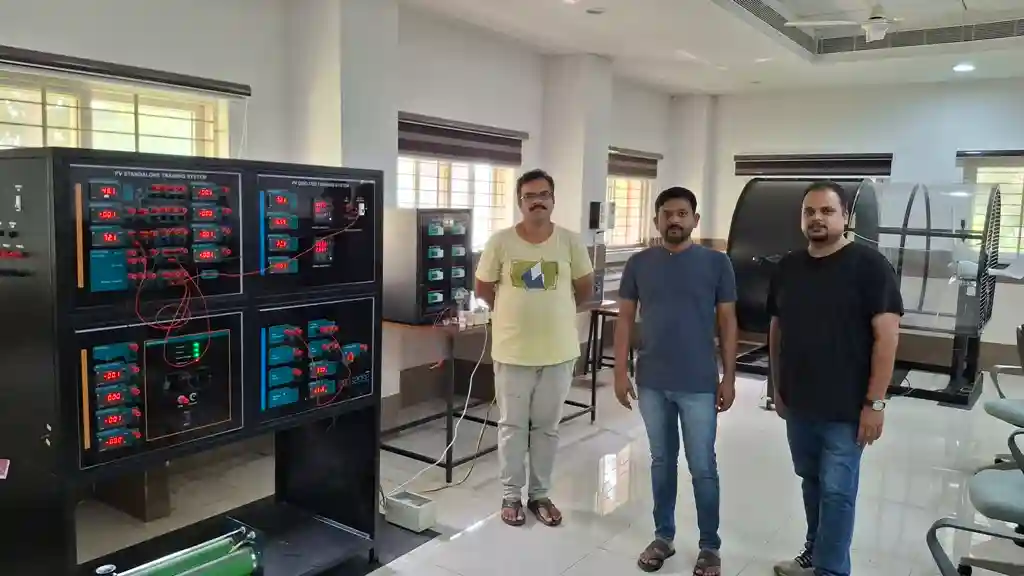
Ecosense specializes in designing and delivering academic-focused renewable energy laboratories that balance technical depth with instructional clarity. Its systems are developed specifically for universities and research institutions, ensuring alignment with curricula and learning outcomes.
With proven installations across premier institutions, Ecosense offers robust equipment, comprehensive documentation, and long-term technical support. The company’s emphasis on modularity, safety, and real-world relevance makes its labs suitable for both teaching and advanced research.
By choosing Ecosense, NIT Andhra Pradesh has invested in a future-ready renewable energy laboratory that will support education, research, and innovation for years to come.