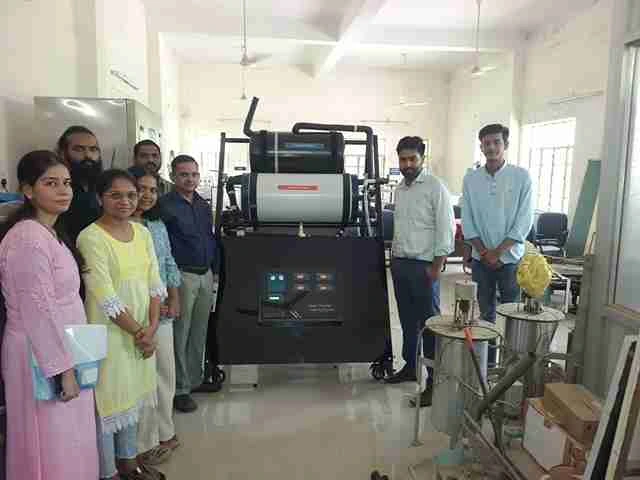
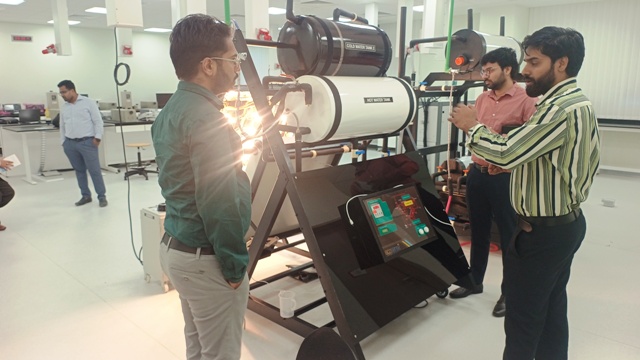
Solar Thermal Lab

Learning Module

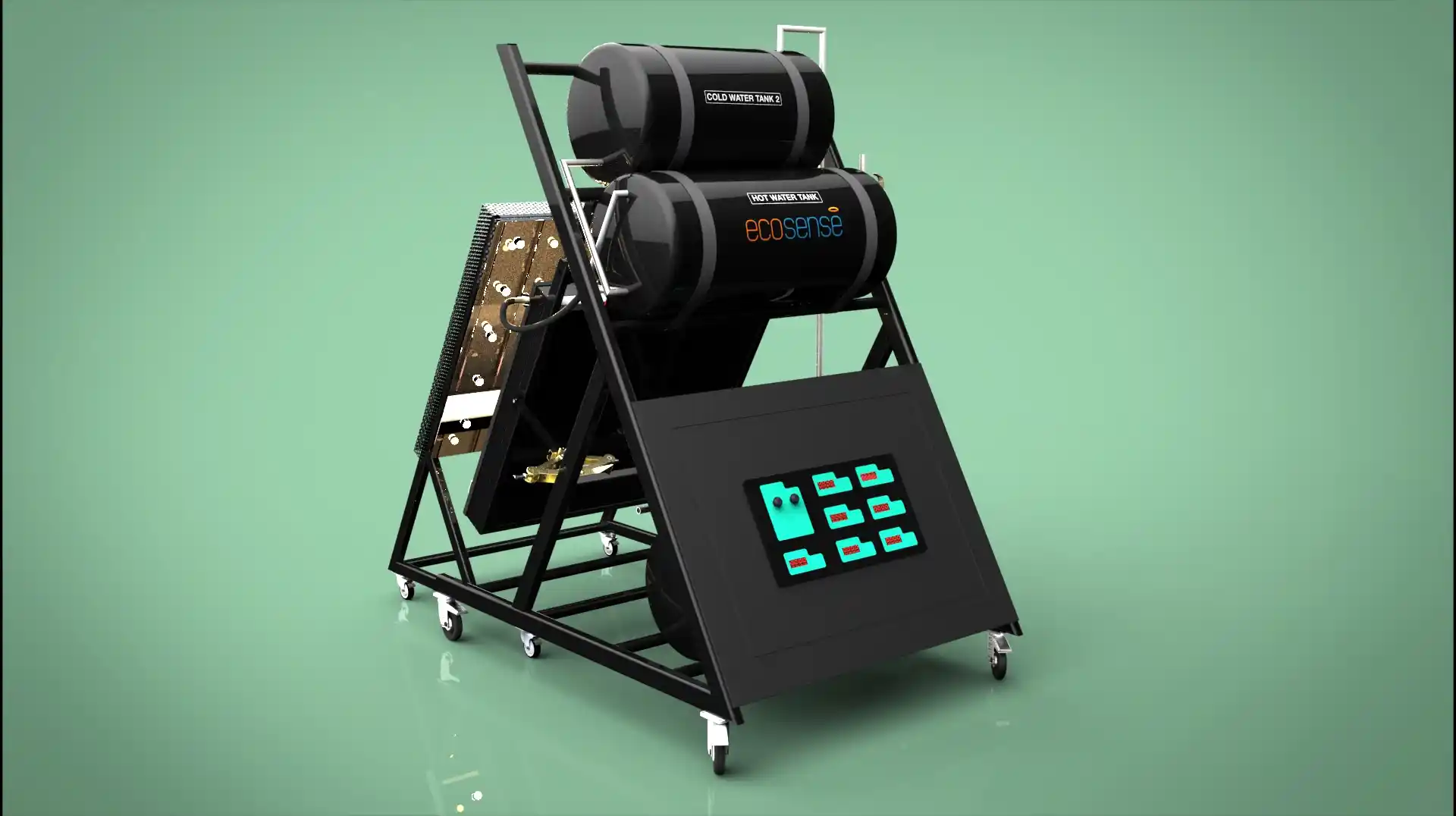
Solar Thermal Training System

The Solar Thermal Training System is a compact, modular platform designed to replicate real-world flat plate solar water heating systems. Engineered for both educational and research applications, it facilitates hands-on experimentation with key thermal performance parameters such as efficiency, overall heat loss coefficient (UL), and heat removal factor (FR). The system's adaptability allows users to conduct experiments under varying conditions, including different wind speeds, fluid temperatures, flow rates, and irradiation levels, making it an invaluable tool for comprehensive thermal analysis.

Know More
Learning Module

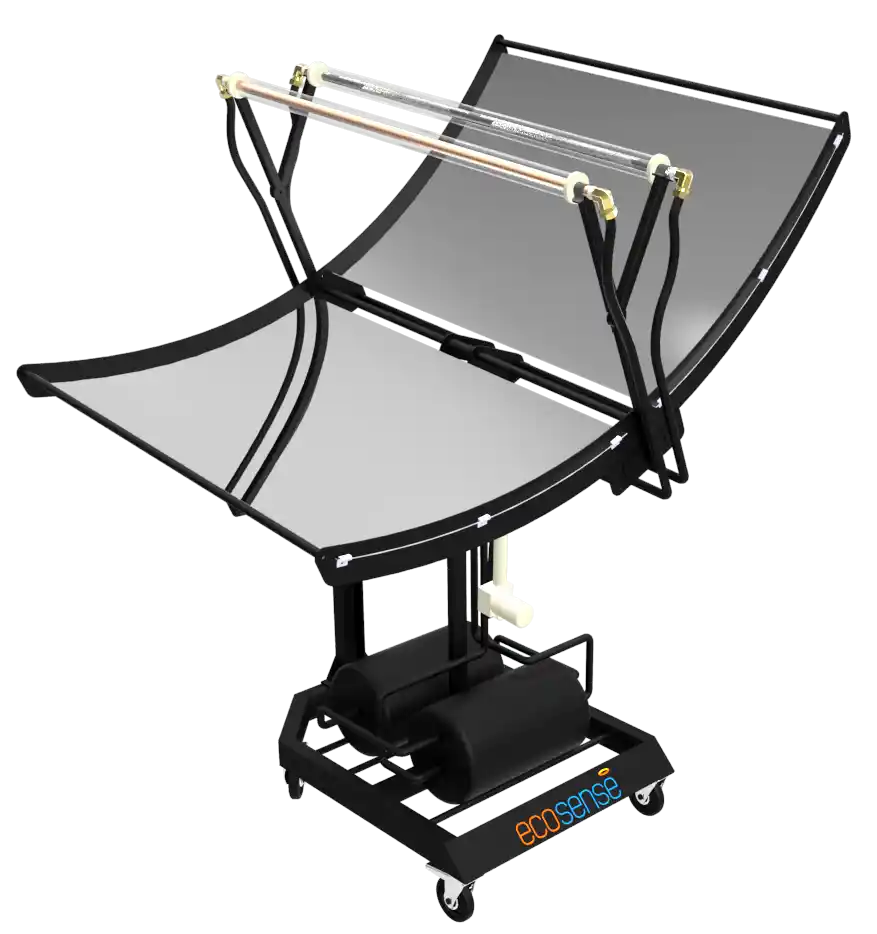
Solar Concentrator Training System

The Solar Concentrator Training System is a compact, modular platform that replicates a parabolic trough–based water heating system. This solar power concentrator setup demonstrates concentrating solar power, enabling users to study thermal energy generation using focused sunlight. It includes parabolic reflectors, absorber tubes, a sun-tracking mechanism, piping, storage tanks, and a control panel. Designed for hands-on learning and research, the system supports laboratory-scale experimentation in solar thermal technologies and concentrated solar energy systems. Its flexibility with working fluids, absorber materials, insulation, and storage configurations makes it ideal for analyzing heat-transfer behavior and efficiency variations in solar concentrator–based systems under different operating conditions.

Know More
Learning Module

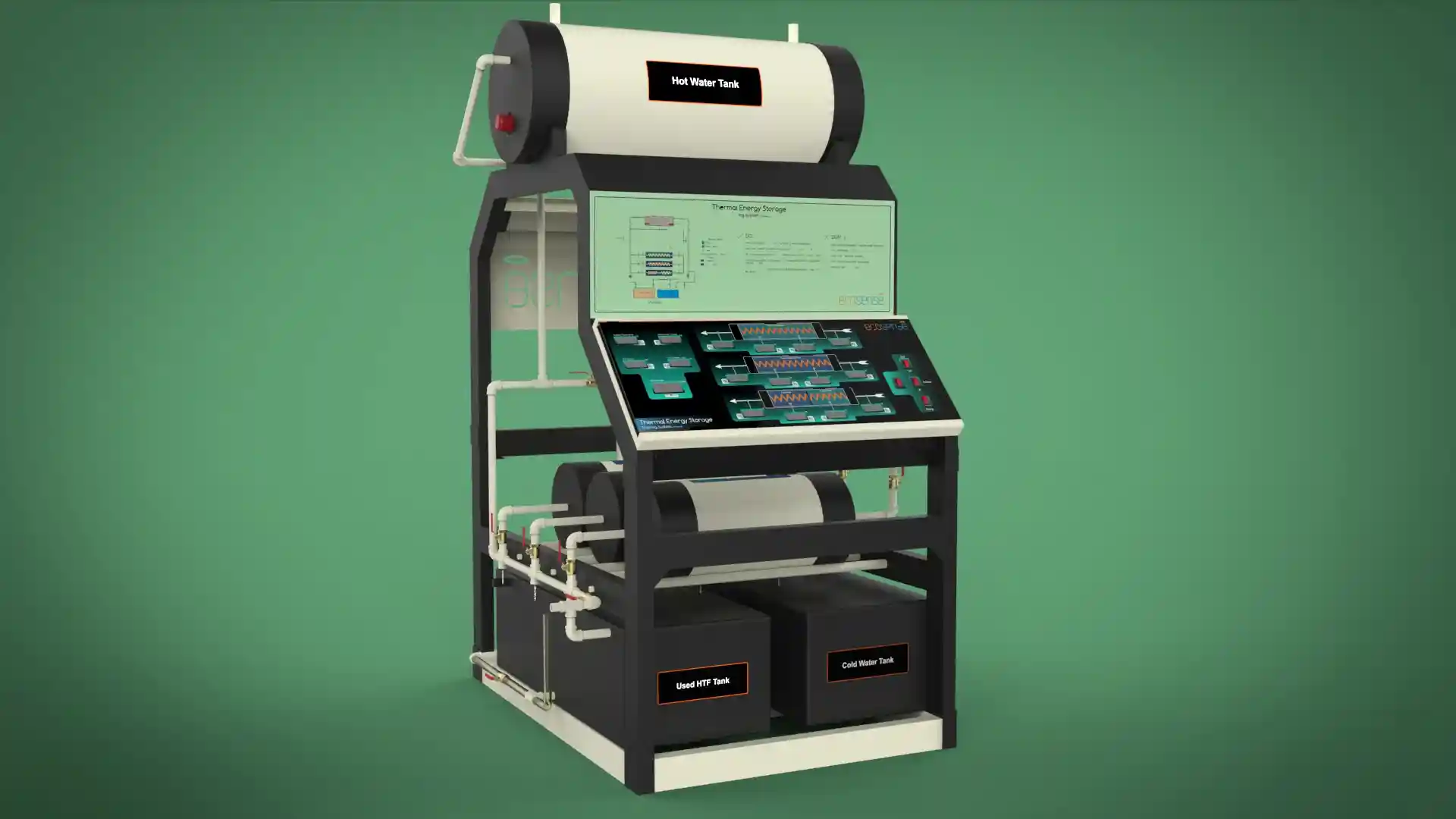
Thermal Energy Storage System

The Thermal Energy Storage System is a compact and modular platform designed for studying thermal energy storage using Phase Change Materials (PCMs). It is well-suited for both academic and research applications, with a strong focus on solar thermal energy storage systems. The system enables users to analyze heat transfer, storage, and discharge processes under controlled conditions, making it ideal for understanding real-world solar thermal energy storage and solar thermal storage applications. Its flexible design supports experimentation with different PCMs, temperatures, and flow rates, helping optimize solar thermal energy storage performance.

Know More
Learning Module

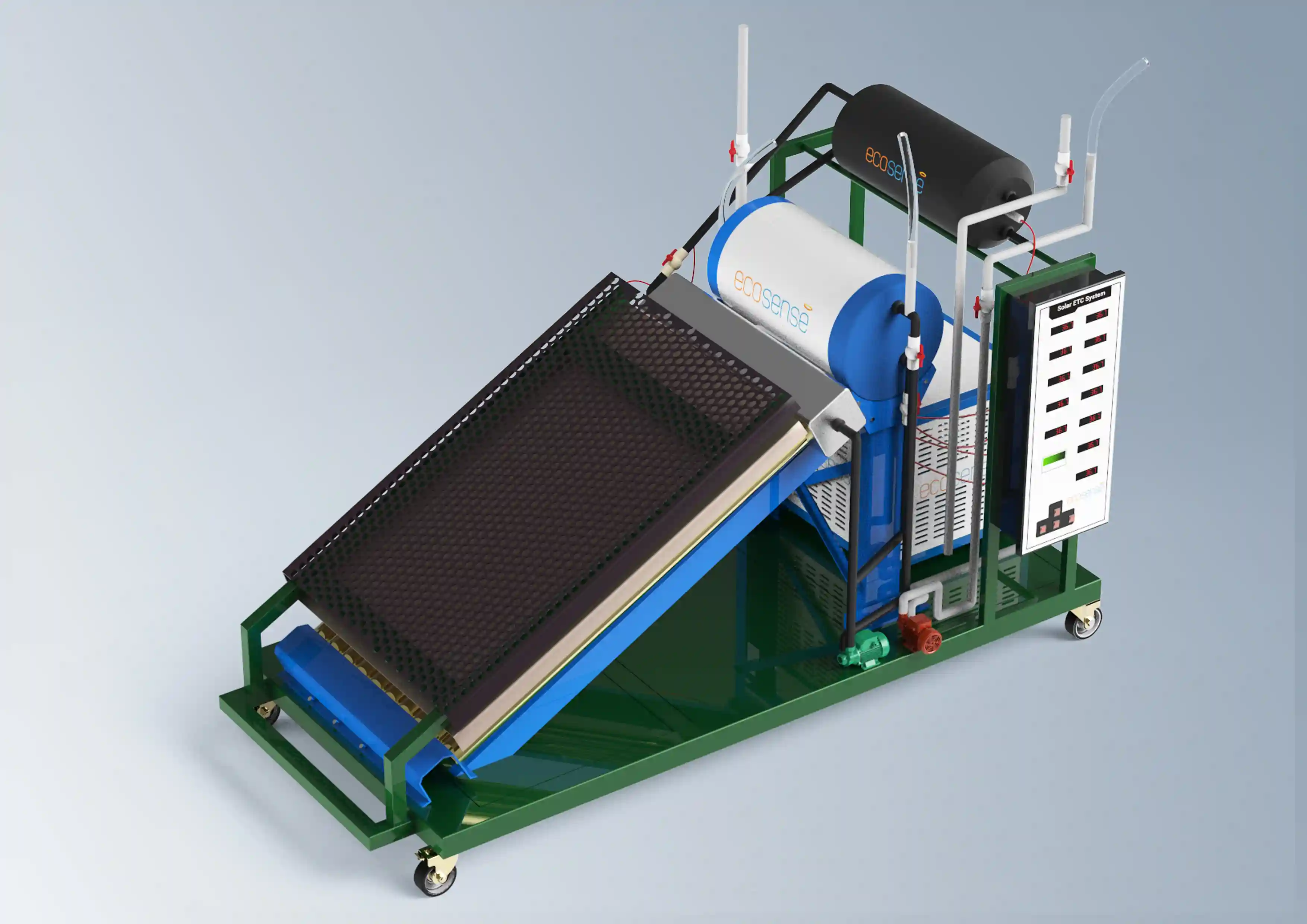
ETC Characterization System

The ETC Characterization System is a compact, closed-loop Evacuated Tube Collector (ETC) setup designed for in-depth thermal analysis of various fluids. Utilizing an artificial sunlight source, this system enables controlled, indoor experimentation independent of natural climate conditions. Ideal for educational institutions, it also serves as a robust platform for advanced research on heat transfer, system efficiency, and the performance of different working fluids, including nanofluids.

Know More

Why Solar Thermal Lab

  • Complete coverage of solar thermal technologies: The Solar Thermal Lab gives students hands-on exposure to every major solar thermal technology—Flat Plate Collectors (FPC), Parabolic Trough Concentrators (PTC), Evacuated Tube Collectors (ETC), and PCM-based Thermal Energy Storage. This full-spectrum approach prepares learners to understand, design, and analyse real thermal energy systems used in homes, industries, and power plants.
  • Hands-on experiments that build practical engineering skills: Students work directly with real collectors, concentrators, heat exchangers, working fluids, temperature sensors, and PCM media. This gives them measurable insights into heat capture, heat loss, efficiency, fluid dynamics, and energy storage—far beyond what textbooks can offer.
  • Ideal for mechanical, energy, and thermal engineering programs: The lab supports coursework in renewable energy, thermodynamics, solar energy engineering, heat transfer, and thermal system design. It is also suitable for diploma, undergraduate, postgraduate, and research-level experiments and projects.
  • Designed for research, innovation, and performance analysis: With systems dedicated to FPC, PTC, ETC, and thermal storage, students can conduct comparative studies, fluid behaviour analysis, performance mapping, and thermal optimization experiments. The lab enables research in areas such as process heating, concentrated solar power, industrial thermal systems, and PCM-based storage technologies.
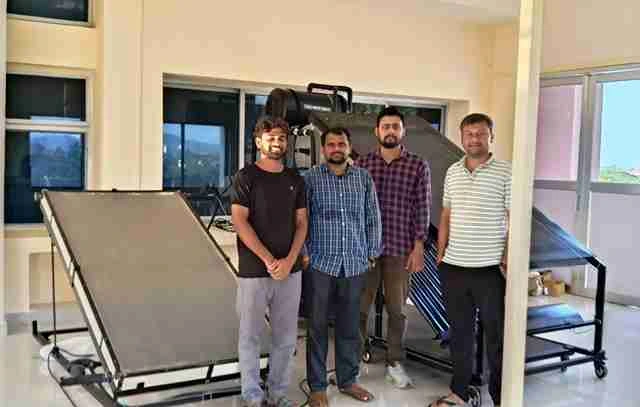
  • Proven reliability and successful installations: Ecosense has deployed solar thermal systems across leading institutes, ensuring robust performance and long-term reliability. Institutions benefit from industry-grade equipment, training-oriented design, and a platform that enhances teaching outcomes from day one.


How the Ecosense Solar Thermal Lab Works

The Ecosense Solar Thermal Lab is built around four independent systems, each representing a key solar thermal technology. Together, they allow students and researchers to understand heat generation, heat transfer, optical concentration, fluid behavior, and thermal energy storage. Institutions can deploy any system individually or combine all four to create a complete thermal-energy learning ecosystem.

1. Solar Thermal Training System (Flat Plate Collector – FPC): This system introduces students to the fundamentals of solar heat collection using a Flat Plate Collector (FPC)—one of the most widely used solar thermal technologies in domestic water heating and low-temperature industrial processes. Solar Thermal Training System allows students to do uninterrupted experimentation indoors using arftificial sunlight source.

Students perform core thermal experiments such as:

  • Measuring inlet and outlet temperature rise
  • Calculating collector efficiency under varying irradiance using artificial sunlight source
  • Studying heat loss from absorber plate and insulation
  • Understanding the effect of mass flow rate on heat gain
  • Observing thermal response during morning, noon, and evening cycles

The system clearly demonstrates how solar radiation is absorbed, transferred to a working fluid, and delivered as usable thermal energy. It forms the foundational learning block for understanding real-world thermal systems like solar geysers and process heating units.

2. Solar Concentrator Training System (Parabolic Trough Collector – PTC)

The Solar Concentrator Training System focuses on high-temperature solar energy generation using a Parabolic Trough Collector (PTC). Unlike flat plate collectors, PTCs concentrate sunlight onto a receiver tube, significantly increasing thermal output.

Students can explore:

  • Optical concentration and focal alignment
  • Dual axis sun tracking
  • Temperature rise at the receiver under different solar intensities
  • Heat transfer performance at elevated temperatures
  • Effects of reflector geometry and tracking accuracy
  • Real-world applications such as steam generation and thermal power cycles
  • This system is ideal for learning concentrated solar thermal (CST) principles and supports research in medium-temperature industrial heating, solar power plants, and advanced collector designs.

3. ETC Characterization System (Evacuated Tube Collector – ETC)

This system enables learners to analyze Evacuated Tube Collectors, which are highly efficient due to their vacuum insulation and cylindrical absorber design. ETCs are critical in colder climates and applications requiring higher thermal output. ETC Characterization System allows students to do uninterrupted experimentation indoors using arftificial sunlight source.

The characterization system allows students to study:

  • Thermal efficiency of ETCs under varying flow conditions
  • Heat transfer behavior inside glass tubes
  • Performance comparison between collector tubes
  • Influence of radiation, ambient temperature, and tube orientation
  • Behavior of different working fluids and thermal properties

It is a powerful platform for research on fluid thermodynamics, heat transfer coefficients, and collector performance optimization, making it valuable for mechanical and energy engineering programs.

4. Thermal Energy Storage System (PCM-Based Storage):Thermal Energy Storage (TES) is essential for using solar heat even when the sun is not available. The Ecosense TES system focuses on Phase Change Materials (PCM), which store heat in the form of latent energy during melting and release it during solidification.

Students can investigate:

  • Charging and discharging characteristics of PCM
  • Temperature profile and thermal stratification during storage
  • Energy retention and insulation performance
  • Comparison of sensible heat storage vs latent heat storage
  • Integration of TES with solar collectors for extended usage

This system teaches the fundamentals of thermal storage engineering, enabling learners to study applications like solar cooking, industrial heating, district heating, and hybrid renewable systems.

Start Anywhere — Learn Everything

Each product in the Solar Thermal Lab is fully independent, allowing institutions to choose solutions aligned with their curriculum or research direction:

  • Start with FPC fundamentals
  • Advance to PTC concentrator technology
  • Explore high-efficiency ETC performance
  • Add PCM thermal storage for applied energy engineering

When combined, the four systems create a complete environment for teaching solar heat generation, advanced heat-transfer systems, and sustainable thermal-energy storage.

Frequently Asked Questions

The Solar Thermal Lab is a hands-on experimental platform designed to teach solar heat collection, optical concentration, heat transfer, and thermal energy storage. It consists of four independent systems: the Solar Thermal Training System (Flat Plate Collector), Solar Concentrator Training System (Parabolic Trough Collector), ETC Characterization System (Evacuated Tube Collector), and Thermal Energy Storage System using PCM materials.

Yes. All four systems are fully standalone. Institutions can use any system individually—whether they want to teach Flat Plate Collector basics, explore concentrated solar thermal using a Parabolic Trough, analyze ETC performance, or study PCM-based thermal energy storage. No system depends on another, allowing flexible adoption and expansion.

Students can measure collector inlet–outlet temperatures, calculate thermal efficiency, study heat loss patterns, analyze mass flow rate effects, and observe how solar radiation is converted into usable heat in a Flat Plate Collector. These experiments help learners understand the fundamentals of solar water heating and low-temperature thermal systems.

The Solar Concentrator Training System uses a Parabolic Trough Collector to demonstrate optical concentration and high-temperature heat generation. Students can analyze focal alignment, receiver temperature rise, concentrator efficiency, and real-world applications such as steam generation and industrial process heating. It is ideal for learning concentrated solar power (CSP) concepts.

The Thermal Energy Storage System teaches how heat can be stored using Phase Change Materials (PCM) and retrieved when sunlight is unavailable. Students can study charging–discharging behavior, latent heat storage, insulation performance, and integration with collectors. This helps in understanding real applications like solar cooking, industrial heating, and hybrid energy systems.

Ecosense serves educational institutions, research centers, and training organizations worldwide. Our lab solutions are deployed across Asia, the Middle East (UAE, Saudi Arabia and Oman), Europe, Africa, and the Americas, supporting universities, polytechnics, and R&D facilities.

Yes. Ecosense provides lab design, equipment supply, and turnkey lab solutions outside India. We regularly support international projects through direct exports, local partners, and on-site coordination based on project scope.

Absolutely. All Ecosense lab solutions can be customized to meet country-specific academic curricula, electrical standards, safety regulations, voltage/frequency norms, and certification requirements. Customization also extends to documentation, experiments, and software interfaces.