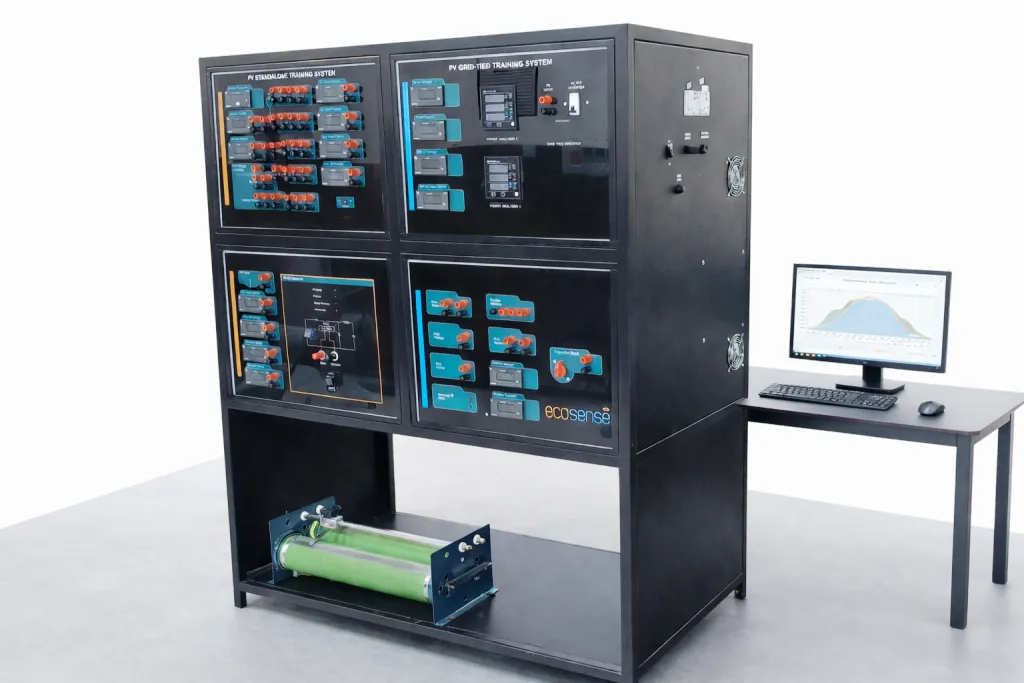
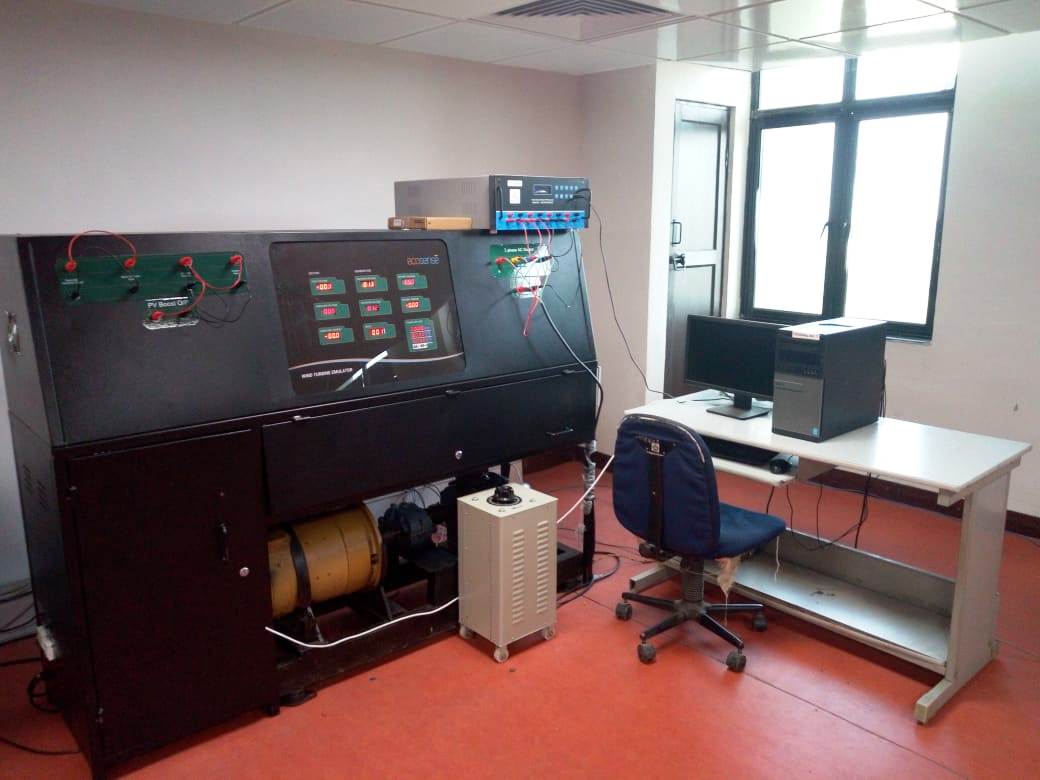
The Ecosense Solar PV Lab is designed as a complete, modular learning environment that allows institutions to teach and explore solar photovoltaic technology through hands-on experiments, system-level studies, and controlled research conditions.
The Lab consists of three independent systems, each developed to address a specific layer of solar PV learning. Every system works independently, has its own instrumentation and safety features, and requires no dependency on the others.
Institutions can adopt a single system based on curriculum requirements, or deploy all three to build a full-spectrum solar learning ecosystem that progresses from fundamentals to grid-level integration and advanced power electronics research.
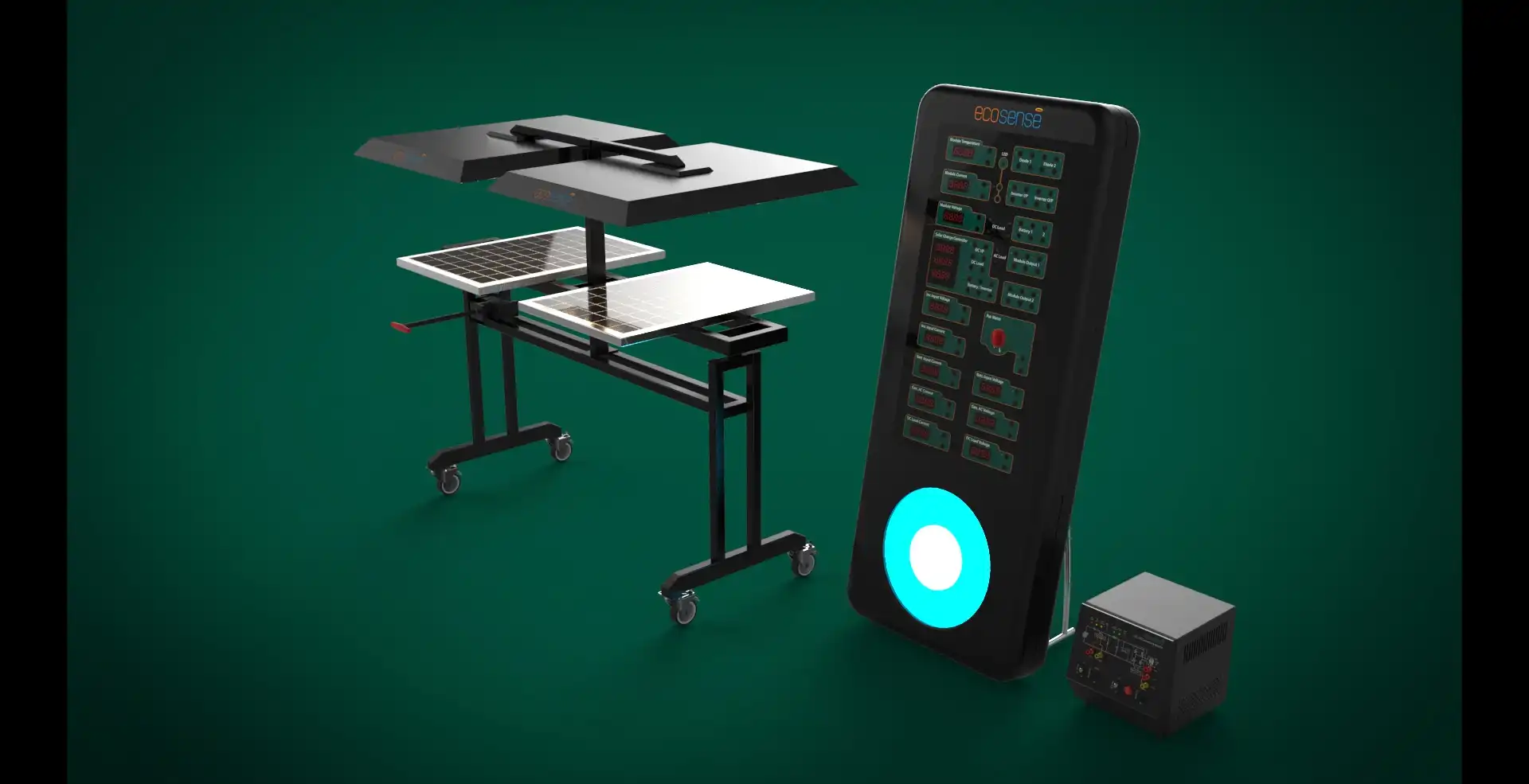
1. Solar PV Training & Research System
The Solar PV Training & Research System is the entry point of the learning journey. This system builds a strong foundation in the science of photovoltaics and core PV system engineering. Students begin with practical experiments on real PV modules, helping them understand how solar cells behave under different environmental and electrical conditions.
With this platform, students perform a wide range of core PV experiments, including:
- V–I and P–V characteristics
- Effect of tilt angle on power generation
- Impact of shading and bypass diodes
- Series-parallel configuration of PV modules
- Temperature effects on voltage and current
These experiments ensure students understand why panel orientation matters, how shading affects overall system performance, and how basic electrical configurations influence power output. The experience is hands-on, not theoretical, making it easier to visualize the relationship between environmental parameters and electrical performance.
Once the fundamentals are mastered, the same system can be transformed into a complete standalone solar PV setup. Here, students integrate PV modules with charge controllers, batteries, inverters, and AC/DC loads to observe real energy flow and understand how off-grid systems are built in the real world. They can measure charging and discharging cycles, analyze load behavior, and explore basic MPPT concepts using real hardware.
With the Solar PV Training & Research System, students can explore:
- How energy moves from generation to storage
- How loads draw power from battery banks
- How system sizing affects energy availability
- How MPPT improves efficiency during variable sunlight
- How standalone systems support rural and remote application
This system is ideal for entry-level and intermediate PV learning, student projects, and basic research experiments. It forms the conceptual and practical foundation for further learning in grid-connected and power-electronics environments.
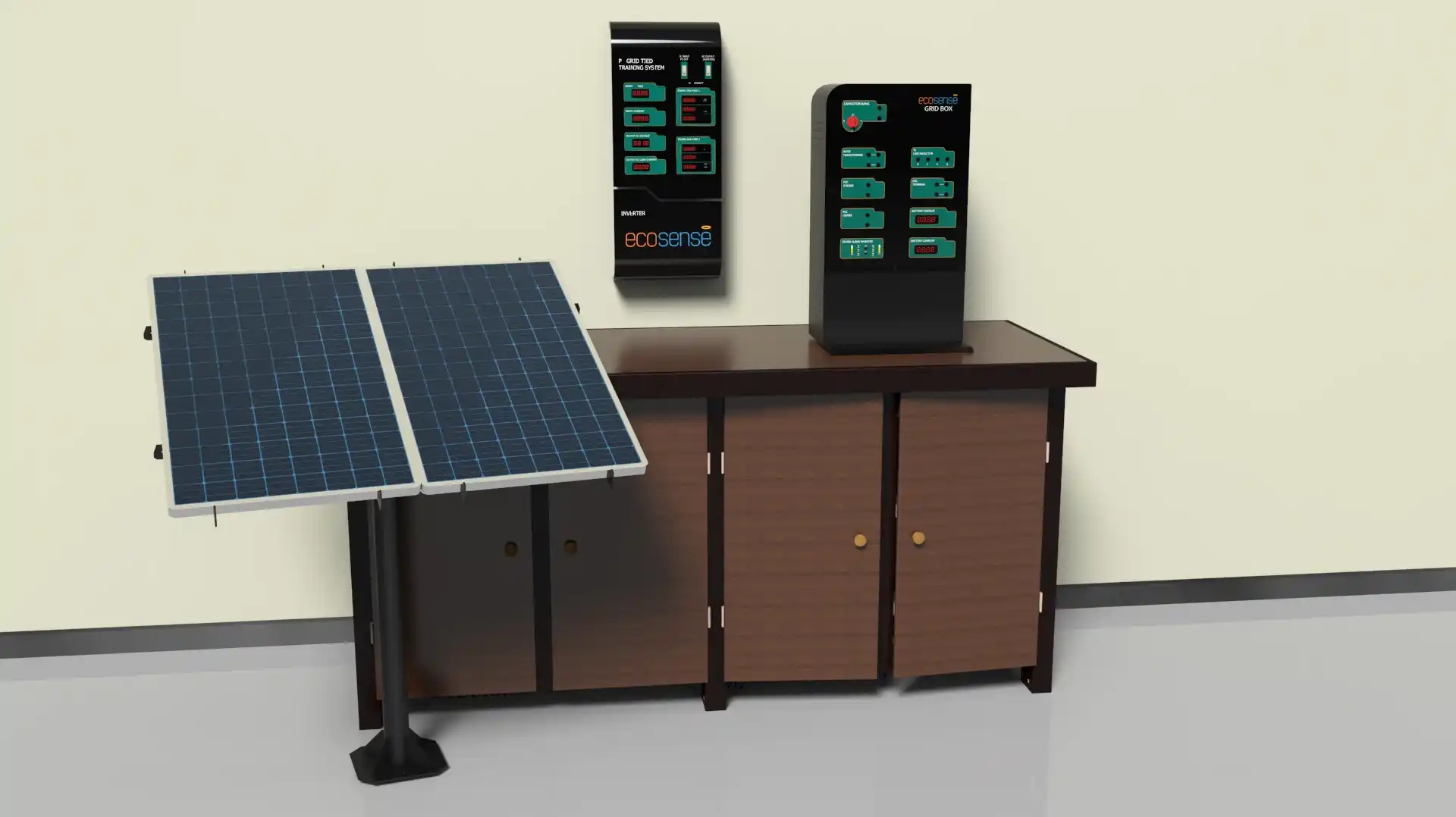
2. Solar PV Grid Tied Training System
The Solar PV Grid Tied Training System moves learning from standalone systems to grid-connected solar operation, focusing on power-system interactions and smart grid behavior. It uses a grid-tied inverter, appropriate interface hardware, and protection features to simulate a real-world PV plant feeding energy into a utility network.
With this system, students perform live experiments related to modern PV grid integration, including:
- Net-metering concepts
- Anti-islanding protection
- Power factor correction
- Effect of inductive loads and line reactance
- Active and reactive power flow
- Integration impact on transmission and distribution line
Students learn how solar plants synchronize with the grid, how energy is exported back into the distribution network, and why safety features like anti-islanding are mandatory for all grid-interactive systems. They also analyze the influence of transmission line inductance, observe how power factor changes under different loads, and calculate the balance between active and reactive power during grid-connected operation.
The Grid Tied Training System is a specialized platform for power systems labs and smart grid education. It helps students understand the real behavior of distributed generation, local consumption, and export of power through grid interfaces. It is especially valuable for students working in electrical engineering, renewable integration, power quality, and utility-scale systems.
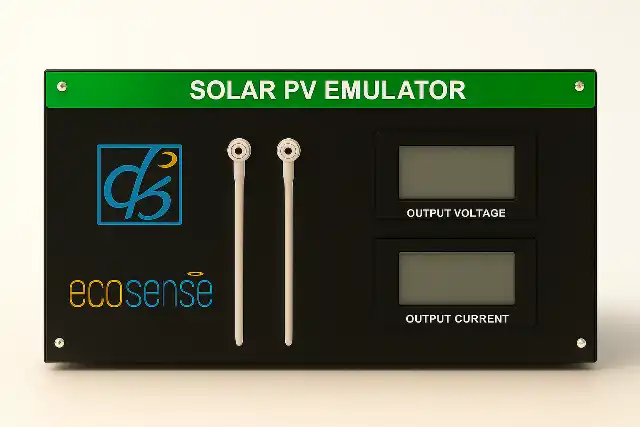
3. Solar PV Emulator
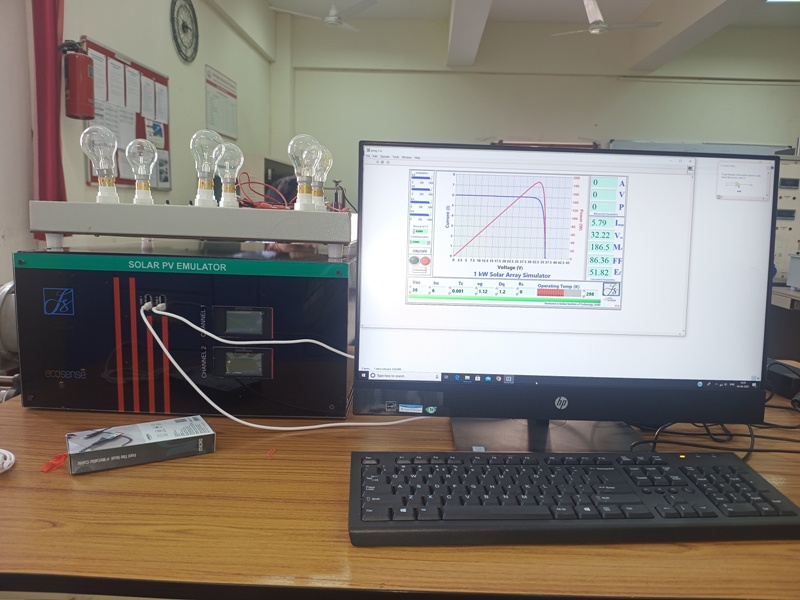
The Solar PV Emulator eliminates climate dependency and allows repeatable, controlled experiments without the need for outdoor panels. Instead of relying on natural sunlight, it generates programmable PV characteristics that simulate real PV behavior exactly as it would occur in the field.
It simulates:
- Irradiation
- Open-circuit voltage (Voc)
- Short-circuit current (Isc)
- Maximum Power Point (MPP)
- Temperature coefficients
- Series resistance and diode quality factor
This enables researchers to create different PV scenarios instantly—such as early morning irradiation, partial shading, thermal effects, or rapid cloud cover—without waiting for ideal weather. It’s especially powerful for power-electronics labs, where students can build, test, and validate their own PV converters, MPPT algorithms, power converters, inverter stages, and grid interfaces.
With the Solar PV Emulator, experiments that normally take days can be repeated in minutes, and data becomes consistent and publishable, which is important for academic research, research papers, and experimental validation.
Start Anywhere — Learn Everything
All three systems are independent and complete. Institutions can begin with the fundamental training system, add the grid-tied platform for power-system education, or directly start with the emulator for advanced power-electronics research. There is no fixed sequence. Over time, combining all three systems builds a full-spectrum solar PV learning ecosystem under one roof—starting from photovoltaic fundamentals and extending to utility integration and algorithm-level innovation.