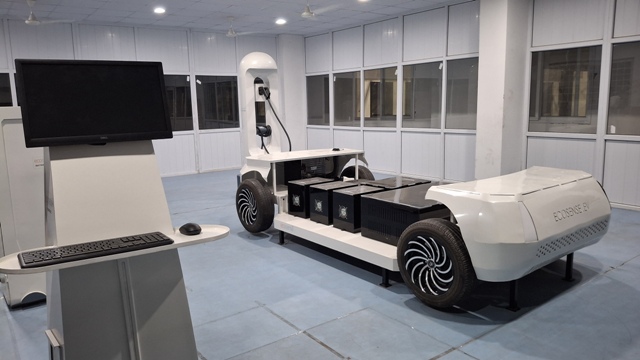
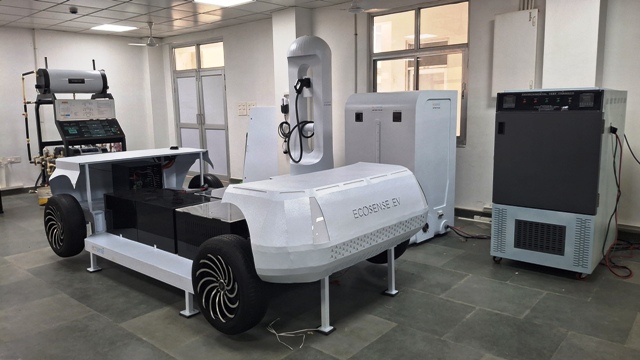
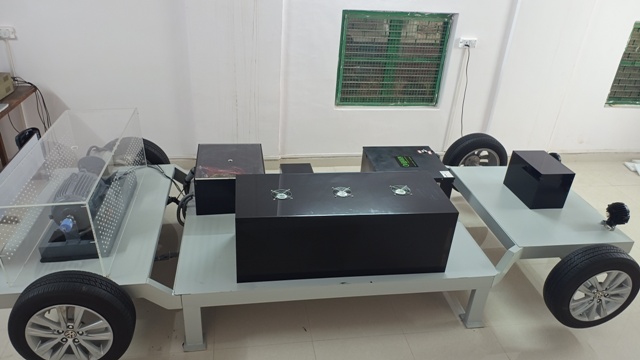
Electric Vehicle Lab

Learning Modules

EV Drive Line Simulator with Controller Development & Validation Platform

The EV Driveline Simulator with Controller Development & Validation Platform is a complete hardware-integrated environment designed for mastering electric vehicle propulsion systems. It enables students, researchers, and engineers to design, test, and validate motor control algorithms on real PMSM traction motors, interact with a programmable dynamometer, execute drive cycles, and evaluate full charging–discharging workflows. The platform replicates a true EV energy ecosystem—from grid to battery to motor and back—making it ideal for advanced learning, research, and prototype development in electric mobility.

Know More
Learning Module

Battery Cycler with Data Analytics

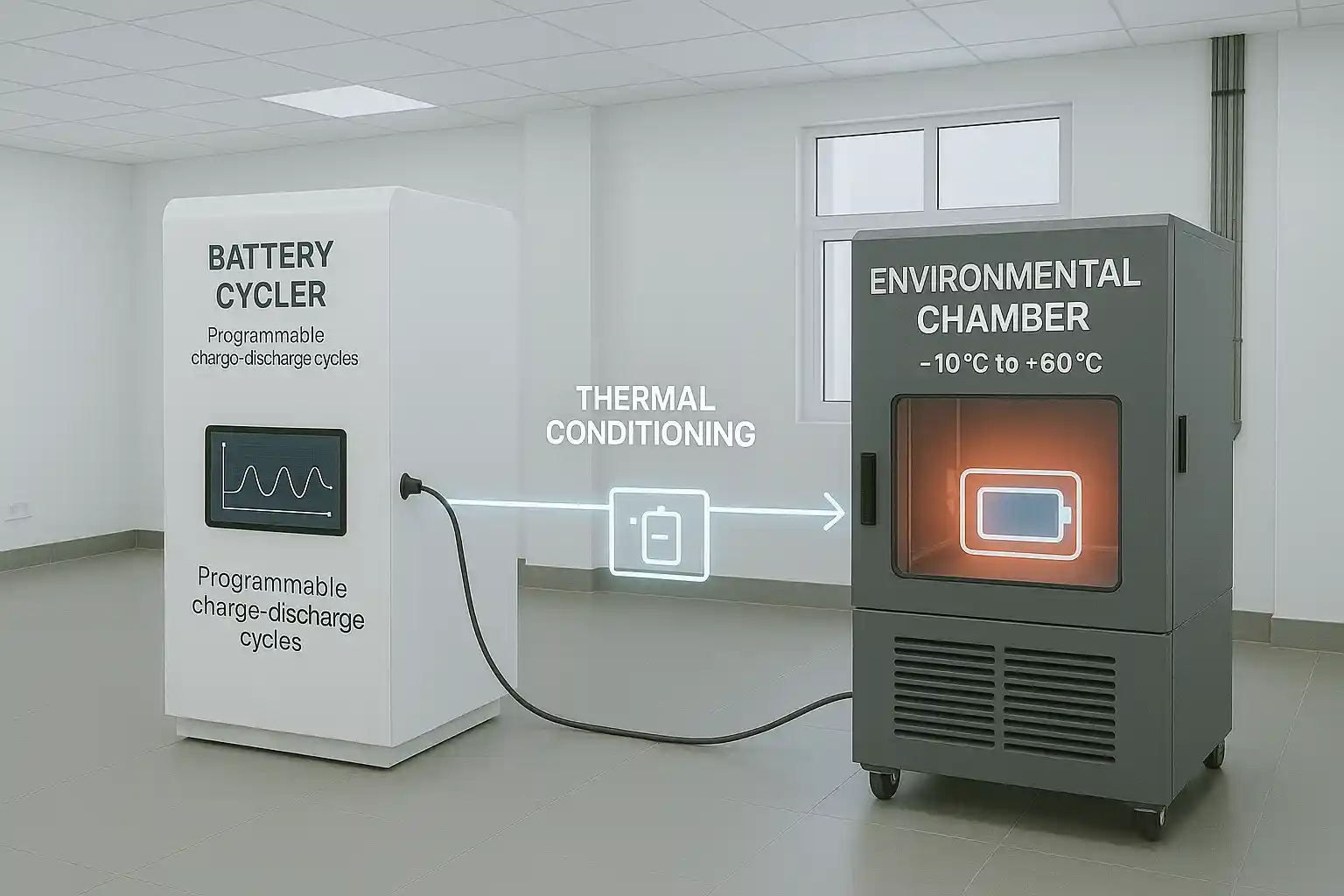
The Battery Cycler with Data Analytics (BCDA) is a comprehensive educational and experimental platform designed to study and analyze electric vehicle (EV) battery systems. Combining real EV components with open-source software and a built-in environmental chamber, this system provides users with the tools to conduct hands-on experiments, simulate real-world conditions, and perform in-depth data analytics. BCDA is ideal for institutions and research labs aiming to deliver practical skills and foster innovation in battery technology and electric mobility.

Know More
Learning Module

BMS Learn & Build Platform

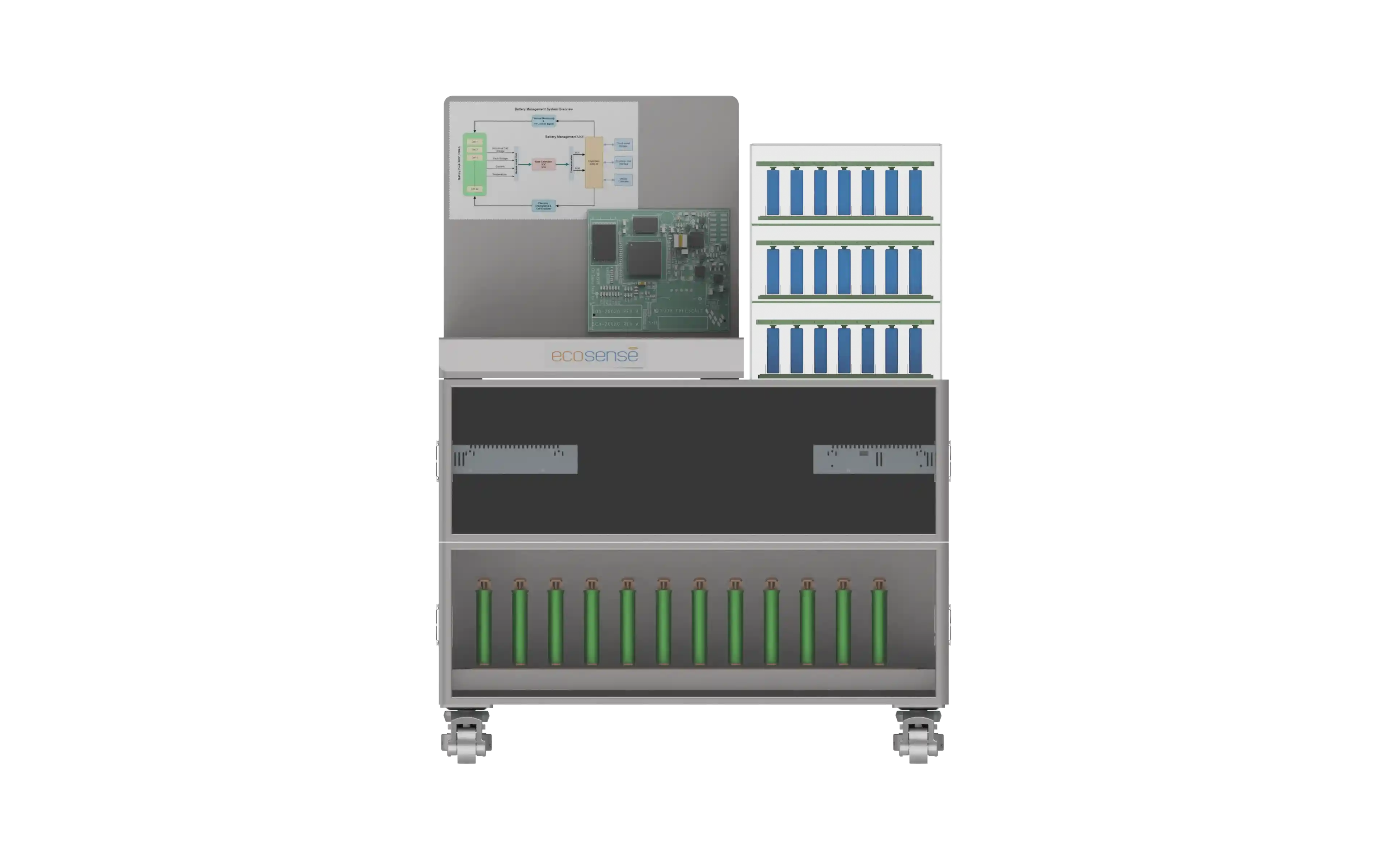
The BMS Learn & Build Platform is a modular training and research system designed to bridge classroom learning with real-world battery applications. It enables students, researchers, and developers to design, program, and validate Battery Management System (BMS) algorithms on real battery packs, addressing the growing demand for safe and intelligent battery management in electric vehicles and energy storage systems.The platform integrates a BMS development unit, a battery cycler with data analytics, and an environmental chamber for controlled charge–discharge and thermal testing. With LabVIEW-based monitoring and open-source firmware, users can configure experiments, simulate protection events, and analyze battery performance in real time. The system provides a scalable, hands-on environment for learning, algorithm development, and BMS validation.

Know More
Learning Module

Modular and Adaptive EVSE

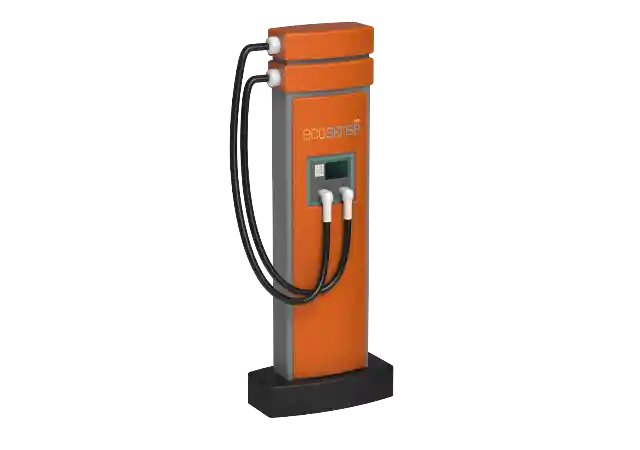
The Modular and Adaptive Electric Vehicle Supply Equipment (MAEVSE) by Ecosense is a fully integrated educational and research platform that simulates the complete EV charging ecosystem. Designed for universities, polytechnics, and technical institutions, MAEVSE combines real EV hardware with open-source control software, enabling students and researchers to explore every aspect of EV charging technology—from onboard AC charging to off-board DC fast charging—through hands-on experimentation, data analysis, and control algorithm development. This lab-grade platform is engineered to bridge the gap between theoretical knowledge and real-world EV infrastructure.

Know More
Learning Module

Green Hydrogen Generation and Storage System

The Green Hydrogen Generation and Storage System by Ecosense is a modular, reconfigurable educational and research-grade platform that replicates the complete hydrogen value chain—from renewable power harvesting to hydrogen generation and safe storage. Designed for engineering institutions, R&D labs, and clean energy centers, this system serves as a real-world replica of decentralized hydrogen production hubs. It enables comparative experimentation with leading electrolyzer technologies (PEM, AEM, Alkaline) and supports multiple input sources including photovoltaic arrays, PV emulators, and AC grid supply. With the flexibility to switch technologies and test variables under controlled lab conditions, this platform prepares students and researchers to design, operate, and optimize hydrogen infrastructure in alignment with future energy systems.

Know More
Learning Module

Green Hydrogen Generation, Storage and Utilization System

The Green Hydrogen Generation, Storage and Utilization System is a customizable experimental and research platform designed to facilitate the comprehensive study of the entire green hydrogen cycle. It enables users to explore every stage—from renewable energy integration (via Solar PV arrays or PV emulator systems) and water purification, to hydrogen generation using a choice of electrolyzers (PEM, AEM, or Alkaline), followed by safe storage and final utilization through a PEM fuel cell. This system offers a complete hands-on learning environment, making it ideal for academic institutions, research laboratories, and technology training centers focused on advancing hydrogen energy technologies with a strong focus on safety, control, and performance analysis.

Know More
Learning Module

Green Hydrogen Microgrid

The Green Hydrogen Microgrid by Ecosense is a cutting-edge educational and experimental platform designed to demonstrate the generation, storage, and utilization of hydrogen energy integrated within a smart microgrid system. This system enables students and researchers to explore real-time renewable energy integration, green hydrogen production via electrolysis, and electricity generation using fuel cells. It provides a holistic learning experience in advanced energy systems, making it an ideal tool for institutions aiming to lead in hydrogen technology and sustainability.

Know More
Learning Module

Electrolyzer Characterization System

The Electrolyzer Characterization System is a laboratory-grade platform designed for detailed testing and performance evaluation of a hydrogen production electrolyzer based on PEM technology. The system supports experimental studies in green hydrogen generation by enabling controlled investigation of electrochemical behavior, efficiency, and durability under a wide range of operating conditions. It features five stackable PEM cells along with additional variable-area cells, powered by a programmable DC supply to allow precise I–V characterization. A distilled water management unit with conductivity monitoring and peristaltic pumps ensures consistent water quality and flow. Integrated gas handling units—including dryers, separators, and flow meters—enable accurate measurement of hydrogen and oxygen output. Operating parameters such as temperature, pressure, voltage, and flow rate are independently adjustable and monitored through a PC-based control and data logging interface. Comprehensive safety systems make the platform suitable for long-duration testing of electrolyzers for hydrogen production in academic and research laboratories.

Know More
Learning Module

Fuel Cell Characterization System

The Fuel Cell Characterization System is an advanced experimentation and research platform for studying PEM fuel cells. It enables detailed exploration of efficiency, durability, and performance under varied operating conditions. The setup includes five single cells and three additional MEA sizes, allowing comparative analysis and scale-up research. Its stackable architecture links single-cell studies to stack-level applications, bridging the gap between laboratory learning and practical deployment. With PC-enabled control, researchers can regulate temperature, humidity, and gas pressure while receiving real-time feedback. A programmable electronic load supports experiments on dynamic operating conditions and optimization. Integrated humidifiers and gas management systems ensure consistent performance. Built-in safety features such as hydrogen leak detection, automatic purging, and overpressure protection guarantee secure operations. Tailored for universities, training centers, and R&D labs, the system provides a complete, safe, and flexible environment for advancing green hydrogen research and innovation.

Know More
Learning Module

Solar PV Training and Research System

The Solar PV Training and Research System is a compact, hands-on educational platform that replicates a real-world standalone solar power plant. Ideal for universities, polytechnics, and research labs, it empowers learners to explore solar photovoltaic technology—from basic principles to advanced MPPT algorithms. The system features structured experiments across three modules: PV characteristics, standalone system integration, and MPPT research. Using modular plug-in units and artificial sunlight, it enables detailed study of panel behavior, wiring, and environmental effects. A complete solution for technical training, academic projects, and solar innovation.

Know More
Learning Module

Solar PV Grid Tied Training System

The grid tied solar PV system is a comprehensive experimental platform designed to replicate the operation of a real grid-connected solar power plant. This solar PV system enables hands-on training and advanced research for universities and technical institutions, focusing on grid integration, power quality, and inverter behavior. With an integrated virtual grid, the grid tie PV system allows controlled experimentation in environments where direct utility grid access is restricted, without compromising realism or safety.

Know More
Learning Module

Solar PV Emulator

Ecosense’s Solar PV Emulator is a versatile experimental tool designed to replicate the characteristics of solar panels, enabling users to simulate various environmental conditions without relying on actual sunlight. Ideal for educational institutions and research labs, it offers a controlled environment to study and analyze solar photovoltaic systems. The emulator can visualize up to four peaks of shading, allowing detailed examination of partial shading effects on solar panel performance.

Know More
Learning Module

Solar Thermal Training System

The Solar Thermal Training System is a compact, modular platform designed to replicate real-world flat plate solar water heating systems. Engineered for both educational and research applications, it facilitates hands-on experimentation with key thermal performance parameters such as efficiency, overall heat loss coefficient (UL), and heat removal factor (FR). The system's adaptability allows users to conduct experiments under varying conditions, including different wind speeds, fluid temperatures, flow rates, and irradiation levels, making it an invaluable tool for comprehensive thermal analysis.

Know More
Learning Module

Solar Concentrator Training System

The Solar Concentrator Training System is a compact and modular experimental platform designed to replicate the functionality of a solar parabolic trough collector–based water heating system. This solar power concentrator setup comprises parabolic reflectors, absorber tubes, a sun-tracking mechanism, piping, storage tanks, and a control panel. The system enables hands-on learning and in-depth research in solar thermal technologies using a laboratory-scale solar concentrator configuration. Its adaptability to different working fluids, absorber materials, insulation thicknesses, and storage configurations makes this solar power concentrator system highly suitable for educational institutions and research laboratories studying heat-transfer dynamics and efficiency variations in solar concentrator–based thermal systems under diverse operating conditions.

Know More
Learning Module

ETC Characterization System

The ETC Characterization System is a compact, closed-loop Evacuated Tube Collector (ETC) setup designed for in-depth thermal analysis of various fluids. Utilizing an artificial sunlight source, this system enables controlled, indoor experimentation independent of natural climate conditions. Ideal for educational institutions, it also serves as a robust platform for advanced research on heat transfer, system efficiency, and the performance of different working fluids, including nanofluids.

Know More
Learning Module

Thermal Energy Storage System

The Thermal Energy Storage System is a versatile experimental platform designed to facilitate in-depth studies of thermal energy storage using Phase Change Materials (PCMs). Engineered for both educational and research applications, this system enables users to explore the dynamics of heat transfer, storage, and retrieval under various operating conditions. Its modular design allows for experimentation with different PCMs, flow rates, and temperatures, making it an invaluable tool for understanding and optimizing thermal energy storage solutions.

Know More
Learning Module

Wind Energy Training System

The Wind Energy Training System is a compact, hands-on laboratory platform designed to introduce students and professionals to the fundamentals of wind power generation and standalone wind energy systems. It replicates the core workings of an actual wind turbine plant in a controlled laboratory environment — perfect for classroom learning, skill development programs, technical training, and renewable energy research. This system facilitates hands-on learning and research by allowing users to study the operational characteristics of wind turbines, understand energy conversion processes, and explore system integration aspects.

Know More
Learning Module

Wind Turbine Emulator

The Wind Turbine Emulator is a real-time, hardware-in-the-loop (HIL) platform that replicates the mechanical and electrical behavior of a wind turbine under controlled laboratory conditions. It eliminates dependence on natural wind while allowing students and researchers to study turbine dynamics, power conversion, MPPT algorithms, and grid interaction with high repeatability and safety.With advanced control architecture and support for external algorithm integration (MATLAB, Simulink, FPGA, etc.), the system facilitates real-time experimentation, deep system modeling, and algorithm validation, all within the safety of a laboratory.

Know More
Learning Module

Wind Turbine Emulator-PV Emulator-Fuel Cell Microgrid

The Wind Turbine Emulator-Solar PV Emulator-Fuel Cell Microgrid is a tri-source, fully integrated hybrid energy training platform that combines Wind Turbine Emulator (WTE), PV Emulator (PVE), and PEM Fuel Cell systems to simulate a real-world microgrid environment. It offers users the ability to model, control, and analyze complex interactions among renewable sources and storage units, with applications in smart grid control, distributed generation, and hybrid energy management. This advanced lab-scale system enables real-time source coordination, dynamic load response, and grid interfacing, making it ideal for universities, technical research labs, and training centers focused on sustainable energy systems. The platform supports integration with battery banks, supercapacitors, and programmable loads, while also offering a fully open-source control software environment for custom experimentation.

Know More
Learning Module

Wind Turbine Emulator-PV Emulator Microgrid

The Wind Turbine Emulator and PV Emulator (WTE-PVE) Microgrid is a comprehensive, lab-scale microgrid system developed for training, experimentation, and research in sustainable power systems. It simulates both wind and solar power generation and allows users to understand, design, and test hybrid energy systems under realistic environmental and load conditions. The system comprises two primary subsystems: the Wind Turbine Emulator (WTE) and the PV Emulator (PVE). Each operates independently but can also be integrated at a common DC link to form a combined hybrid system. The platform supports bidirectional power flow with energy storage, programmable loads, and inverter-based AC output, making it suitable for microgrid studies, control algorithm development, and grid synchronization.

Know More
Learning Module

Wind Turbine Emulator - Fuel Cell Microgrid

The WTE-FC Microgrid is an advanced hybrid energy training and research platform that integrates a Wind Turbine Emulator (WTE) with a Proton Exchange Membrane (PEM) Fuel Cell system. Designed to explore power continuity and backup energy strategies in microgrids, this system enables users to simulate and analyze the interplay between intermittent renewable generation and steady hydrogen-based power supply. The platform mirrors real-world microgrid operation, where wind energy serves as the primary variable source and hydrogen fuel cells provide reliability during low-wind scenarios. This system is ideal for developing skills in microgrid design, renewable backup strategies, energy security analysis, and grid-independent operation.

Know More
Learning Module

Fuel Cell Training System

The Fuel Cell Training System is a fully integrated, modular, and scalable experimental setup designed to bridge the gap between fuel cell theory and practical application. Built for engineering institutes, research labs, and skill development centers, this lab platform allows users to explore everything from fundamental electrochemistry to advanced energy system integration. With a real PEM fuel cell stack at its core, and support components such as a charge controller, battery bank, inverter, and active load modules, the lab facilitates a wide range of experiments, from V-I curve plotting to hybrid system design. Whether you are a student learning fuel cell basics or a researcher developing advanced MPPT algorithms, the Fuel Cell Training System delivers both flexibility and depth.

Know More
Learning Module

Fuel Cell Drive Train

The Fuel Cell Drive Train is a modular laboratory platform designed to simulate and study the complete electric drive train of a hydrogen fuel cell hybrid electric vehicle (FCEV). It provides a hands-on learning environment that demonstrates how hydrogen energy is converted into electric propulsion through coordinated interaction between power electronics, energy storage systems, and motor drives. This lab-scale system integrates a PEM fuel cell, bidirectional power converters, battery bank, ultracapacitor module, and a complete motor drive setup. The traction system consists of a Permanent Magnet Synchronous Motor (PMSM) mechanically coupled to a PMDC loading motor and resistive load bank, enabling controlled road condition and load profile simulation. The architecture closely mirrors a real vehicle electric drive train, allowing detailed study of component-level and system-level behavior.

Know More
Learning Module

Ocean Wave Energy Simulator

The Ocean Wave Energy Simulator by Ecosense is a complete lab-scale system that replicates the behavior of Oscillating Water Column (OWC) wave energy plants. It uses real ocean wave data to simulate irregular sea states and emulates the full energy conversion process using a DC motor to replicate turbine torque and a Permanent Magnet Synchronous Generator (PMSG) for electrical generation. With LabVIEW-based control, real-time monitoring, and grid-connected operation, it serves as a robust platform for education, research, and control strategy development in marine renewable energy.

Know More
Learning Module

Integrated Platform for Carbon Capture and Utilization

The Integrated Platform for Carbon Capture and Utilization is a comprehensive, hands-on educational system designed to bring real-world carbon capture utilization and storage processes into academic laboratories. Developed for engineering and science institutions, this lab-scale setup enables students and researchers to study the complete CCUS workflow—from simulated carbon emissions and selective adsorption to controlled desorption and final mineralization into stable compounds such as CaCO₃. By combining precision gas handling, advanced sensing, and PID-based control, the platform enables practical understanding of carbon capture and storage under controlled and repeatable laboratory conditions. Its IoT-enabled data acquisition system supports both foundational teaching and advanced experimental research.

Know More
Learning Module

RE-Based Smart Energy Management System

The RE-Based Smart Energy Management System by Ecosense is a comprehensive educational platform designed to demonstrate and analyze renewable energy generation and management. It integrates solar and wind energy sources, enabling users to explore various configurations such as standalone, grid-connected, and hybrid systems. The system offers hands-on experience in energy production, storage, and smart load management, making it an invaluable tool for academic instruction and applied research in sustainable energy technologies.

Know More
Learning Module

Three/Single Phase Programmable RLC Load

The Programmable Three-Phase/Single Phase RLC Load System is a hardware-based programmable load bank that uses real resistors, inductors, and capacitors to simulate a wide range of electrical loading scenarios. Controlled via a LabVIEW-based graphical user interface (GUI), the system allows users to independently set resistive (R), inductive (L), and capacitive (C) load levels by entering reference power values, offering precise and dynamic control of active and reactive loads. With built-in power measurement, harmonic analysis, and multi-point communication this platform is ideal for power systems education, energy audits, and three-phase power quality research.

Know More
Learning Module

Programmable DC Load

The Programmable DC Load System is a real, hardware-based resistive load bank that allows precise, software-controlled application of electrical loads to DC power sources such as fuel cells, batteries, solar PV modules, and DC power supplies. Unlike electronic or transistor-based loads, this system uses actual resistors as load elements, making it a perfect match for scenarios where users need to observe true thermal, electrical, and physical behavior under resistive loading conditions. Featuring a LabVIEW-based graphical user interface (GUI), the system offers both manual toggle and automated control modes, real-time parameter monitoring, data logging, and live graph plotting. It's a highly effective tool for engineering education, renewable energy research, and system testing.

Know More
Learning Module

Zonal DC Microgrid

The Zonal DC Microgrid is a next generation educational and research platform that replicates a 2 zone, distributed DC power system capable of simulating real world fault handling, isolation, and resilience strategies. Installed at IIT Roorkee, this system is equipped with multiple DC buses, adjustable voltage levels, and independent load/source configurations in each zone. The platform allows students and researchers to generate faults intentionally in one zone and observe how the other zone remains unaffected, paving the way for smart grid and resilient infrastructure training.

Know More
Learning Module

Universal Datalogger

The Universal Data Logger System is a highly adaptable platform designed to acquire, display, and log real-time data from multiple sensor types including temperature (RTDs, thermocouples), pressure, and flow sensors. Ideal for multidisciplinary labs, the system supports a wide range of input types and allows students and researchers to perform comprehensive measurements and data analysis across various energy, fluid, and thermal systems. Its modular design and LabVIEW-based GUI make it perfect for educational institutions and industrial training centers that require accurate, flexible, and scalable data acquisition systems.

Know More
Learning Module

Grid-Connected Battery Energy Storage System

The Grid-Connected BESS is a fully functional battery energy storage lab system that simulates real-time grid interaction, renewable buffering, and demand-side energy control. It enables experimentation on peak shaving, frequency response, and bidirectional energy exchange. The system combines a battery bank, inverter, smart controller, and energy monitoring software to form a modular and programmable BESS ideal for both educational and pilot-scale smart grid implementations.

Know More
Learning Module

Multiple Input Multiple Output (MIMO) Converter

The MIMO DC-DC Converter is a robust and intelligent energy management system capable of handling multiple energy sources and storage systems simultaneously. Developed for use in research-oriented microgrid and hybrid system labs, the converter features multiple isolated input/output ports, each programmable for source or sink operation. This platform allows researchers and students to study MPPT, power balancing, energy routing, and converter control strategies between combinations of solar PV, batteries, fuel cells, and supercapacitors.

Know More
Learning Module

VERIFICATION OF STRESS HYPOTHESIS – ECS234

This apparatus is designed to generate multi-axial loads on test samples made of ductile metals such as steel, copper, brass, and aluminium. It is used for verification of the Rankine and Tresca yield criteria and representation of stresses and strains in Mohr’s circle.

Know More
Learning Module

DEFORMATION OF BARS UNDER BENDING OR TORSION (ECS140)

This apparatus is used to study deformation of bars under bending and torsion. It allows bending tests and torsion tests to determine modulus of elasticity and shear modulus for various materials such as aluminium, steel, brass, and copper.

Know More
Learning Module

EQUILIBRIUM OF MOMENTS ON A TWO-ARM LEVER (ECS085)

The Equilibrium of Moments on a Two-Arm Lever Apparatus (ECS085) demonstrates the fundamental law of the lever and the concept of moments in static equilibrium. It enables students to understand how force and distance influence rotational balance, making it an essential experiment for the study of statics and basic mechanics principles.

Know More
Learning Module

FORCES IN A CRANE JIB (ECS188)

This apparatus allows the determination of forces in a planar crane jib system. It enables the study of tensile and compressive bar forces, vectorial handling of forces, and the analysis of various jib configurations.

Know More
Learning Module

TIMING BALL (ECS596)

The Timing Ball apparatus is used for the measurement of total time of flight during projectile motion and to determine acceleration due to gravity ‘g’. It includes Bluetooth connectivity for data measurement and digital display.

Know More

Why Choose EV Lab

  • Complete Research-Oriented Platform: Integrates Regenerative Battery Cycler, EV Drive Line Simulator, and Modular & Adaptive EVSE for full EV ecosystem learning.
  • Hands-On Learning: Supports battery testing, motor control, drive cycle simulation, and charger characterization. 
  • Modular & Scalable Design: Enables expansion into advanced studies such as BMS development and algorithm testing. 
  • Proven Reliability: Installed in premier academic and research institutions with strong local support.
  • Comprehensive Documentation: Comes with manuals, experiment guides, and data logging tools for seamless lab integration. 
  • Intuitive Interface: Features user-friendly graphical software for real-time monitoring and analysis. 
  • Future-Ready: Empowers students and researchers to explore sustainable mobility and innovation through experiential learning.

How the Ecosense Electric Vehicle Lab Works

The Ecosense Electric Vehicle Lab is a modular, scalable, and integrated platform designed to provide comprehensive, hands-on learning and research opportunities in the field of electrified transportation. It brings together battery technology, drivetrain systems, and charging infrastructure under one roof, enabling students, researchers, and engineers to simulate, design, test, and validate electric vehicle (EV) systems in real time.

1. Battery Technology 

Battery technology is at the heart of electric vehicles, contributing to nearly 50% of their total cost. Understanding charging, discharging, battery management systems (BMS), and overall performance is critical to EV development. The lab offers two specialized subsystems for battery research: 

A. Battery Cycler with Data Analytics (BCDA) 

This subsystem allows controlled battery testing under varied load and environmental conditions. Users can:

  • Evaluate charging characteristics using Constant Current (CC), Constant Voltage (CV), and Constant Power (CP) modes. 
  • Analyze discharging performance across different load cycles and C-rates. 
  • Study temperature-dependent behavior using the integrated Environmental Chamber.
  • Perform fuel economy comparisons between new and aged batteries. 
  • Monitor State of Charge (SoC) and State of Health (SoH) to assess capacity and longevity. 

The system workflow involves setting up test cases via application software on a PC, which communicates with a microcontroller to control the charge/discharge hardware. Real-time data on voltage, current, temperature, and SoC is logged and visualized for analysis. Users can modify algorithms because of the open-source framework, enabling experimental studies and custom research.

B. Modular Battery & BMS Development Platform 
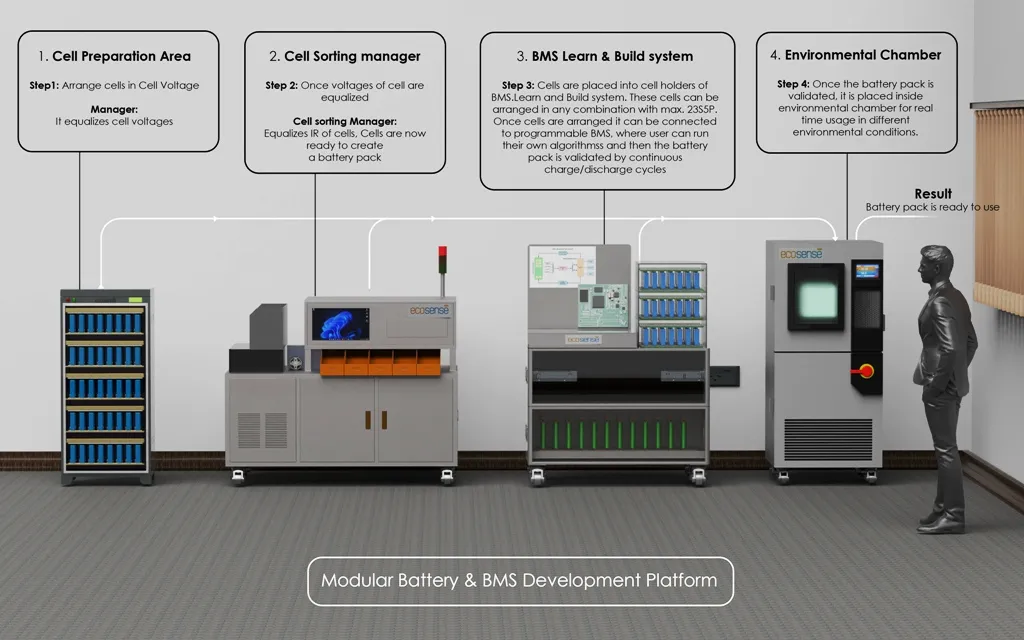
This platform supports battery pack assembly, custom BMS development, and algorithm validation. Key components include: 

  • Cell Voltage Manager: Ensures uniform cell voltages before assembly to improve performance and longevity. 
  • Cell Sorting Unit: Groups cells based on internal resistance to prevent imbalance and premature aging.
  • BMS Development & Validation: Offers voltage, current, and temperature monitoring; protection mechanisms; active, passive, and dynamic balancing; and multiple SoC estimation algorithms such as Coulomb Counting, OCV, and Kalman Filters. 

Integrated with the BCDA and Environmental Chamber, this platform allows end-to-end validation of battery packs under real-world operating conditions. 

 2. Drivetrain Technology 

The EV Driveline Simulator with Controller Development & Validation Platform enables students to study how electrical energy is converted into mechanical energy to propel the vehicle. The subsystem includes: 

  • A 5kW PMSM traction motor and PMSM-based dynamometer to emulate road-like loading conditions. 

  • Programmable motor controllers supporting Field-Oriented Control (FOC), sensor less operation, and other advanced algorithms. 

  • Integration with the traction battery and BMS to provide real-world system feedback. 

  • Drive cycle simulations (IDC, WLTP, NEDC, FTP-75) with regenerative braking for efficiency studies. 

The system captures real-time data on torque, speed, voltage, and thermal behavior through a high-speed data acquisition system. Users can develop custom motor control algorithms, monitor system performance, and analyze the effect of various drive cycles and regenerative strategies. 

3. Charging Infrastructure Technology 

The Modular & Adaptive EVSE subsystem provides a realistic training platform for EV charging technologies, supporting both onboard and offboard charging. Key features include: 

  • AC Level 2 slow charging and DC fast charging up to 9 kW. 

  • Communication with the vehicle’s BMS and onboard charger using standard EV protocols. 

  • Real-time programmable FPGA controller for testing custom charging algorithms and strategies. 

  • Simulation of start-up, charging, and shutdown phases, including safety cut-offs, efficiency optimization, and fault injection scenarios. 

Students can experiment with charging profiles, analyze energy flow, and optimize processes for real-world applications. Open-source software allows algorithm modification and experimentation with innovative charging strategies. 

3. Charging Infrastructure Technology 

The Modular & Adaptive EVSE subsystem provides a realistic training platform for EV charging technologies, supporting both onboard and offboard charging. Key features include: 

  • AC Level 2 slow charging and DC fast charging up to 9 kW. 

  • Communication with the vehicle’s BMS and onboard charger using standard EV protocols. 

  • Real-time programmable FPGA controller for testing custom charging algorithms and strategies. 

  • Simulation of start-up, charging, and shutdown phases, including safety cut-offs, efficiency optimization, and fault injection scenarios. 

Students can experiment with charging profiles, analyze energy flow, and optimize processes for real-world applications. Open-source software allows algorithm modification and experimentation with innovative charging strategies. 

4. System Integration & Workflow 

Each subsystem is designed to operate independently but integrates seamlessly into the RTSCET platform for end-to-end EV experimentation. The workflow begins with battery preparation, BMS development, and environmental testing. Once the battery pack is ready, it powers the driveline simulator, enabling motor control studies and drive cycle analysis. Charging infrastructure experiments can then be performed with the same battery system, providing a complete view of energy flow and system performance. 

By combining hardware, software, and real-time simulation, the Ecosense EV Lab provides a research-ready, educational environment where users can: 

  • Understand battery chemistry, performance, and BMS design. 

  • Study motor dynamics, control strategies, and regenerative braking. 

  • Explore charging infrastructure, protocols, and optimization techniques. 

  • Conduct experiments under controlled conditions with real-time monitoring and data analysis. 

In summary, the Ecosense EV Lab empowers students and researchers to simulate, design, build, and validate electrified transportation systems safely and effectively, bridging the gap between theoretical knowledge and real-world EV technology. 

Frequently Asked Questions

The EV Lab is a modular, research-focused platform that integrates battery technology, EV driveline simulation, and charging infrastructure. It allows students and researchers to study, design, and validate EV systems through hands-on experiments, real-time data monitoring, and advanced simulation.

The lab includes four main subsystems: 

  • Battery Cycler with Data Analytics (BCDA) 
  • Modular Battery & BMS Development Platform 
  • EV Driveline Simulator with Controller Development & Validation
  • Modular & Adaptive EVSE for AC/DC charging studies 

The lab enables controlled charge/discharge testing, SoC/SoH analysis, thermal testing, and custom BMS algorithm development. Students can build, test, and validate battery packs under real-world conditions using open-source software. 

Yes. The EV Driveline Simulator allows testing of traction motors (PMSM, BLDC, induction), motor controllers, regenerative braking, and drive cycle simulation. Users can develop custom algorithms and analyze performance under variable load conditions. 

The Modular & Adaptive EVSE enables hands-on experiments with AC and DC charging, communication with BMS and onboard chargers, and testing of charging algorithms. Users can optimize charging profiles, study energy efficiency, and explore safety protocols. 

Ecosense serves educational institutions, research centers, and training organizations worldwide. Our lab solutions are deployed across Asia, the Middle East (UAE, Saudi Arabia and Oman), Europe, Africa, and the Americas, supporting universities, polytechnics, and R&D facilities.

Yes. Ecosense provides lab design, equipment supply, and turnkey lab solutions outside India. We regularly support international projects through direct exports, local partners, and on-site coordination based on project scope.

Absolutely. All Ecosense lab solutions can be customized to meet country-specific academic curricula, electrical standards, safety regulations, voltage/frequency norms, and certification requirements. Customization also extends to documentation, experiments, and software interfaces.