
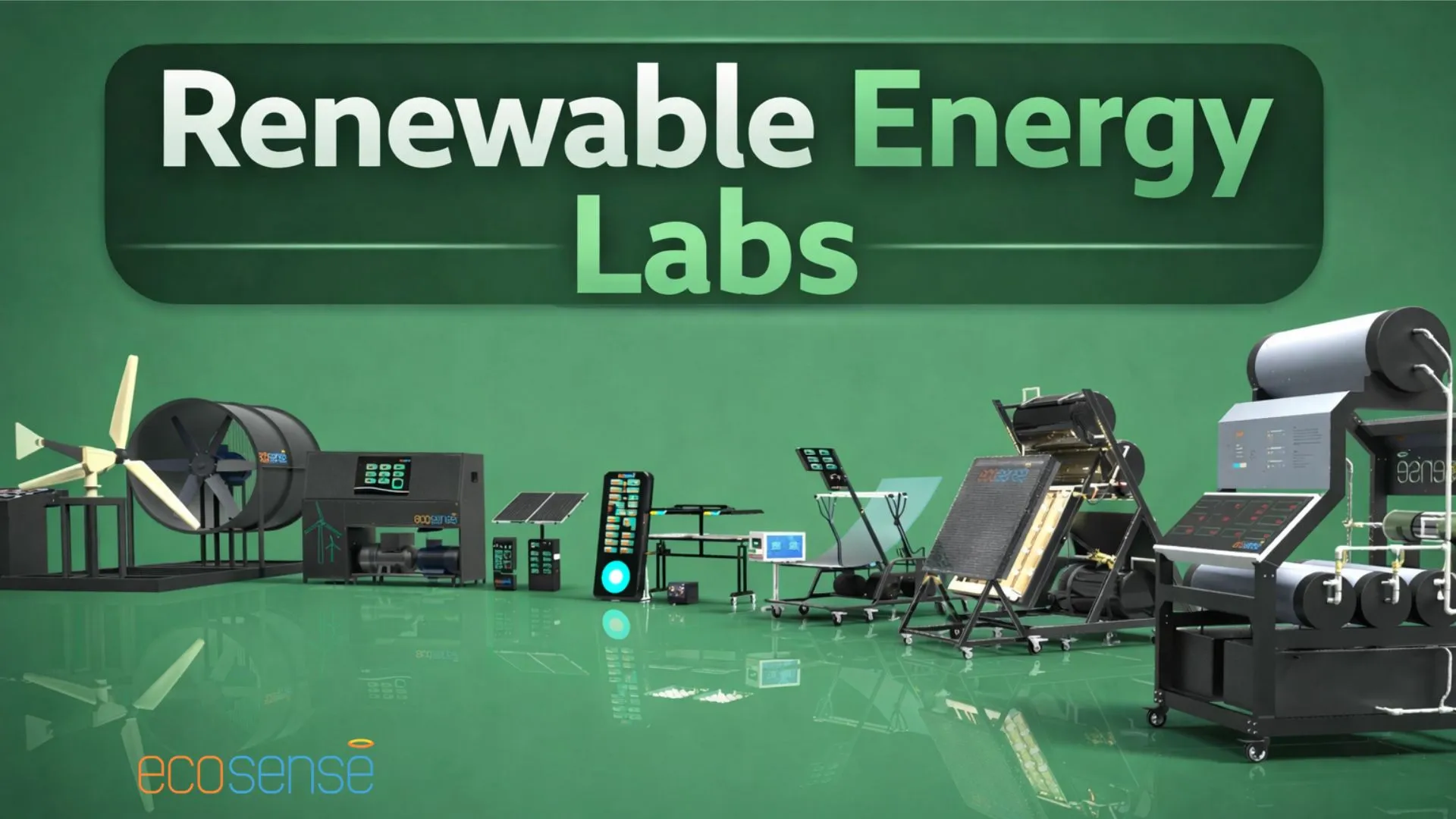
Renewable Energy Labs
India's engineering institutions are under real pressure. Industry wants graduates who can commission a solar inverter, debug a charge controller, validate an MPPT algorithm, or manage energy dispatch across a hybrid microgrid not just pass a multiple-choice paper on power electronics. A properly equipped renewable energy lab closes that gap. It puts real hardware in students' hands and real data on their screens. Ecosense has been building these labs for universities, NITs, IITs, and research centres not as resellers of imported kits, but as designers and manufacturers of systems built specifically for Indian engineering education.
Types of Renewable Energy Labs Available at Ecosense
Ecosense's renewable energy lab portfolio spans five technology domains. Each domain has multiple product tiers which spans from entry-level training systems to research-grade systems.
The Solar PV Training and Research System is a compact indoor standalone system with real panels, a charge controller, battery, and inverter enabling students study I-V characteristics, MPPT algorithms, and full power flow from generation to load.
The Solar PV Grid Tied Training System connects a 1000 Wp rooftop array to a lab-side control unit with a built-in virtual grid, covering grid synchronisation, anti-islanding, net metering, and power quality experiments without needing utility grid access.
The Solar PV Emulator is a programmable 2 kW power supply that replicates any solar panel's I-V curve including partial shading effects giving researchers a weather-independent, fully repeatable platform for testing inverters, charge controllers, and MPPT algorithms.
The Solar Thermal Training System is a flat plate collector with artificial irradiation and a controllable wind source, usable entirely indoors. Students study collector efficiency, heat loss coefficients, and heat removal factors across thermosyphonic and forced flow modes.
The Solar Concentrator Training System is a parabolic trough setup with single-axis tracking and two working fluid options water and thermal oil for high-temperature heat transfer experiments. The ETC Characterisation System is a closed-loop evacuated tube collector with an integrated chiller, designed specifically for advanced research on nano-fluid thermal performance.
The Wind Energy Training System is a 300 W PMSG turbine mounted in front of a VFD-controlled fan, giving students a fully controllable indoor wind source to study power curves, tip speed ratio, coefficient of power, and standalone power flow. The turbine is certified by the National Institute of Wind Energy.
The Wind Turbine Emulator is the research-grade version with an FPGA-controlled DC-motor-PMSG/DFIG setup that can replicate any turbine model under any wind profile, with three operating modes (Manual, Table, and CSV upload) for custom MPPT and control algorithm development.
The Ecosense Microgrid Lab is a fully configurable hardware platform built around four layers energy sources, storage, AC/DC loads, and a programmable EMS that replicates real-world microgrid operation at lab scale. Institutions choose their source mix, storage type, and control logic, and can expand the system later without redesigning the core.
Microgrid labs for students simulate distributed energy systems integrating solar, wind, batteries, and smart controllers, ideal for advanced grid research and power systems training.
The RE-Based Smart Energy Management System integrates a 2 kW solar array, a 1 kW IEC-certified wind turbine, a battery bank, standalone and grid-tied inverters, a hybrid inverter, a real-time weather station, and a smart home load module all managed through a centralised touchscreen controller with open-source editable EMS software. Students study standalone, grid-connected, and hybrid operation, demand-side management, and weather-based protection in a single unified platform.
Key Features of Ecosense Renewable Energy Labs
Every Ecosense renewable energy lab system shares a set of design principles applied consistently across the product range.
- All systems are modular and scalable. The microgrid lab can start with two sources and expand to five. The energy management system can add more renewables, larger storage, or additional load modules without redesigning the core. The solar PV training system works indoors with halogen lamps or outdoors with real sunlight. This modularity protects institutional investment over time.
- No internal pre-wiring is a deliberate design choice in the training systems. Students make all connections themselves, following illustrated step-by-step wiring manuals. This is how real installation and commissioning skills are built not by observing a pre-wired demonstration unit.
- Data logging, PC software, and RS-485 communication are standard across the range. Most systems include real-time plotting of I-V, P-V, V-t, P-t, and I-t curves. Data exports to CSV and image formats support research documentation. The microgrid EMS and energy management central controller support open-source editable software researchers can implement and test custom algorithms directly on the hardware.
- All specifications are customisable panel wattage, battery capacity, inverter rating, generator type, storage chemistry, number of sources, and experiment sets can all be adjusted to fit existing infrastructure and curriculum requirements.
Importance for Universities and Engineering Colleges
India's Ministry of New and Renewable Energy has set a 500 GW renewable energy capacity target for 2030. Meeting that target requires power electronics engineers, solar project managers, wind farm technicians, microgrid operators, and energy auditors trained in college labs, not on the job.
A renewable energy lab built around real hardware produces graduates who have actually commissioned a standalone solar system, actually managed energy dispatch across a hybrid microgrid, actually tested an MPPT algorithm on a programmable emulator, and actually analysed power quality under non-linear loads. These are not skills picked up from simulation software. Institutions with active, well-equipped labs also attract better research funding DST, MNRE, and SERB-funded projects require infrastructure that can support serious experimental work.
Why Choose Ecosense Renewable Energy Labs
Ecosense has supplied renewable energy research labs to institutions across India and internationally.
Every system is designed and manufactured in-house. Engineering decisions like topology choices, component ratings, software architecture, EMS logic are made by Ecosense's own team. That means post-sale support is direct, knowledgeable, and not routed through a third-party distributor chain. Faculty training and commissioning are included with every installation. Illustrated experiment manuals are written for each specific system configuration, not adapted from a generic product.
Common Applications and Use Cases of Renewable Energy
A renewable energy training lab at an engineering institution serves more than undergraduate practical sessions.
- For undergraduate teaching, training systems directly support laboratory courses in power electronics, electrical machines, energy conversion, and renewable energy systems — with experiments structured to match standard university syllabi.
- For postgraduate and doctoral research, emulator-class systems the Solar PV Emulator, Wind Turbine Emulator, and Microgrid EMS provide the control access and measurement infrastructure needed for journal-level work. Researchers implement custom MPPT algorithms, test new inverter control strategies, study partial shading impacts on grid-tied systems, validate EMS dispatch logic, or analyse power quality under variable loads.
- For faculty-led funded projects, the solar thermal systems support heat transfer research with configurable fluid types, flow rates, and insulation thicknesses. The ETC system supports nano-fluid performance evaluation. The microgrid and energy management labs support EMS optimisation, demand response, and smart-grid research, all active areas of DST and MNRE-funded work.
- For short-term training, the modular design of all systems makes them usable for FDPs, industry refresher programmes, and skill development workshops alongside regular student use without equipment conflict.
Recent Installations Case Study
Renewable Energy Lab at NIT Andhra Pradesh
National Institute of Technology Andhra Pradesh received a comprehensive renewable energy lab from Ecosense covering three technology domains in a single integrated facility: Solar PV On-Grid/Off-Grid, Wind Energy, and Fuel Cell. Each system was installed as an independent experimental platform, ensuring there is no operational overlap between technologies. Students can run focused experiments on any one system without interfering with parallel sessions running on another.
Solar Thermal Lab at Sultan Qaboos University, Oman
Ecosense's installation at Sultan Qaboos University in Oman is significant for two reasons. First, it was Ecosense's first project in Oman marking the company's entry into the Gulf region's higher education ecosystem. Second, the lab is one of the most complete solar thermal facilities Ecosense has delivered internationally, integrating four distinct collector technologies under one roof.
The lab includes the Flat Plate Collector Training System for foundational heat transfer studies, the Parabolic Trough Concentrator Training System for concentrating solar power concepts and high-temperature experiments, the ETC Characterisation System for evacuated tube performance analysis and fluid-based thermal studies, and a Solar Thermal Energy Storage System for heat storage charging and discharging experiments. All four systems operate independently — faculty can schedule parallel experiments across technologies, and students get direct comparison data between collector types rather than studying them in isolation.