
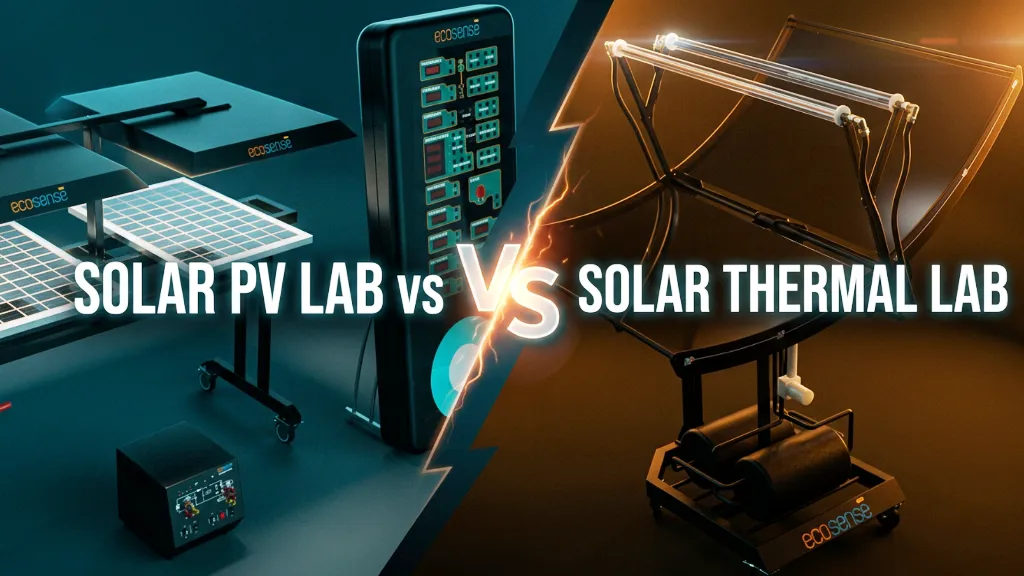
Solar PV Lab vs Solar Thermal Lab: Use, Career & ROI
Pick the wrong one and you've spent Rs. 15 lakhs on a lab that doesn't match your curriculum, can't support your placement goals, and runs three demonstrations a year during accreditation visits.
That's not hypothetical. It happens regularly at institutions that treat solar PV and solar thermal as two flavours of the same technology. They're not. The physics is different. The instruments are different. The careers are different. And the solar pv vs solar thermal lab decision deserves more than a five-minute committee vote.
Solar PV vs Solar Thermal: The Core Difference
PV is electricity from light. Directly. Photons hit silicon, electrons move, current flows out of the panel. No heat, no fluid, no moving parts in the panel itself.
Solar thermal is heat from light. Collectors absorb radiation and dump that energy into a fluid (water, glycol, or a thermal oil depending on the operating temperature). What happens next depends on the application. Low-temperature systems heat water for domestic or industrial use. High-temperature concentrating systems (CSP) push that heat through a turbine and generate electricity, but only after several conversion steps that don't exist in a PV system.
The difference between solar pv and solar thermal isn't a matter of degree. It's a fork in the physics. A student who understands PV efficiency losses needs to know about recombination, bandgap alignment, and fill factor. A student who understands thermal efficiency losses needs to know about heat transfer coefficients, fin effectiveness, and thermal resistance networks. These are not the same subject wearing different clothes.
What a Solar PV Lab Teaches
The I-V curve is the starting point and it's more interesting than it sounds.
Sweep a load across a panel under controlled illumination, plot current against voltage at each point, and what you get is a curve that encodes the panel's entire operating behaviour. Open-circuit voltage, short-circuit current, maximum power point, fill factor, efficiency. Every solar plant designer in the world works from that curve. Students who've actually generated one understand why. Students who've only seen it in a textbook often don't. This is the foundation experiment of any Solar PV lab worth it's budget.
MPPT experiments come next. Inverters track the maximum power point continuously as sun angle, irradiance, and cell temperature shift. Different algorithms handle that tracking differently. Perturb-and-observe is simple but loses power during rapid irradiance changes. Incremental conductance is more accurate but computationally heavier. Students who run both on actual hardware, compare the efficiency numbers, and explain the difference in a lab report are learning something that directly applies to commissioning work at a solar plant.
Inverter synchronisation, anti-islanding protection, reactive power control, THD measurement. This is where PV lab experiments enter grid integration territory. It's also where most teaching labs stop short because the equipment gets expensive. Don't stop short. These are the skills EPC engineers actually use.
Shading mismatch is worth its own session. One shaded cell in a series string drops the whole string's output disproportionately. Students who measure this rather than read about it retain the bypass diode concept permanently. The ones who only read about it tend to forget it by the next exam.
What a Solar Thermal Lab Teaches
Flat plate collector. Evacuated tube collector. Parabolic trough. These are not variations on a theme. They behave substantially differently under the same irradiance conditions, and comparing them is the foundational experiment in any solar thermal lab.
CSP experiments (concentrated solar power) are the bridge to electricity generation. Focus sunlight onto a receiver, heat a working fluid to high temperature, run a Stirling engine or small turbine. Not every thermal lab has a CSP rig, but the institutions that do give students a view of the full solar energy conversion chain that a flat plate efficiency experiment alone can't provide.
Solar PV Lab vs Solar Thermal Lab: Comparison
| Parameter | Solar PV Lab | Solar Thermal Lab |
| Core Physics | Photoelectric effect, semiconductors | Heat transfer, thermodynamics, fluid flow |
| Primary Output | Electricity | Heat or electricity via CSP |
| Key Experiments | I-V curves, MPPT, inverter testing, shading | Collector efficiency, heat transfer, thermal storage, CSP |
| Key Instruments | Solar simulator, IV tracer, inverter trainer, pyranometer | Thermocouple arrays, flow meter, collector rigs, calorimeter |
| Industry Applications | Rooftop solar, utility PV, grid integration | Solar water heating, industrial process heat, CSP |
| Career Paths | PV design, solar EPC, grid integration, energy audit | Thermal systems, HVAC-solar, building energy, CSP O&M |
| Lab Cost Range | Rs. 8 to 30 lakhs | Rs. 5 to 20 lakhs |
| Curriculum Fit | EEE, ECE, power electronics | Mechanical, civil, building services |
Use Cases: Which Lab Fits Your Program?
- EEE departments: build a PV lab. This isn't complicated. Power electronics, semiconductor devices, inverter control. All of that coursework connects directly to PV experiments. The instruments overlap with what's already in the department. The careers align with where EEE graduates get placed. There's no strong argument for building a solar thermal lab in an EEE department unless it already has a strong PV lab and is expanding.
- Mechanical engineering: solar thermal is the better fit, and usually the more defensible budget decision. Heat transfer, fluid mechanics, thermodynamics. Third-year ME students are already doing experiments that directly precede thermal collector efficiency analysis. A flat plate collector rig is not a conceptual leap. It's the next logical step.
- Civil and building services programmes: thermal. Solar water heating system design, building-integrated thermal collection, seasonal storage sizing. These are directly relevant to building energy and not well-served by a PV lab.
- Interdisciplinary renewable energy or energy engineering programmes need both. Running only one type of solar lab in a programme called "Energy Engineering" or "Renewable Energy Systems" is a curriculum gap that students notice and employers notice.
Which solar lab is better for a given institution comes down to this: match the lab to the dominant engineering stream in the department, not to which equipment looks more impressive in a photograph.
ROI & Career Relevance
Research pathways differ significantly. Students targeting M.Tech or PhD work in energy get more exposure to thermodynamic cycles, heat storage mechanisms, and fluid dynamics from a thermal lab. Students going into power electronics or grid research benefit more from MPPT and inverter experiments. Neither path is wrong. They just go to different places.
One thing worth saying directly: PV lab ROI is higher for most Indian engineering colleges right now because the domestic market for PV-trained graduates is larger. That may shift as industrial solar thermal and CSP projects scale. But for a department making a decision this academic year, PV has the stronger near-term placement case.