
Types of Supercapacitors: A Complete Selection & Sizing Guide
What is a Supercapacitor?
10,000 watts per kilogram. That's what some supercapacitors push out, and no conventional battery gets anywhere near it. First-time engineers usually do a double take at that number.
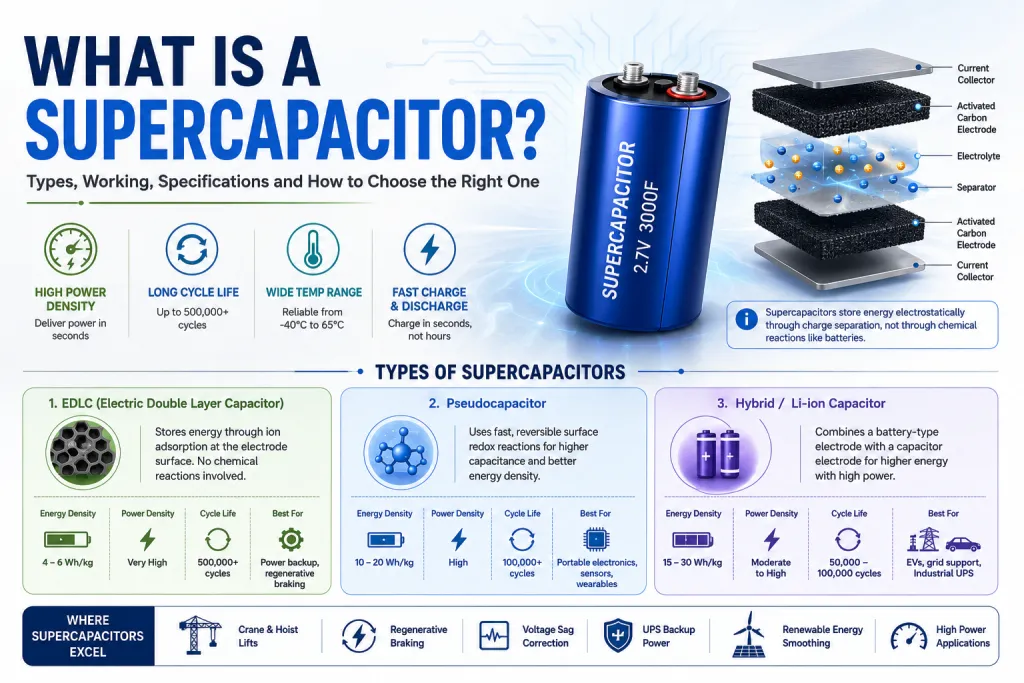
So what is a supercapacitor, exactly? It's a device that stores energy electrostatically, through charge separation across two electrodes, instead of through a chemical reaction like a battery uses. That's the whole trick behind near-instant charging and a service life most batteries only dream about. Some people call it an ultracapacitor. Same thing.
But here's the catch nobody mentions upfront: "supercapacitor" was never one design. It's a family, and the different types of supercapacitors aren't built the same way. EDLCs, pseudocapacitors, hybrids, each one trades energy density against power density a little differently, and that difference is bigger than most spec sheets let on.
Get that trade-off wrong and you're stuck with something oversized, underperforming, or just overpriced for the job. We've watched all three happen on real projects, usually the ones that skipped this step entirely.
So here's the plan for this guide. The main supercapacitor families first, then how each one actually works, then the specs worth paying attention to. After that, a practical way to select and size the right unit, not just whichever one reads best on a datasheet.
Main Types of Supercapacitors
Three families, roughly speaking, and each one splits the difference between energy density and power density a bit differently.
EDLCs store charge purely through ion adsorption at the electrode surface, nothing chemical about it. Pseudocapacitors add fast, reversible surface redox reactions on top of that, which buys extra capacitance beyond simple charge separation. Then you've got hybrids, including lithium-ion capacitors. They pair a capacitor-type electrode with a battery-type one, pushing energy density higher without giving up much of that fast charge and discharge behavior.
Here's how the numbers stack up before we get into each one on its own.
| Type | Energy Density | Power Density | Cycle Life | Typical Use Case |
| EDLC | 4-6 Wh/kg | Very high | 500,000+ cycles | Power backup, regenerative braking |
| Pseudocapacitor | 10-20 Wh/kg | High | 100,000+ cycles | Portable electronics, sensors |
| Hybrid/Li-ion capacitor | 15-30 Wh/kg | Moderate to high | 50000-100000 cycles | EVs, grid support, industrial UPS |
Electric Double Layer Capacitors (EDLC)
EDLCs are the most common of the bunch, and probably the ones you've already run into without realizing it. Activated carbon electrodes, extremely high surface area, that's the whole design in a nutshell.
No chemical reaction means near-instant charge and discharge. This is what makes EDLCs a natural fit for anything needing a rapid burst of power, crane lifts, voltage sag correction, that kind of thing.
Energy density is where they fall short though. Per kilogram, they just can't store as much as a battery can. So they stay in the short-duration, high-power lane rather than trying to compete on long-term storage.
What they do offer is cycle life, and a lot of it. We're talking 500,000-plus charge and discharge cycles, often more, which suits applications with frequent, repetitive power demands running for years without much fuss.
Pseudocapacitors
Pseudocapacitors take the EDLC formula and push energy density up a notch. They use materials like metal oxides or conducting polymers to add fast surface redox reactions. More stored energy per unit weight, basically.
The catch is power density and cycle life both dip slightly compared to a pure EDLC. Those redox reactions are quick, sure, but they wear the electrode down faster than simple ion adsorption ever would.
Where do they actually get used? Portable electronics, wearables, sensor networks, anywhere that needs a middle ground between energy and power rather than maxing out one or the other.
Heavy industrial settings tend to skip pseudocapacitors though. When the priority is the fastest power delivery or the longest possible cycle life, a modest bump in energy density usually isn't worth the trade.
Hybrid Supercapacitors & Lithium-Ion Capacitors
Hybrid designs pair a lithium-doped carbon anode with a capacitor-type cathode. Lithium-ion capacitors are the most common version you'll see. The result is noticeably higher energy density without sacrificing much of the power performance that makes supercapacitors useful in the first place.
Of all the types of supercapacitors, hybrids get closest to battery-like territory. More stored energy than an EDLC, faster charging than a typical lithium-ion cell. Best of both, more or less.
That's why electric vehicles lean on them where quick charging and decent range both matter. Grid support systems do too, smoothing out renewable generation swings without needing a full battery bank on site.
Nothing comes free though. Hybrid designs use pricier materials and more complex manufacturing, so expect to pay more per unit than an EDLC for a comparable power rating.
Key Supercapacitor Specifications
A handful of specs decide whether you've picked the right unit or not. Rated voltage is the first one, since it determines how many cells you'll need in series to hit your application's voltage requirement.
Capacitance, in farads, tells you how much charge the unit holds at a given voltage. More capacitance usually means more stored energy, but also a bigger, heavier package, so it's rarely a free upgrade.
Then there's ESR, equivalent series resistance, which governs how much energy gets lost as heat during charge and discharge. Lower ESR, higher efficiency, better performance under heavy current loads. Simple as that.
Cycle life and operating temperature range round things out. Together they tell you how the unit will actually hold up over its service life, not just what the datasheet promises on day one.
How to Select & Size a Supercapacitor
Start with the load profile. What's the peak power, how long does that peak last, and how often does it repeat? Those three answers drive most of the sizing decision right there.
From there, calculate the capacitance you need based on your target voltage window and the energy required per cycle. Undersize it and you'll see voltage sag under load. Oversize it and you're paying for cost and weight you didn't need.
Match the type to the job. High-frequency, short-burst loads point toward EDLCs. Applications needing more stored energy per cycle usually do better with a hybrid or lithium-ion capacitor design instead.
Last step, check the operating environment against the datasheet, especially temperature range and expected cycle count. Skip this and you risk early degradation nobody sees coming until it's too late.
Honestly, working through this hands-on beats reading a spec sheet every time. A lab setup like Ecosense's Microgrid Lab lets engineers validate sizing calculations against real load conditions before locking in a final design.
Conclusion
Three families, three different jobs. EDLCs win on power and cycle life, pseudocapacitors sit in the middle on energy density, hybrids get closest to battery-like performance. None of them is the "best" one, they're just built for different problems.
The real skill is matching the type to the actual load profile instead of defaulting to whichever one you're most familiar with. That's what separates a well-sized system from one that's oversized, underperforming, or both.