
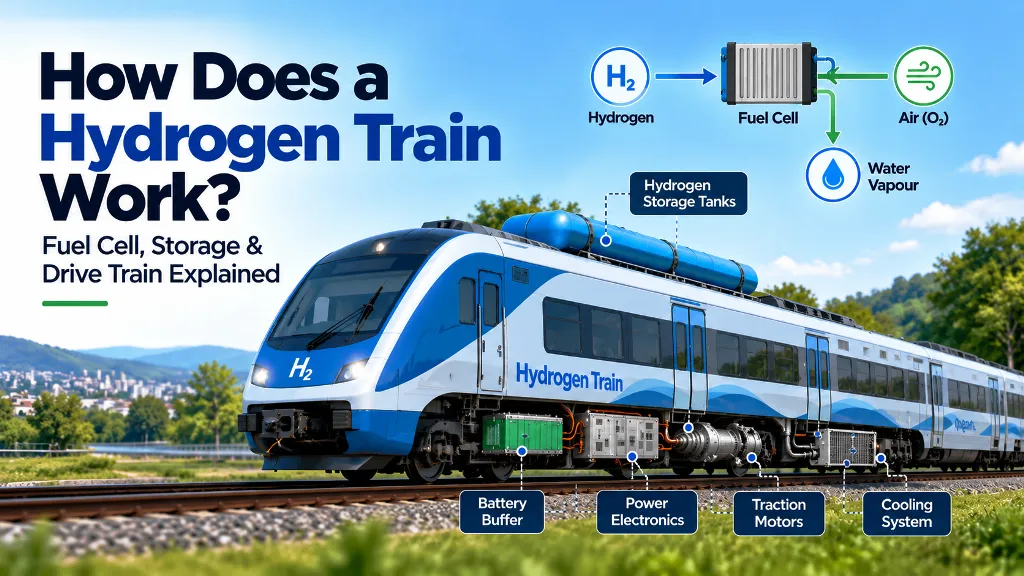
How Does a Hydrogen Train Work? Fuel Cell & Drivetrain
How does a hydrogen train work?
Put simply, it burns
nothing. Hydrogen stored in roof tanks flows into a fuel cell, where it reacts
with oxygen pulled in from outside air and produces electricity. A battery
holds braking energy and helps on take-off. The motors do the rest, and what comes
out of the vent is water vapour.
Introduction
Jind isn't a town most people link with new
technology. Yet on 17 July 2026, India's first hydrogen passenger train pulled
out of its station, bound for Sonipat. No diesel engine. No overhead wire.
Within eight days it had run over 1,200 km and saved more than 3,200 litres of
diesel, according
to Indian Railways.
We get asked about it a lot, mostly by
students and faculty. How does a hydrogen train work, really? The fuel cell
part is easy to explain. What surprises most people is how much of the train is
about everything else: tanks, batteries, converters, cooling. So that's where
we'll start.
Key Components of a Hydrogen Fuel Cell Train
Six systems, give or take. On most designs the tanks go on the roof, the traction gear goes under the floor, and cooling pipes run between the two.
| Component | Function |
| Hydrogen storage tanks | Carbon fibre cylinders, usually up on the roof, holding gas at 350 bar or more. A regulator drops that pressure before it reaches the stack. |
| Fuel cell stack | Where the power actually comes from. Hundreds of cells in series turn hydrogen and air into DC, warm water and some heat. |
| Battery buffer | A lithium ion pack that grabs braking energy and hands it back when the train pulls away. |
| Power electronics (inverter and DC to DC converter) | The go-between. The converter steadies the stack's voltage; the inverter turns DC into three-phase AC for the motors. |
| Traction motors | The same kind you'd find on any electric train. They double as generators when braking. |
| Cooling and thermal management system | Radiators, pumps and fans. A PEM stack likes to sit around 60 to 80°C, and the battery wants it cooler than that. |
Look down that list again and you'll notice
what isn't there. No engine block, no exhaust stack, no pantograph. On a line
nobody ever wired, that absence is the whole point.
How the Hydrogen Fuel Cell Works
The type you'll find on nearly every
passenger train is PEM, short for proton exchange membrane. It's a film of
polymer, thinner than paper, pressed between two platinum-coated electrodes.
Hydrogen goes in on one side. Air goes in on the other.
On the hydrogen side, the anode, platinum
pulls each molecule apart into protons and electrons. The membrane is picky.
Protons get through, electrons don't, and they're forced the long way round
through an external circuit. That detour is your electric current.
The two meet again at the cathode, along
with oxygen from the air, and form water. A fair bit of heat comes off too.
One cell on its own gives you 0.6 to 0.8 V
under load. Hardly anything. You need hundreds of them in series before a
traction inverter is interested. And there's a catch students spot quickly on a
test bench: draw more current and the voltage drops, sometimes steeply. So
stacks get sized for the worst moment on the route, usually a full train on an
uphill grade.
Onboard Hydrogen Storage
Hydrogen is light, which sounds helpful
until you try to carry enough of it. Per litre, there's very little energy in
the gas. The fix is pressure, typically 350 bar and sometimes 700. India's Jind
train carries 27
hydrogen cylinders and manages about 250 km between fills. CRRC's CINOVA H2
crams in up to
316 kg at 70 MPa.
Is that safe? It's the first thing people
ask, and the engineering answer comes in layers. Sensors near the tanks, pipes
and stack watch for hydrogen and close the supply valves if they catch any. If
a cylinder overheats, relief devices vent the gas upward. The cylinders
themselves are usually Type 4 (a plastic liner with carbon fibre wound over
it), tested against drops, impacts and fire.
India's trainset adds its
own detection for leaks, heat, flames and smoke. Hydrogen's lightness helps
here, oddly enough. A leak shoots upward and thins out fast, so roof-mounted
tanks make a lot of sense.
Battery Buffer and Power Electronics
Look closely and every hydrogen train in
service is really a hybrid. There's a lithium ion pack sitting next to the
stack. Why bother, if the fuel cell already makes power?
- Braking. As the train slows, its motors start generating, and that current has to go somewhere. Into the battery, ideally.
- Starting from a standstill.
Leaving a station takes a big burst of power for a short time, and the battery
supplies most of it.
- Keeping the stack happy. Fuel cells wear out faster when the load keeps jumping around, so the battery takes the jumps instead.
Builders don't agree on chemistry. Jind's
train uses lithium
iron phosphate. CRRC went with a 366
kWh lithium titanate pack alongside four 240 kW fuel cells on the CINOVA
H2.
Tying it all together is the power
electronics. A DC to DC converter boosts the stack's wandering output up to a
fixed DC link. An inverter then makes three-phase AC for the motors, at
whatever frequency the speed calls for. Power has to flow both ways, into the
battery on braking and out of it on a climb. Getting that control loop stable
is, in our experience with lab setups, where students lose the most hours.
Drive Train and Traction Motors
Crawl under one and you'd struggle to tell
it apart from a normal electric multiple unit. That's really what it is. An
electric train that brings its own power station along.
The motors drive the axles through a
single-stage gearbox, and two kinds are in common use. Induction (asynchronous)
motors are tough, affordable and have been on electric trains for decades.
Permanent magnet synchronous motors weigh less and run more efficiently at part
load. They also cost more and need rare earth magnets, which is why plenty of
operators haven't switched.
The motor doesn't know, or care, whether
its current came from a fuel cell, a battery or a wire overhead. Handy if
you're a student. Learn traction drives once and the knowledge travels with
you.
Step by Step: How a Hydrogen Train Moves
Put together, here's how a hydrogen train
works in practice, tank to wheel.
- Hydrogen leaves the storage tank, passing through a regulator that knocks the pressure down.
- It enters the fuel cell stack on the anode side. A compressor pushes filtered air into the cathode side.
- The fuel cell reaction produces
electricity, as DC.
- The power electronics send the
electricity to the motor and battery, rebalancing many times a second.
- Motors on the powered bogies
take that current and turn the wheels through a gearbox.
- On acceleration the battery
tops up the power, and on braking it takes energy back.
- The only exhaust is water vapour. On a cold morning you can actually see it.
Hydrogen Train vs Diesel Train vs Electric Train
How does it stack up against diesel and conventional electric? Roughly like this.
| Parameter | Hydrogen Train | Diesel Train | Electric Train |
| Fuel Source | Compressed Hydrogen Gas | Diesel | Grid power via overhead line |
| Emissions | Water vapour | CO2, NOx and particulates from the exhaust | None at the train; upstream emissions |
| Refuelling or charging time | About 15 minutes for a regional unit | Minutes, similar to hydrogen | None needed; draws power continuously |
| Overhead line needed | No | No | Yes |
| Noise level | Quiet; you mostly hear the air compressor and cooling fans | Loud, with engine rumble you feel through the floor | Quiet |
| Best route type | Unwired regional or branch lines where traffic can't pay for electrification | Freight and remote routes, until something replaces it | Busy main lines and suburban corridors |
We'd be doing you a disservice if we
skipped the downside. Hydrogen loses energy at every hop: electrolysis,
compression, then the fuel cell itself. Put an electric train under wires and
it will use far less electricity for the same trip. Hydrogen earns its place
where there are no wires.
Real World Hydrogen Train Examples
Germany got there first. Alstom's Coradia
iLint started carrying passengers in Lower Saxony in September 2018, with a
top speed of 140 km/h and about 1,000 km on a tank.
China came at it from the city side. CRRC
Changchun's urban
hydrogen train touched 160 km/h in 2024 testing, and CRRC claims more than
1,000 km of range.
And then Haryana. Indian Railways' Jind
to Sonipat train, ten coaches and built in India, has run daily since July
2026. It's capped at 75 km/h in service but has done 120 km/h in tests.
Why Hydrogen Trains Matter for India
Most articles skip an awkward fact. By
November 2025, Indian Railways had wired up 99.2%
of its broad gauge network. Only 574 route km were left. Diesel on the main
lines is on its way out regardless.
So where does hydrogen fit? Think of the
hill railways, metre and narrow gauge sections, heritage lines and quiet branch
routes where nobody can justify catenary. That's the thinking behind Hydrogen
for Heritage, which plans 35
hydrogen trains.
Then there's the 2030 deadline. Indian
Railways has promised to be a net
zero carbon emitter by 2030, and diesel units count against it. Where the
hydrogen comes from matters a great deal here. Jind makes its own by
electrolysis. Gas-derived grey hydrogen would just push the carbon further up
the chain.
For a student trying to understand how a
hydrogen train works, Jind is a gift: electrolysis, fuel cells, converters and
storage, all in one system.
Conclusion
So, how does a hydrogen train work?
Hydrogen in, electricity out. A battery covers the peaks, motors turn the
axles, and the vent puffs out water vapour.
Honestly, most of this clicks faster on a
bench than on a page. Electrolysis is easy to see in a green hydrogen lab.
Stack behaviour under load shows up quickly in a fuel cell lab,
especially when students plot their first polarisation curve. And the battery
and converter juggling? A microgrid lab
covers that well.