
Fuel Cell or Electrolyzer: Why Modern Labs Need Both
Nobody builds a solar lab and only installs the inverter.
That analogy is imperfect but the point holds. A lab that purchases a fuel cell stack and stops there has bought one end of a hydrogen energy system and called it a lab. The fuel cell or electrolyzer question that surfaces in procurement meetings is the wrong question. Both devices exist because they do opposite things. One produces hydrogen. One consumes it. Teaching the system means having both.
What Is an Electrolyzer?
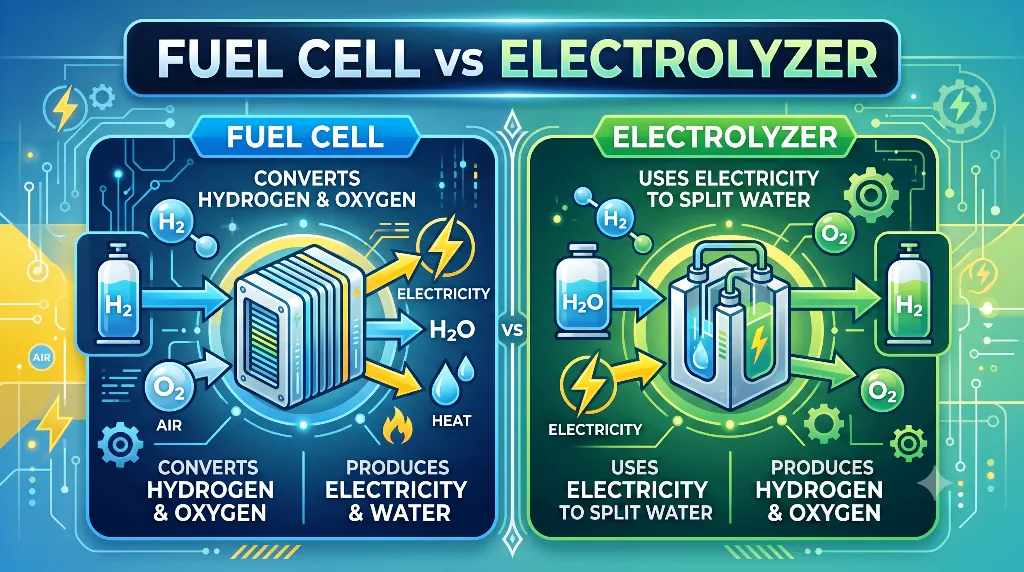
An electrolyzer is a device that uses electrical energy to split water into hydrogen and oxygen through a process called electrolysis. Apply a voltage across two electrodes separated by an electrolyte, and water molecules break apart: hydrogen collects at the cathode, oxygen at the anode. The hydrogen can then be stored and used as a fuel.
PEM electrolyzers are what most teaching labs buy now. A solid polymer membrane (Nafion, typically) separates the two gas streams and conducts protons. The hydrogen that comes out is high purity. The system responds quickly to variable power input, which is why PEM pairs well with solar panels in integrated lab setups. Feed water needs to be deionised. The platinum and iridium catalysts are where the cost sits.
Alkaline electrolyzers use liquid potassium hydroxide as the electrolyte. They've been running industrial hydrogen production for decades and they're cheaper per unit of hydrogen at scale. The trade-off is slower dynamic response and a liquid electrolyte that needs periodic concentration checks. A lab that wants to put established industrial technology next to current-generation PEM and let students compare them directly gets something from having one of each.
SOEC operates at 700 to 900°C and uses heat alongside electricity to improve efficiency. Genuinely useful for graduate research on high-temperature electrolysis. Not a teaching lab instrument.
What Is a Fuel Cell?
A fuel cell is a device that converts hydrogen and oxygen into electricity through an electrochemical reaction. Feed hydrogen to the anode and oxygen (or air) to the cathode, and the reaction releases electrons through an external circuit. The outputs are electricity, water, and heat. No combustion takes place at any point in that process.
In functional terms it is Electrolysis backwards. Feed hydrogen to the anode, oxygen or air to the cathode, and the reaction releases electrons through an external circuit. Electricity out. Water out. Some heat. No combustion.
The efficiency figure (40 to 60% for electrical output) is what gets cited in comparisons with internal combustion engines. A petrol engine at 25% thermal efficiency looks bad next to that number. The comparison is legitimate, though fuel cells and ICEs serve different purposes and the fuel supply chain is what determines which technology makes sense for a given application.
PEM fuel cells are the standard teaching instrument. They run at 60 to 80°C, start in minutes, and the operating conditions are manageable in a shared lab space. Hydrogen purity matters: the platinum catalyst starts poisoning above 10 ppm CO, so 99.99% minimum is not a conservative specification, it's a functional requirement. Most PEM stacks sold for educational use have extensive published experiment guides, which matters when faculty are running the equipment for the first time.
Alkaline fuel cells need pure oxygen at the cathode. Atmospheric CO₂ reacts with the KOH electrolyte over time. NASA ran Apollo and the Space Shuttle on alkaline cells under tightly controlled conditions, but those conditions don't exist in a general-purpose teaching lab. Most institutions add an alkaline cell to demonstrate the contrast with PEM, not as the primary stack.
SOFC is research-grade. 700 to 1000°C operating temperature, fuel-flexible, highly efficient, and completely unsuitable for undergraduate practical sessions. It belongs in the curriculum as a topic, not on the lab bench as a teaching instrument.
Fuel Cell vs Electrolyzer: Comparison
| Parameter | Electrolyzer | Fuel Cell |
| Function | Produces hydrogen from electricity and water | Produces electricity from hydrogen and oxygen |
| Energy Direction | Electrical energy in, chemical energy stored | Chemical energy in, electrical energy out |
| Inputs | Water and electricity | Hydrogen and oxygen or air |
| Outputs | Hydrogen and oxygen | Electricity, water, and heat |
| Common Types | PEM, Alkaline, SOEC | PEM, Alkaline, SOFC |
| Operating Temp (PEM) | 50 to 80°C | 60 to 80°C |
| Role in Energy System | Production and storage | Utilisation and conversion |
| Lab Teaching Role | Hydrogen generation, electrolysis experiments | Power generation, polarisation curves, efficiency mapping |
How They Work Together: The Power-to-Power Loop
The hydrogen sits in a pressure vessel overnight. Wednesday evening demand spikes and the sun has set. Draw from the vessel, feed the fuel cell, put power onto the load. Chemical energy as a buffer between generation and demand. That's the power-to-power loop at its simplest, and it's the architecture behind every serious grid-scale hydrogen storage proposal.
At bench scale the sequence is the same. Power supply drives the electrolyzer. Hydrogen collects in a small cylinder. Fuel cell draws from storage and feeds a programmable load bank. A DAQ system logs voltage, current, temperature, and flow throughout. One lab session covers a concept that would otherwise take three lectures and still not land properly.
Take the electrolyzer out of that experiment and what's left is a fuel cell fed from a bottled hydrogen cylinder. Useful for learning about electrochemical conversion. Not the same thing. Not close to the same thing.
Why a Green Hydrogen Lab Needs Both
Ecosense's green hydrogen lab systems and fuel cell lab setups are designed around this paired configuration. The intention is explicitly to give students the complete system rather than one endpoint.
A fuel-cell-only lab cannot teach: where hydrogen comes from, how production efficiency relates to utilisation efficiency, what system round-trip losses look like when both ends of the chain are accounted for, or why renewable intermittency is what makes the hydrogen storage case in the first place.
Key Hydrogen Lab Components
| Component | Function |
| PEM electrolyzer | On-site hydrogen generation from deionised water |
| Hydrogen storage vessel or metal hydride tank | Buffer storage between generation and use |
| PEM fuel cell stack | Power generation from stored hydrogen |
| Pressure regulators and safety relief valves | Flow control and overpressure protection |
| Deionised water supply system | Feed water quality for PEM electrolyzer |
| Hydrogen gas detector (catalytic or electrochemical) | Continuous leak monitoring |
| Data acquisition system | Voltage, current, temperature, flow logging |
| Programmable load bank | Controlled discharge for fuel cell experiments |
| Mass flow controller | Hydrogen flow measurement for Faraday efficiency |
| Purity analyser (optional) | Hydrogen quality verification for research setups |
The first six hydrogen lab components on that list are the ones that matter for getting a teaching lab operational. Everything below that line adds research capability incrementally. A lab that commissions the core six properly and runs experiments reliably for two years is worth more than a lab with ten instruments that three faculty members don't know how to use