
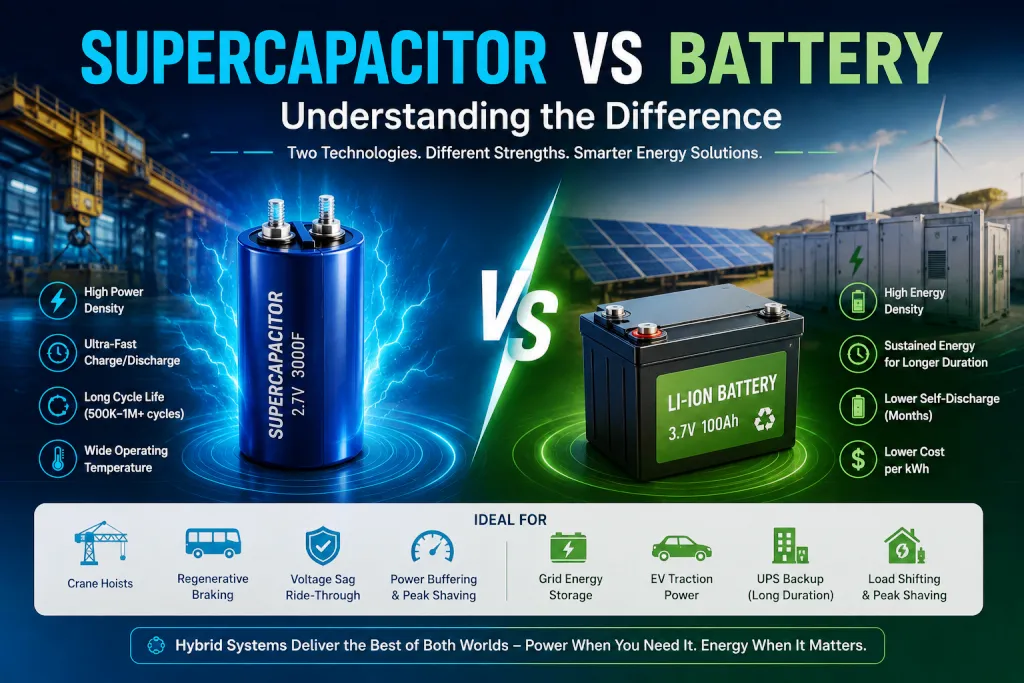
Supercapacitor vs Battery: Understanding the Difference
Try starting an EV bus in sub-zero weather and you'll see the difference between these two technologies in about two seconds flat. A supercapacitor delivers that first hard jolt of power instantly, even in the cold. A battery just isn't built for that kind of instant punch; it's built to keep the bus running for miles afterward. That's the whole supercapacitor vs battery question in one everyday example.
Here's why it works out that way. A supercapacitor stores energy electrostatically, using two electrodes separated by an electrolyte and a thin separator. No chemistry involved, just charge sitting there ready to move. A battery stores energy through actual chemical reactions inside its cells, and that takes time to happen both ways, charging and discharging. Everything in this comparison, energy density, cycle life, cost, comes back to that one difference.
On a factory floor or a fleet depot, this isn't just trivia. Get the technology wrong for a crane hoist, a UPS bridge, or an EV charging bay. You're looking at short backup windows, early failures, or a bill nobody signed off on. We've seen all three happen.
So, this guide sticks to what actually helps. Working principle, a side-by-side table, real performance gaps, and where each technology genuinely earns its place on an industrial floor, not in a textbook. It wraps up with hybrid setups too, since most working systems these days run both rather than picking a side.
Supercapacitor vs Battery: Side-by-Side
Eight metrics, and honestly, that covers most of what you need before going deeper into either technology.
| Parameter | Supercapacitor | Battery (Li-ion) |
| Energy Density | 5-10 Wh/kg | 150-250 Wh/kg |
| Power Density | 10000+ W/kg | 250-350 W/kg |
| Charge/discharge time | seconds | minutes to hours |
| Cycle Life | 500,000 - 1,000,000+ cycles | 500-2000 cycles |
| Efficiency | 95-98% | 85-95% |
| Operating temperature range | -40 deg. C to 65 deg. C | 0 deg. C to 45 deg. C typical |
| Self-discharge rate | High (days) | Low (months) |
| Typical cost per kWh | High | Moderate |
Use this table as a gut-check before you get into the finer parameters. It won't settle every supercapacitor vs battery argument on its own, but it rules out the obviously wrong choice fast.
Key Performance Differences
A battery packs far more energy into the same weight, so it handles sustained loads well. A supercapacitor does the opposite. It releases stored energy almost instantly, which suits short, intense bursts far better than any battery chemistry on the market today.
No real debate here: cycle life is where supercapacitors win outright. A well-designed unit handles a million charge cycles without much loss in capacity. Compare that to a typical lithium-ion battery, which starts losing capacity after a few thousand cycles (sooner, if you're running it through deep discharges regularly).
Efficiency follows the same pattern, mostly.
Electrostatic storage means lower losses during charge and discharge. Batteries lose more energy as heat, especially during fast charging. Newer chemistries are closing that gap a bit faster than people expected a few years back. Cold environments flip the script though. Supercapacitors keep working reliably where battery performance drops off sharply, and that's often the deciding factor for outdoor or unheated sites. Nobody wants a backup system that fails on a January morning.
When to Use Each in Industrial Energy Storage
Crane hoist lifts. Regenerative braking recovery. Voltage sag ride-through. These are the applications where industrial energy storage needs are short, sharp, and repetitive, and where supercapacitors do their best work.
Batteries take over when the load needs sustained delivery over minutes or hours. Grid load shifting, EV traction power, extended backup during a real outage: energy density matters more than burst power here.
So the supercapacitor vs battery question usually reduces to one thing. Does the load need a lot of power briefly, or a moderate amount for a long time? Get that answer early. It's a lot cheaper than redesigning the system after installation.
Cost tips the scale too. Supercapacitors carry a higher price per unit of stored energy. Oversizing one for long-duration storage almost never makes financial sense. We've seen this play out firsthand on the odd RFQ that specs a supercapacitor bank. A battery would've done the same job for a third of the cost. Batteries stay the default for bulk storage.
Hybrid Systems: Supercapacitor and Battery
Why choose at all? Most industrial systems now don't. The supercapacitor absorbs sudden power spikes, the battery handles the steady long-duration load, and each gets to do only the job it's actually good at.
That pairing extends battery life more than people expect. Shielding the battery from high peak currents cuts thermal stress and cycling fatigue on the cells. Fewer replacements. Lower maintenance cost over the life of the system.
Electric vehicles lean on this hybrid setup constantly: supercapacitor for acceleration bursts and braking recovery, battery pack for range. Grid support systems borrow the same idea to smooth out renewable generation swings. The sizing ratio there tends to skew more toward the battery side.
Getting a hybrid design right means understanding both technologies at the component level, not just the datasheet numbers. This is usually where hands-on validation, through a setup like Ecosense's Microgrid Lab, earns its keep.
Industrial Applications
Crane and hoist systems in manufacturing plants are a textbook case here. Lifting events need a rapid burst of power, then sit idle. A supercapacitor covers that burst without pulling a large current spike from the main grid connection every single time.
UPS systems are picking up the same trick. They bridge the first few seconds of an outage, before a generator kicks in or a battery bank takes over. It's just enough to keep sensitive equipment from seeing a voltage dip.
Fast EV chargers use them too, to absorb the initial inrush current.
Less stress on the grid connection. Slightly better efficiency out of the charger overall. And then there's wind turbines. Pitch control systems and short-term power smoothing run on supercapacitors, while the batteries in the same installation handle the longer storage duties. Nobody markets it as a hybrid setup. It works exactly like one anyway.
Conclusion
There's no universal winner here. Never was. The supercapacitor vs battery debate keeps resurfacing because people expect one answer. The honest one is "it depends on the load profile."
Supercapacitors win on fast, repetitive power delivery and a service life most batteries can't touch. Batteries win on sustained energy storage and cost per kWh. Match the technology to the actual load, not to whichever one you're more familiar with.