
What Is a Green Laboratory? Features, Equipment and How Colleges Can Build One
India now has more than 300 GW of non-fossil power capacity. It crossed that mark on 31 July 2026, and over 54% of installed capacity is now clean. Good news, with a catch. Someone has to commission the inverters and service the electrolyzers. Someone also has to work out why a battery pack heats up at 2 pm. Textbooks don't cover that well. A green laboratory does.
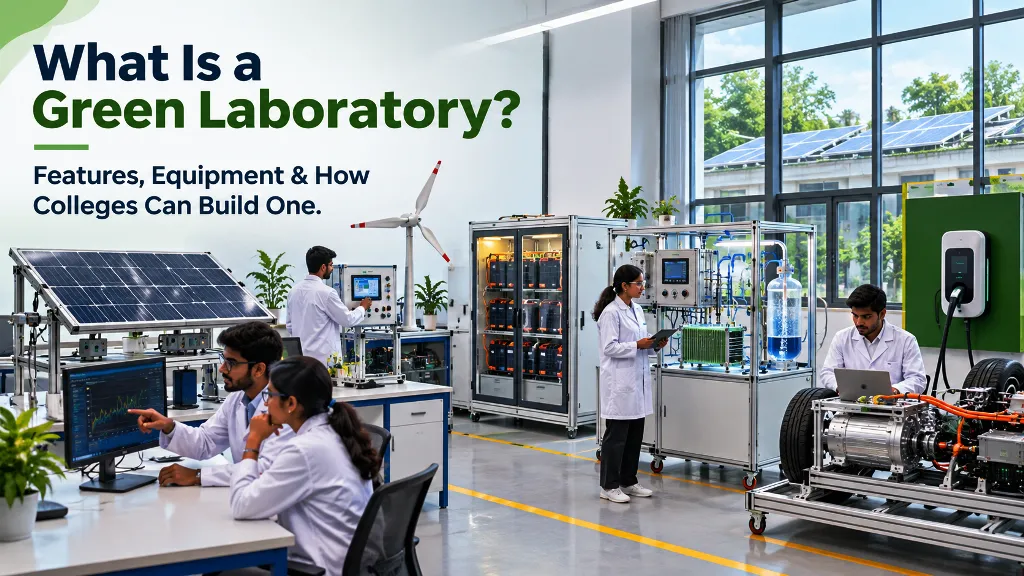
So what is a green laboratory, exactly? Usually it's a room in an engineering college where students run real clean energy hardware. Panels on the roof, a wind emulator in one corner, maybe a fuel cell and an EV battery rig on the next bench. It has nothing to do with recycling or cutting chemical waste (that's a different kind of green lab). Students switch things on, change settings, measure what happens and rebuild.
Most of the time it belongs to the electrical, mechanical or energy department. Students work in small groups, log their readings and then argue about why the numbers don't match the theory. That argument is the useful bit. It's what stays with them after the exam. Some colleges stretch the idea into a sustainability living lab and let real campus loads feed the experiments.
Why Colleges Are Building a Green Laboratory Now?
The target is 500 GW of non-fossil capacity by 2030. Solar carries the biggest share at about 165 GW, with wind at roughly 58 GW, according to Mercom India. Each gigawatt needs engineers to design it, and others to commission and maintain it. Hiring managers know this. They keep asking for graduates who've run real systems, and a simulation doesn't count.
Policy backs this up. The Ministry of Education says NEP 2020 promotes experiential learning in the curriculum. That's a nice phrase. A working lab turns it into timetabled practicals that students actually attend. Faculty benefit as well, since the same setup gives them something real to base projects and student papers on.
Then there's research. A paper needs data, and data needs an instrumented system. One decent lab can serve a B.Tech practical on Monday, an M.Tech dissertation on Wednesday and a PhD scholar's runs over the weekend. When budgets get reviewed, that spread of users makes the spend much easier to defend.
What Makes a Green Laboratory Different From a Normal Lab?
Walk into a traditional electrical lab and you'll find small bench kits and a lot of resistors. Fine for circuits. A green laboratory works at proper scale instead. Students see generation, storage and load push against each other live. A cloud passes, the output sags, the battery steps in. A load spikes and something trips. You can say all this on a slide, but it lands differently when the meter moves.
Core Systems in a Green Laboratory
Six systems cover most of the ground. Between them they run the whole chain from generation to storage, conversion and control. The table lists what each one teaches.
| System | What Students Learn | Sample Experiments |
| Solar PV | How panels behave, MPPT, grid-tie operation | Plot I-V curves as irradiance changes |
| Wind Energy | Turbine behaviour under different wind speed, Tip Speed Ratio and CoP calculations | Measure power output at different wind speeds |
| Battery Storage and BMS | Charging limits, SoC estimations, cell balancing | Cycle a battery pack and watch the BMS functions, develop different estimation techniques |
| Green Hydrogen | Electrolyzer and Fuel Cell Operation | Work out round trip efficiency |
| Microgrid and Energy Management | Load sharing, islanding, control logic | Flip a microgrid between grid and island mode |
| EV drive train and Charging | Motor Contro, regeneration, charger design | Run a drive train under changing load |
Nobody needs all six on day one. A lot of colleges start with solar and storage, then add hydrogen or EV modules when the next budget comes through. Modular systems make that possible. Buying everything in one go looks impressive on paper. In practice, half the lab can end up gathering dust because nobody has been trained to run it.
Green Lab Equipments to Plan For
Training systems get all the attention. The supporting green lab equipments quietly decide how much students learn. Here's what to budget for:
- Programmable loads. They repeat the same demand pattern, which makes results comparable.
- Data loggers with proper software. No logger, no data.
- Solar and wind emulators, so the experiment runs even when it's cloudy or the monsoon is on.
- Safety gear: hydrogen sensors, fire protection, isolation switches.
- A big display. Thirty students can't crowd around one meter.
Look for open data export and standard communication ports too. Software that lets students log, plot and compare runs matters more than most buyers realise. Without it, the lab is a demo room. Visitors admire it. Nobody publishes from it.
How a Green Laboratory Builds Employable Skills
Interviewers in the energy sector love specifics. A student who commissioned a solar array can talk about what went wrong on the first try. One who logged a battery test has real numbers to quote. They've also written procedures, recorded data and worked safely with teammates. Solar developers, EV makers, utilities and research labs all notice those habits.
Space, Power and Budget Planning
Space first. A solar and storage setup fits in an ordinary classroom. Hydrogen and EV modules don't, because they need ventilation and clearance around them. Before you order anything, check the floor load, the incoming supply and the earthing. Boring checks, expensive if skipped. Then the money: budget for installation, commissioning and training, not just hardware. A small reserve for consumables and yearly maintenance also helps.
Safety in the Lab
Batteries need over-current and temperature protection. Hydrogen needs leak sensors, ventilation and a shutdown procedure everyone knows by heart. Electrical systems need isolation and emergency stops. Write the procedures down, train every user and stick them on the wall. One more thing gets forgotten: what happens to old batteries and electronics? A real laboratory sustainability plan answers that. Otherwise the lab ends up making the waste it's supposed to help reduce.
How to Build a Green Laboratory, Step by Step
- Start with learning outcomes. Which courses and research areas must the lab support?
- Pick two or three core systems that match those outcomes and your budget.
- Check space, power, ventilation and floor load. Do this before placing any order.
- Find a supplier who handles installation, trains your faculty and supplies a manual for every experiment.
- Tie each experiment to the syllabus, so students use the lab from semester one.
- Leave room to grow. Modular systems let you add hydrogen, EV or microgrid units later.
Common Mistakes to Avoid
Four mistakes are easy to make. The first is buying panels and inverters but no data acquisition, so students see a working system and can't measure anything. The second is skipping faculty training, which leaves equipment idle once the inauguration is over. Third, no safety plan for hydrogen and batteries. Fourth, a lab that never makes it onto the timetable and becomes a showpiece. Sort these out early and the lab earns its keep for years.
Conclusion
India's clean energy build-out needs graduates who've handled real systems. A green laboratory is one practical route there. Begin with clear outcomes, choose modular systems and plan data collection from day one. Want to see what a complete setup looks like? Explore Ecosense's green energy lab range, built for universities and technical institutes.