
Green Hydrogen Microgrid: How It Works and Why Labs Teach It
The Government of India aims for at least 5 million tonnes of green hydrogen a year by 2030. About 125 GW of new renewable capacity is expected to support it. Somebody has to make that hydrogen, store it and put it to use. A green hydrogen microgrid fits that whole chain into one room, which is why it's becoming a core teaching system.
Strip away the jargon and a green hydrogen microgrid is a self-contained power system. It takes spare solar or wind energy, turns it into hydrogen, and later turns it back into electricity. Think of a savings account. Batteries cover the daily spending while hydrogen holds the long-term reserve. No diesel needed, and the system can run with or without the main grid.
How a Green Hydrogen Microgrid Works
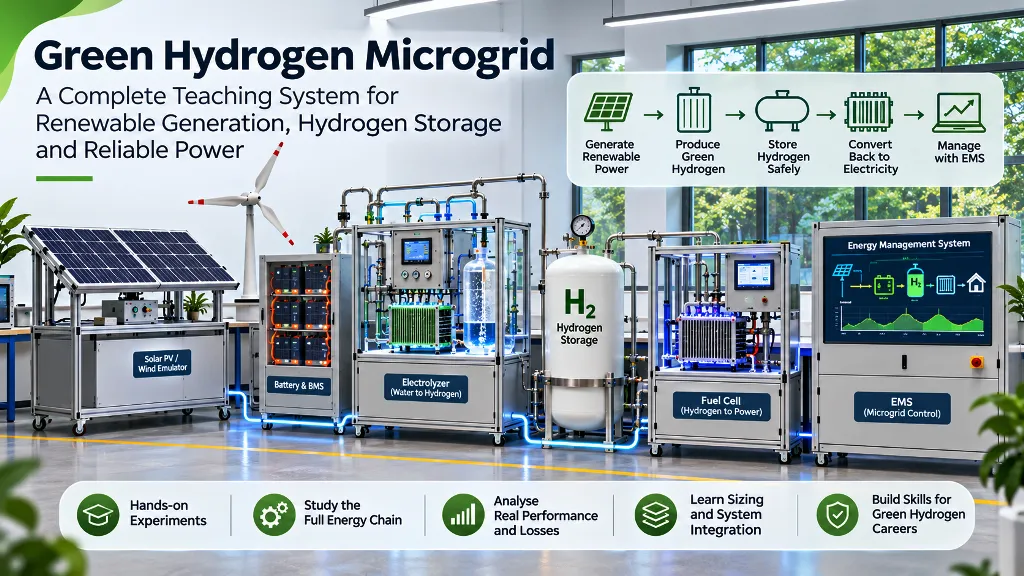
The flow makes sense once you see the order. Researchers at the University of Southern Queensland describe it this way. If more electricity is generated than the battery can store, an electrolyzer splits water into oxygen and hydrogen. The hydrogen is stored. Later, a fuel cell uses it to generate electricity.
- Solar panels or a wind source generate the electricity.
- That power serves the load first and tops up the battery.
- Surplus runs the electrolyzer, which splits water into hydrogen and oxygen.
- The hydrogen goes into a tank at the required pressure.
- When generation drops, the fuel cell turns stored hydrogen back into electricity.
- An energy management system decides, moment to moment, which source feeds the load.
Main Components of a Hydrogen Microgrid
| Component | Role in the System |
| Solar PV or wind source | Where the clean power starts |
| Battery and BMS | Quick response, daily balancing |
| Electrolyzer | Turns surplus power into hydrogen |
| Hydrogen storage | Holds energy for days or weeks |
| Fuel Cell | Turns hydrogen back into electricity |
| Energy management system | Directs power flow, protects equipment |
Each part of a green hydrogen microgrid can be studied alone. The real learning starts when they run together. Change the load suddenly and you can watch the battery, fuel cell and controller share the work, each at its own pace. That interaction is hard to see in a lab built around a single technology.
Why Add Hydrogen to a Battery Microgrid?
Batteries respond in milliseconds but get expensive for long storage. Hydrogen energy storage is slower, but it suits longer gaps. The same Queensland team notes that hydrogen is not a replacement for batteries. It's another option when longer storage is needed or several days of backup are essential. Think of them as partners, not rivals.
Where Hydrogen Microgrids Are Being Tested
Resilience is the easiest example to picture. A planned hydrogen microgrid on Vieques island in Puerto Rico will use a solar-powered electrolyzer. IEEE Spectrum reports that the hydrogen side can supply power when the solar array can't, after storms for instance. For an island, that matters a lot.
Borrego Springs in California has a different problem. Its microgrid carries about 37 MW of installed solar and struggles with overgeneration and curtailment. Batteries of 1.5 MW and 4.5 MWh were added. Still, a US research project says a longer-duration, low-emission storage option is needed. The team is testing a hydrogen energy storage system to fill that gap.
The Efficiency Trade-Off
Hydrogen storage has a price. A California Energy Commission study tested a power-to-power system with an alkaline electrolyzer, high-pressure storage and a PEM fuel cell. Round-trip efficiency came out relatively low. The study also flagged thermal management constraints. Those two findings matter more than any brochure number.
That's useful for students. Measure the losses at each stage and you learn where this technology makes sense and where a battery alone wins. Nobody leaves that lab believing hydrogen is free energy. Honest numbers build better engineers than polished brochures do.
Sizing a Hydrogen Microgrid in Simple Terms
Sizing a hydrogen microgrid starts with the load. Estimate the daily energy use, then find the longest gap in generation you must cover. The battery handles the short gaps and the hydrogen tank covers the rest. Electrolyzer rating decides how fast surplus power becomes hydrogen. Fuel cell rating sets the peak power you can deliver. Students can try different sizes in simulation before touching hardware.
A Sample Student Experiment
One afternoon is enough to show the whole idea. First, set the solar emulator to a bright, steady output and let the battery fill. Next, raise the input so surplus power flows to the electrolyzer, and record the hydrogen produced. Then cut the input to mimic evening. The fuel cell takes over the load. Plot power against time and every handover becomes visible, so the class can argue about each loss.
Challenges to Plan For
A green hydrogen microgrid asks for more care than a battery system does. Electrolyzers need clean, treated water. Storage needs a safe, ventilated space. Costs run higher, and the controller needs careful tuning so the electrolyzer and fuel cell don't cycle too often. Annoying? A bit. But these challenges are teaching points too. Students learn to weigh safety, cost and performance, which is exactly what real projects demand.
Why Universities Teach the Green Hydrogen Microgrid
A green hydrogen microgrid combines four subjects in one system: power electronics, electrochemistry, storage and control. That opens up experiments no single-technology lab offers:
- Measure electrolyzer efficiency at different input powers.
- Plot a fuel cell polarization curve.
- See how the energy management system reacts to sudden cloud cover.
- Size hydrogen storage for a given load profile.
Jobs matter too. The Press Information Bureau notes that the National Green Hydrogen Mission is expected to generate over 6 lakh jobs by 2030. Graduates with hands-on experience will be better placed for those roles. A student who has actually run an electrolyzer has a story to tell in the interview.
Setting Up a Teaching Hydrogen Microgrid
A lab-scale electrolyzer and fuel cell microgrid is far smaller than a field installation. It usually pairs a solar emulator or PV array with a battery, a small electrolyzer, a storage cylinder and a fuel cell. Decide the experiments first, then size the components to match. The space needs ventilation, hydrogen sensors and a documented shutdown procedure. Train every user before the first run.
Conclusion
A green hydrogen microgrid shows students how renewable energy can be stored for long periods and used again. It also teaches the limits of hydrogen, not just the benefits. To see how Ecosense builds this for institutions, explore the green hydrogen microgrid system and the wider green hydrogen lab range. You can also browse the full set of renewable energy labs.