
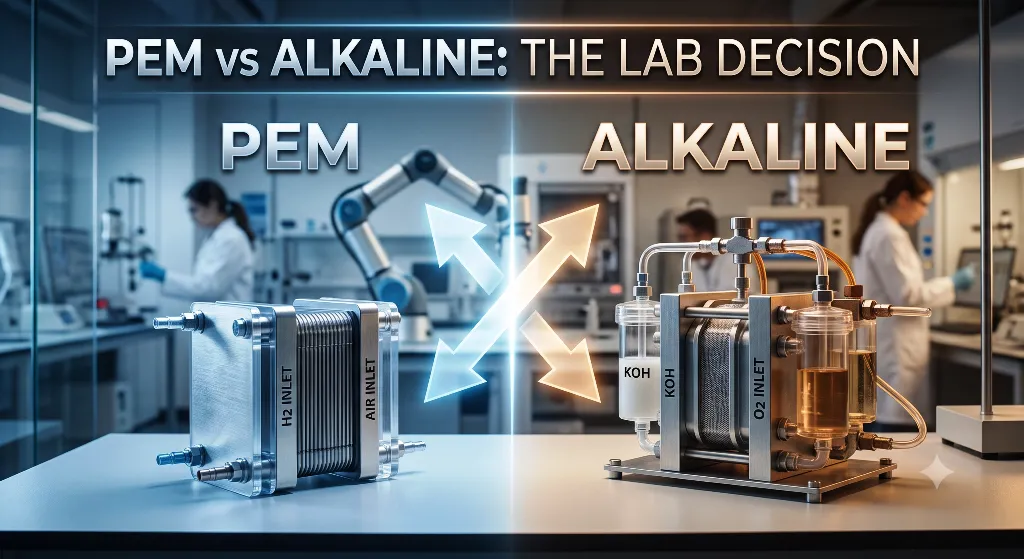
PEM Fuel Cell vs Alkaline Fuel Cell: Which Is Better for College Labs?
NASA's Apollo missions ran on alkaline fuel cells. The ISS still does. If alkaline technology was good enough for space, why does almost every new teaching lab in India purchase PEM instead?
The answer isn't that PEM is better. It's that college labs aren't spacecraft — and the infrastructure requirements, student safety protocols, and curriculum goals of a university electrochemistry lab point in a specific direction once you work through them honestly.
What Is a Fuel Cell?
A fuel cell turns chemical energy into electricity through an electrochemical reaction. No combustion, no moving parts, no noise. Hydrogen goes in at the anode, oxygen at the cathode, and the output is electricity, water, and heat.
Efficiency is the number that surprises most students when they first encounter the technology. A well-run fuel cell converts 40 to 60% of fuel energy into usable electricity. A petrol engine manages 20 to 25% on a good day. That gap — not just the zero-emission output — is why fuel cells belong in any serious clean energy curriculum.
The pem or alkaline fuel cell distinction comes down to what sits between those two electrodes. One uses a solid polymer membrane. The other uses liquid potassium hydroxide. That single difference cascades into different operating temperatures, different purity requirements, different maintenance routines, and ultimately different lab experiences for students who have a two-hour practical session and a demonstrator who has six other groups to manage simultaneously.
PEM Fuel Cell — How It Works, Pros & Cons
PEM stands for Proton Exchange Membrane. The electrolyte is solid — a polymer membrane, usually Nafion — and it conducts protons while blocking electrons. Hydrogen fed to the anode gets split by a platinum catalyst into protons and electrons. Protons cross the membrane. Electrons take the external circuit path, doing electrical work on the way. At the cathode, both recombine with oxygen to form water.
Operating range: 60 to 80°C. Cold start to operational in minutes.
The membrane needs to stay hydrated. Too dry and proton conductivity drops. Too wet and flooding degrades performance. Most educational PEM stacks handle this automatically, which matters more in a lab context than it sounds — a demonstrator explaining polarisation curves to 20 students doesn't have bandwidth to also be monitoring membrane hydration manually.
Pros:
- Solid electrolyte — no liquid handling, no spill risk, simpler student safety protocol
- Fast startup suits timed lab sessions
- Compact stack formats available — single cell up to multi-cell assemblies
- Extensive published literature and standardised test protocols
- Works directly with PEM electrolyzer setups for closed-loop hydrogen cycle experiments
Cons:
- Platinum catalyst is CO-sensitive — hydrogen purity must be 99.99% or better
- Membrane replacement is a recurring consumable cost
- Higher per-cell cost than alkaline in some configurations
- Requires careful water management at higher current densities
Alkaline Fuel Cell — How It Works, Pros & Cons
Alkaline fuel cells use liquid potassium hydroxide (KOH) as the electrolyte. Hydroxide ions travel from cathode to anode — opposite direction to PEM proton movement. The chemistry still produces electricity and water, but the internal ion transport mechanism is fundamentally different, and that matters for how you operate and maintain the cell.
Operating temperatures vary widely — 60°C for low-concentration KOH up to 220°C for high-concentration configurations. The NASA Apollo cells ran at the higher end of that range under tightly controlled conditions.
Here's the practical problem for college labs: alkaline fuel cells cannot tolerate CO₂. Atmospheric air is approximately 400 ppm CO₂. That CO₂ reacts with KOH to form potassium carbonate, which degrades the electrolyte over time and eventually blocks electrodes. Running an alkaline cell on air cathode feed is a slow way to destroy it. Pure oxygen is required — a separate supply, separate regulator, separate safety consideration on top of the hydrogen infrastructure you already need.
Pros:
- Non-platinum catalysts are viable — nickel-based electrodes reduce material cost
- Higher tolerance for hydrogen purity compared to PEM
- Demonstrates liquid electrolyte electrochemistry that solid-membrane cells can't show
- Lower cell cost in some configurations
Cons:
- KOH is corrosive — handling protocols, PPE requirements, disposal procedures all add lab overhead
- Pure oxygen supply required at cathode (CO₂ intolerance rules out air)
- Electrolyte concentration drifts over time — monitoring and replenishment needed
- Bulkier than equivalent-power PEM stacks
- Limited availability in compact educational formats
PEM or Alkaline Fuel Cell: Side-by-Side
| Parameter | PEM Fuel Cell | Alkaline Fuel Cell |
| Electrolyte | Solid polymer membrane (Nafion) | Liquid KOH solution |
| Operating Temperature | 60–80°C | 60–220°C |
| Hydrogen Purity Required | 99.99% (CO-sensitive) | 99.5–99.9% |
| Cathode Feed | Air or pure O₂ | Pure O₂ only |
| Catalyst | Platinum | Nickel-based possible |
| Startup Time | Minutes | Longer at higher temps |
| Electrolyte Maintenance | None | KOH monitoring and replenishment |
| Lab Safety Complexity | Lower | Higher (corrosive liquid) |
| Educational Availability | Wide | Limited compact formats |
Look at the cathode feed row. That single line is what eliminates alkaline from most college lab shortlists before cost or curriculum even enter the conversation.

Which Is Better for College Labs?
PEM. For most institutions, the decision isn't close once the infrastructure requirements are laid out clearly.
The reason isn't performance. Alkaline fuel cells are genuinely competitive on efficiency and can operate with cheaper catalysts. The reason is that a college lab isn't an optimised industrial environment — it's a place where students rotate through every few hours, where demonstrators manage multiple groups, and where the infrastructure has to stay safe and functional across dozens of sessions per semester without dedicated maintenance staff.
- Pure oxygen supply is the first barrier. Most labs setting up hydrogen education already budget for a hydrogen cylinder and regulator. Adding a separate pure oxygen supply for alkaline cell operation isn't impossible, but it doubles the gas infrastructure, doubles the safety protocols, and gives students two compressed gas systems to manage instead of one. For a lab whose goal is teaching fuel cell electrochemistry — not gas handling procedures — that's overhead that doesn't serve the learning objective.
- Liquid KOH is the second barrier. It's corrosive. It requires PPE beyond what most introductory lab sessions assume. Spills need specific neutralisation and disposal. Concentration monitoring adds a variable that experienced researchers manage routinely but that complicates an undergraduate session where the primary experiment is supposed to be a polarisation curve.
- The curriculum fit argument matters too. A student who learns fuel cells on PEM equipment leaves the lab with knowledge directly applicable to hydrogen vehicles, stationary backup power, and portable energy systems — technologies they're likely to encounter in their careers. That's not a reason to ignore alkaline entirely, but it's a reason to make PEM the starting point.
If a specific advanced electrochemistry module needs liquid electrolyte dynamics or non-precious metal catalyst demonstration, alkaline has a place. Start with PEM and build outward from there. For institutions still weighing the options, the best fuel cell for education at undergraduate level is consistently PEM — infrastructure, safety, and curriculum alignment all point the same way.
Other Fuel Cell Types to Know
Three others come up regularly when discussing types of fuel cells for lab education, though none of them compete with PEM as a starting point.
- SOFC (Solid Oxide Fuel Cell) runs at 700 to 1000°C. Fuel-flexible and highly efficient, but the operating temperature puts it out of reach for undergraduate teaching labs. Research and industrial territory.
- MCFC (Molten Carbonate Fuel Cell) operates around 650°C with a liquid carbonate electrolyte. Useful for graduate-level power generation research. Not a college practical option.
- DMFC (Direct Methanol Fuel Cell) uses liquid methanol directly as fuel — no hydrogen handling required. Lower power density and efficiency than PEM, and methanol is a hazardous liquid, but occasionally used in demonstrations where hydrogen infrastructure doesn't exist yet.
Practical shortlist for institutions building from scratch: PEM first, alkaline second if the curriculum specifically needs it, DMFC only as a bridging option before hydrogen infrastructure is in place.
Setting Up a Fuel Cell Lab
A teaching fuel cell kit at minimum includes the stack, hydrogen connection and safety fittings, a variable load or resistor bank, measurement instruments for voltage and current, and software capable of plotting a polarisation curve.
That polarisation curve is the core experiment. It maps cell voltage against current density and visually shows activation losses, ohmic losses, and concentration losses in one graph. Students who run this experiment once understand more about electrochemical system behaviour than a semester of theory lectures conveys. The data is real, the losses are measurable, and the shape of the curve matches exactly what the textbook equations predict.
Complete lab setup also needs a hydrogen cylinder with regulator, flashback arrestor, and appropriate ventilation. Labs that add electrolysis to the setup — which is the configuration that teaches the full hydrogen story — also need a PEM electrolyzer for on-site hydrogen generation. Ecosense's fuel cell lab systems and green hydrogen lab setups are built around this paired design, so students run both generation and utilisation in a single session rather than treating them as separate topics.
Conclusion
For colleges choosing between PEM and alkaline, PEM is the practical answer — simpler infrastructure, better safety profile for undergraduate use, and direct alignment with where hydrogen technology is heading commercially.
Alkaline fuel cells aren't outdated. They're just better suited to labs with specific advanced electrochemistry requirements that most undergraduate programmes don't have yet.
The more important point is this: a fuel cell lab that only runs the fuel cell is teaching half the subject. Hydrogen production and hydrogen utilisation belong together in the same session. The institutions that understand that early build better labs — and produce graduates who understand the full energy system, not just a single component of it.