
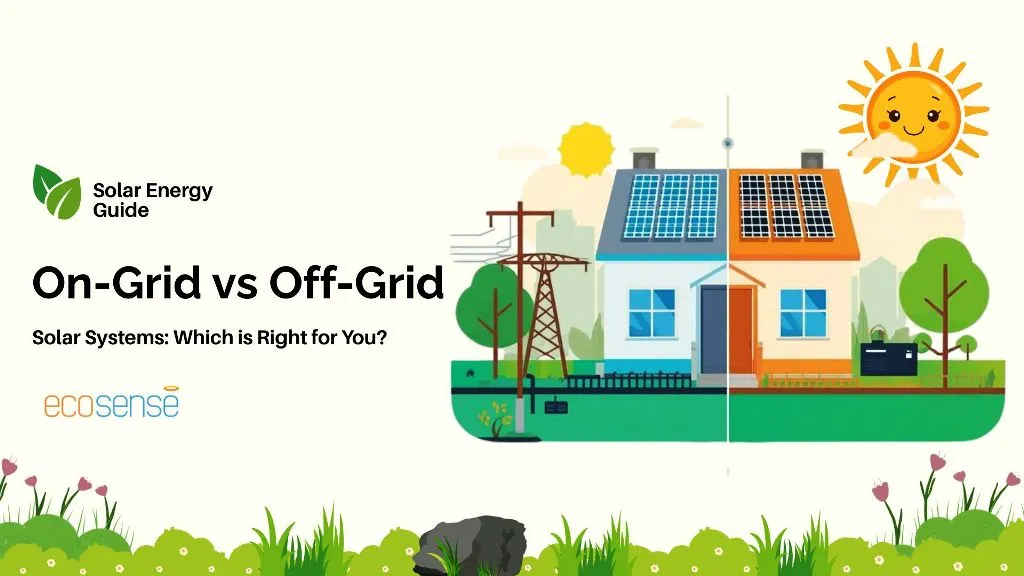
On-Grid vs Off-Grid Solar Systems Comparison
An on-grid solar system (grid-tied) connects to the utility grid — solar powers your loads first, surplus is exported via net metering, and the grid fills any gap. No battery required. Cost: ₹45,000–₹60,000 per kW (India). Best for: urban areas with stable grid supply.
An off-grid solar system operates independently with a battery bank. Best for: remote locations or areas with frequent power cuts. Cost: ₹80,000–₹1,20,000 per kW. A third option — the hybrid system — combines grid connection with battery backup, giving the benefits of both.
What Is an On-Grid Solar System?
If your institute already has a decent electricity connection, you don’t really need to reinvent the whole system. That’s where an on-grid solar setup fits in.
It works along with the existing power supply. During the day, solar panels generate electricity and your building uses it instantly. If production goes beyond your demand, that extra power is sent back to the grid.
When solar is not enough, the grid simply fills the gap. You don’t have to think about switching anything.
There are no batteries here. That’s the reason the system stays simple and cost-effective. Fewer components also mean fewer things that can go wrong.
One limitation though. If there is a power cut, the system shuts down. Even if your panels are generating power, you won’t be able to use it during that time.
What Is an Off-Grid Solar System?
Now take a different case. A lab where power cuts are frequent, or voltage is not stable. In such situations, depending on the grid is risky.
An off-grid solar system avoids that dependency completely.
Here, solar panels generate electricity and also charge a battery bank. That stored energy is what keeps things running when sunlight is not available.
The system works on its own. No connection to the utility supply.
This gives you control, but it also adds responsibility. Batteries need proper sizing, monitoring, and eventual replacement. You can’t ignore them.
For research setups where even a short outage can affect results, this kind of system is often worth the effort.
What is a Hybrid Solar System?
Enphase's article is titled "How to choose the right solar system: On-grid, off-grid, or hybrid?" — three options, not two. Your page currently covers only two. The hybrid system is a rapidly growing category in India and a gap that your competitors have clearly identified.
A hybrid solar system combines a grid connection with battery backup. Solar powers loads directly, surplus charges the battery and/or exports to the grid, and the battery provides backup during grid outages. When the battery is depleted, the grid takes over.
📚 How Hybrid Works
- Daytime with sun: Solar → loads + battery charging + grid export (net metering)
- Night or cloudy: Battery → loads; grid as secondary backup
- Grid outage: Battery → loads (islanding mode — unlike on-grid which shuts down)
- Battery full + grid on: Net export to grid for credits
₹ Hybrid Cost (India 2026)
- System cost: ₹1,00,000–₹1,50,000 per kW (incl. battery bank)
- Battery types: Lead-acid (cheaper, shorter life) or Lithium-ion (more expensive, 10+ yr life)
- Ideal for: Urban homes/institutions with moderate power cuts (2–6 hrs/day)
- MNRE subsidy: Available for grid-connected component
How Does an On-grid Solar
System Work?
🔆
Solar Panels (DC)
→
⇄
Grid-Tied Inverter
→
🏠
Building Load
⇄
🔌
Utility Grid (Net Meter)
- Solar panels generate DC electricity during daylight hours, proportional to irradiance.
- Grid-tied inverter converts DC to AC at the same frequency and voltage as the grid (230V, 50Hz in India).
- Building loads are powered first — the solar AC is used by the building's electrical system in real time.
- Surplus is exported to the grid through a bi-directional net meter, earning energy credits on your electricity bill.
- Grid fills any deficit — at night or on cloudy days, the grid supplies power seamlessly without any manual switching.
- Anti-islanding protection: If the grid goes down, the inverter detects this and immediately stops generating — a mandatory safety feature to protect utility workers.
- Solar panels generate DC electricity during daylight hours, proportional to irradiance.
- Grid-tied inverter converts DC to AC at the same frequency and voltage as the grid (230V, 50Hz in India).
- Building loads are powered first — the solar AC is used by the building's electrical system in real time.
- Surplus is exported to the grid through a bi-directional net meter, earning energy credits on your electricity bill.
- Grid fills any deficit — at night or on cloudy days, the grid supplies power seamlessly without any manual switching.
- Anti-islanding protection: If the grid goes down, the inverter detects this and immediately stops generating — a mandatory safety feature to protect utility workers.
How Does an Off-grid Solar
System Work?
- Solar panels charge the battery bank via a charge controller (MPPT or PWM type) during daylight hours.
- Charge controller regulates charging — prevents overcharging, maximises energy harvest, protects battery life.
- Battery bank stores energy for use when solar is insufficient — overnight, cloudy periods, or high-demand moments.
- Off-grid inverter converts battery DC to AC at 230V, 50Hz for standard electrical loads.
- No grid connection means no utility bill — but also means no backup if batteries run out and sun is unavailable.
Key Differences Between On-Grid and Off-Grid Solar Systems
When you compare an off grid and on grid solar system, the difference shows up quickly in practical use.
| Parameter | On-Grid Solar System | Off-Grid Solar System |
| Cost | Lower upfront | Higher due to batteries |
| Storage | Not required | required |
| Reliability | Depends on grid | Independent |
| Maintenance | Low | Higher |
So the choice is not complicated. Either you optimize for cost, or you optimize for independence.
Components Required for On-Grid and Off-Grid Solar Systems
Both systems start with the same basics, but they don’t end the same way.
Common Components
- Solar panels
- Inverter
- Mounting structure and wiring
On-Grid System
- Grid-tied inverter
- Net meter
- Utility connection
Off-Grid System
- Battery bank
- Charge controller
- Off-grid inverter
The moment batteries enter the system, design and cost both change. That’s the real split between off grid and on grid solar power setups.
Cost Comparison: On-Grid vs Off-Grid Solar Systems
This is usually the deciding factor for most institutes.
An on-grid system is easier to justify financially. In India, it typically costs between ₹45,000 and ₹60,000 per kW. Since there is no battery, maintenance stays low and payback is quicker.
Off-grid systems are more expensive from the start. Costs can go up to ₹80,000–₹1,20,000 per kW depending on how much backup you need. Batteries take a big chunk of that cost.
And it doesn’t stop there. Batteries don’t last forever, so replacement becomes part of the long-term expense.
Still, in places where power supply is unreliable, the conversation shifts. It’s less about saving money and more about keeping systems running.
Advantages and Disadvantages of On-Grid and Off-Grid Solar
On-Grid Solar System
| Advantages | Disadvantages |
| Lower Cost | No backup during outages |
| Simple to install and operate | Depends entirely on grid availability |
| Less maintenance | Not suitable for intallations at remote areas |
Off-Grid Solar System
| Advantages | Disadvantages |
| Independent Operation | Higher Cost |
| Works during power cuts | Battery Maintenance |
| Suitable for remote setups | More complex overall system |
In most cases, the decision between off grid and on grid solar comes down to how critical uninterrupted power is for you.
Which Solar system Is Better for Your Institute & Research Labs
This is usually where people expect a direct answer.
For commercial projects, you can give one. For institutions, it’s not that straightforward. Because the goal isn’t just to install a system. It’s to understand how these systems behave.
- An on-grid setup helps you observe how solar interacts with the grid—how energy flows, how exports happen, how consumption changes through the day.
- An off-grid setup shows something else entirely. It forces you to deal with storage, limitations, and what happens when there’s no external support.
Both are useful. In different ways.
If you only work with one, you’re only seeing part of the picture. That’s why many labs are moving toward setups where both systems can be studied, sometimes even side by side. Not because it’s required for operation—but because it’s necessary for learning.
Regardless of which configuration you choose, understanding connecting solar panels in series vs parallel is critical, it determines your system voltage, current, and compatibility with the charge controller or inverter.
Solutions developed by Ecosense follow this approach. Instead of focusing on a single configuration, they allow institutions to work with on-grid, off-grid, and hybrid systems within a controlled environment. So, the better question isn’t which system is better.
It’s which setup helps you understand how real systems behave.
Future of Solar Energy Systems
Things are already moving beyond just off grid and on grid solar systems.
Hybrid systems are becoming more common. They combine grid connection with battery backup, so you don’t have to fully depend on either.
Battery technology is also improving. Costs are slowly coming down, and performance is getting better.
There is also more focus on smarter energy management. Systems can now monitor usage and adjust automatically.
For institutes and labs, this is not just about saving power anymore. It also opens up opportunities to study and work with evolving energy systems.
Conclusions
The choice between an off grid and on grid solar system depends on what you need more, savings or reliability. On-grid systems are simpler and cost-effective for most institutes. Off-grid systems provide independence and consistent power where the grid cannot be trusted. The right decision comes from understanding your power requirements, not just comparing features.