
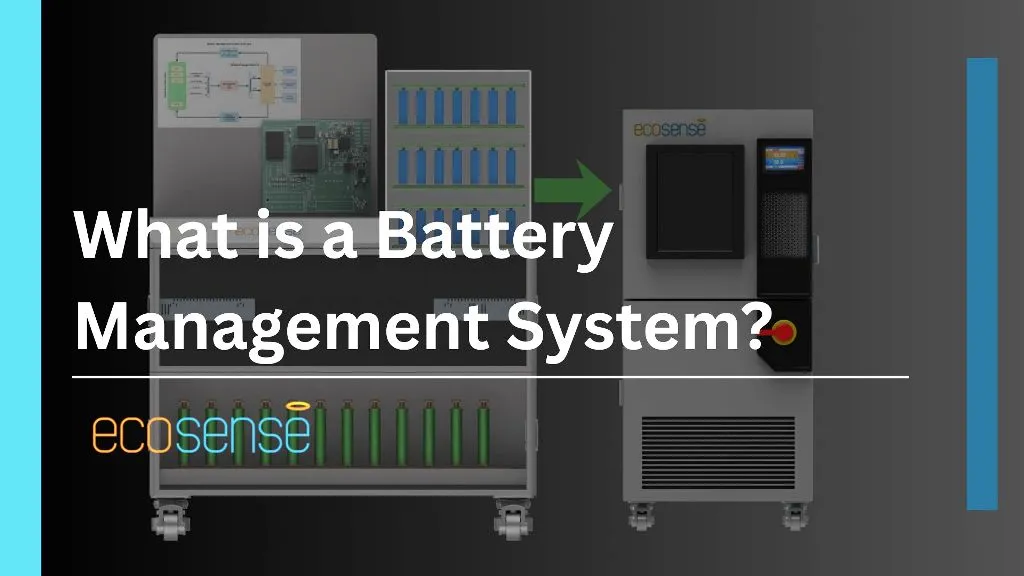
What Is a Battery Management System?
A battery management system (BMS) is an electronic system that monitors, controls, and protects rechargeable battery packs in real time. It continuously tracks voltage, current, and temperature across every cell, estimates state of charge (SOC) and state of health (SOH), performs cell balancing, manages thermal conditions, and enforces protection limits against overcharge, overdischarge, short circuit, and thermal runaway.
BMS is essential for lithium-ion batteries in electric vehicles (EVs), BESS (battery energy storage systems), laptops, smartphones, and eVTOL aircraft. Without a BMS, cells in a pack develop imbalances that shorten life, reduce usable capacity, and risk dangerous failure modes. The seven primary BMS functions are: monitoring, state estimation, cell balancing, power management, thermal management, protection, and communications (MathWorks classification).
Key Components of a BMS Battery Management System
A bms battery management setup is made up of a few parts, but they are all tied closely together.
- Battery Sensors: These are spread across the pack. They measure voltage, current, and temperature. Without these inputs, nothing else really works.
- Control Unit: This is where decisions happen. It reads sensor data and reacts based on limits that are already defined.
- Communication System: Not always visible, but important. It sends data outside, especially in systems where monitoring is required.
- Protection Circuits: These act when something crosses a limit. Overvoltage, overheating, excessive current, this is where the system steps in.
Individually, each part is simple. Together, they keep the system stable.
How a Battery Management System Works?
A bms battery system doesn’t really “start” or “stop” in a clear way. It’s just there, running all the time.
- Cell voltages are being checked continuously
- Current keeps getting tracked during charge and discharge
- Temperature readings keep updating
Now based on that:
- If voltage rises too much, charging is limited
- If it drops too low, discharge is cut off
- If temperature climbs, the system restricts operation
There’s no delay in this. It reacts as things happen.
At the same time, the system keeps adjusting how energy flows.
- Charging doesn’t happen blindly
- Discharging isn’t left uncontrolled
It’s more like constant correction rather than step-based control.
In real setups, especially where load keeps changing, this continuous adjustment is what keeps things from going unstable.

Fig. How Battery Management System Works?
Why Is a Battery Management System Important?
🛡️
Safety
Prevents overcharge and overdischarge that cause thermal runaway — a self-amplifying reaction where heat generates more heat, potentially leading to fire. BMS disconnects pack in <1 ms if limits are breached.
❤️
Battery Life Extension
Keeps cells within optimal voltage/temperature window, avoiding stress that causes premature aging. Lithium-ion cells can lose 20–40% capacity in 2 years without proper BMS protection.
🎯
Performance Optimisation
SOC/SOH estimation gives accurate state-of-charge display (EV range, laptop battery %). Cell balancing maximises usable pack capacity by equalising cells.
₹
Cost Reduction
Extends battery replacement cycles, reduces maintenance, and maximises energy utilisation. BMS also ensures compliance with safety regulations — a requirement for EVs in India under BIS IS 17886.
Safety
Prevents overcharge and overdischarge that cause thermal runaway — a self-amplifying reaction where heat generates more heat, potentially leading to fire. BMS disconnects pack in <1 ms if limits are breached.
Battery Life Extension
Keeps cells within optimal voltage/temperature window, avoiding stress that causes premature aging. Lithium-ion cells can lose 20–40% capacity in 2 years without proper BMS protection.
Performance Optimisation
SOC/SOH estimation gives accurate state-of-charge display (EV range, laptop battery %). Cell balancing maximises usable pack capacity by equalising cells.
Cost Reduction
Extends battery replacement cycles, reduces maintenance, and maximises energy utilisation. BMS also ensures compliance with safety regulations — a requirement for EVs in India under BIS IS 17886.
The 7 Primary Functions of a Battery Management System
Types of Battery Management Systems
Not all battery packs are built the same, so the battery management system also changes accordingly.
- Centralized BMS: One unit handles everything. Works fine for smaller systems but gets harder to manage as size increases.
- Distributed BMS: Control is split across modules. Each section handles itself and communicates with others.
- Modular BMS: Somewhere in between. Designed to scale without redesigning the whole system.
There’s no “best” type. It depends on how complex the battery setup is.
Functions of a Battery Management System
A battery management system ends up doing multiple things at once, even if it doesn’t look like it.
- Cell Monitoring: Keeps track of how each cell behaves
- Battery Balancing: Prevents one cell from drifting too far from others
- State of Charge (SOC): Gives an estimate of available energy
- Thermal Management: Keeps temperature within a usable range
These are not separate tasks. They overlap a lot.
If monitoring is off, balancing won’t work properly. If temperature isn’t controlled, everything else starts getting affected.
Applications of BMS Battery Systems
A bms battery management system shows up wherever batteries are used seriously.
- Electric Vehicles: Where load conditions keep changing
- Solar Energy Storage: Where charging cycles are repetitive but not always predictable
- Consumer Electronics: Where space is limited but safety still matters
- Industrial Systems: Where failure is not really an option
- EV labs dedicated to battery research rely extensively on BMS platforms to characterise cell behaviour, validate protection algorithms, and test state of charge estimation methods under real cycling conditions.
As the system size increases, the need for proper management becomes more obvious.
A battery cycler with data analytics provides the experimental environment needed to validate BMS algorithms across different C-rates, temperatures, and ageing cycles.
Benefits of Using a Battery Management System
A battery management system doesn’t improve the battery itself. It improves how the battery is used.
- Longer Lifespan: Cells are not pushed beyond limits
- Better Safety: Risk conditions are handled early
- Stable Performance: Output stays consistent over time
- The effect is gradual, but noticeable.
Battery Management System in Renewable Energy Labs
In renewable energy labs, a battery management system is not just used for protection. It becomes part of how students and researchers interact with the battery itself.
In setups like the BMS Learn & Build Platform, the system is exposed rather than hidden. Instead of treating the BMS as a black box, users can see how decisions are being made.
- Students can observe how voltage varies across individual cells during charging
- Temperature changes can be tracked under different load conditions
- Charging and discharging limits can be studied in real time
This changes the way battery systems are understood. Instead of only looking at final output, the focus shifts to internal behavior.
In solar and energy storage labs, this becomes even more relevant.
- Batteries are charged from variable sources like solar PV
- Load conditions are not constant
- System response changes throughout the day
A bms battery management system helps in analyzing these variations. It allows controlled experimentation without risking damage to the battery pack.
It is also useful from a research perspective.
- Different balancing strategies can be tested
- Performance under stress conditions can be evaluated
- Fault scenarios can be simulated safely
For students, this bridges the gap between theory and actual system behavior. For researchers, it provides a controlled environment to validate ideas.
That is why, in modern labs, a battery management system is not treated as an accessory. It becomes a core part of the learning and testing setup.
Thermal Management in a BMS
Temperature is the single biggest factor in battery degradation. MathWorks and Infineon both cover thermal management as a primary BMS function. Your page references temperature monitoring but not thermal management as a separate, active function.
- Optimal temperature range for Li-ion: 15–35°C for operation; 0–45°C for charging. Below 0°C, lithium plating risk. Above 45°C, accelerated SEI layer growth and capacity fade.
- Cooling strategies: Air cooling (passive fins or active fan) for low-power packs; liquid cooling (glycol-water loop) for EV battery packs; phase-change material (PCM) for advanced BESS.
- Heating strategies: Resistive heating films or battery self-heating (controlled low-current cycling) to bring cold cells up to minimum operating temperature before charging.
- Thermal runaway detection: BMS monitors for rapid temperature rise (ΔT/Δt thresholds), gas sensors, or pressure sensors. Triggers emergency disconnect and alerts. Infineon's TLE9012DQU ICs include dedicated thermal runaway detection logic.
Conclusions
A battery management system becomes necessary once batteries move beyond simple setups. It helps maintain safety and keeps performance stable, but it is not identical for every application. A small lab setup and an EV battery pack won’t use the same approach. The choice depends more on how the battery is used than on the battery itself.