
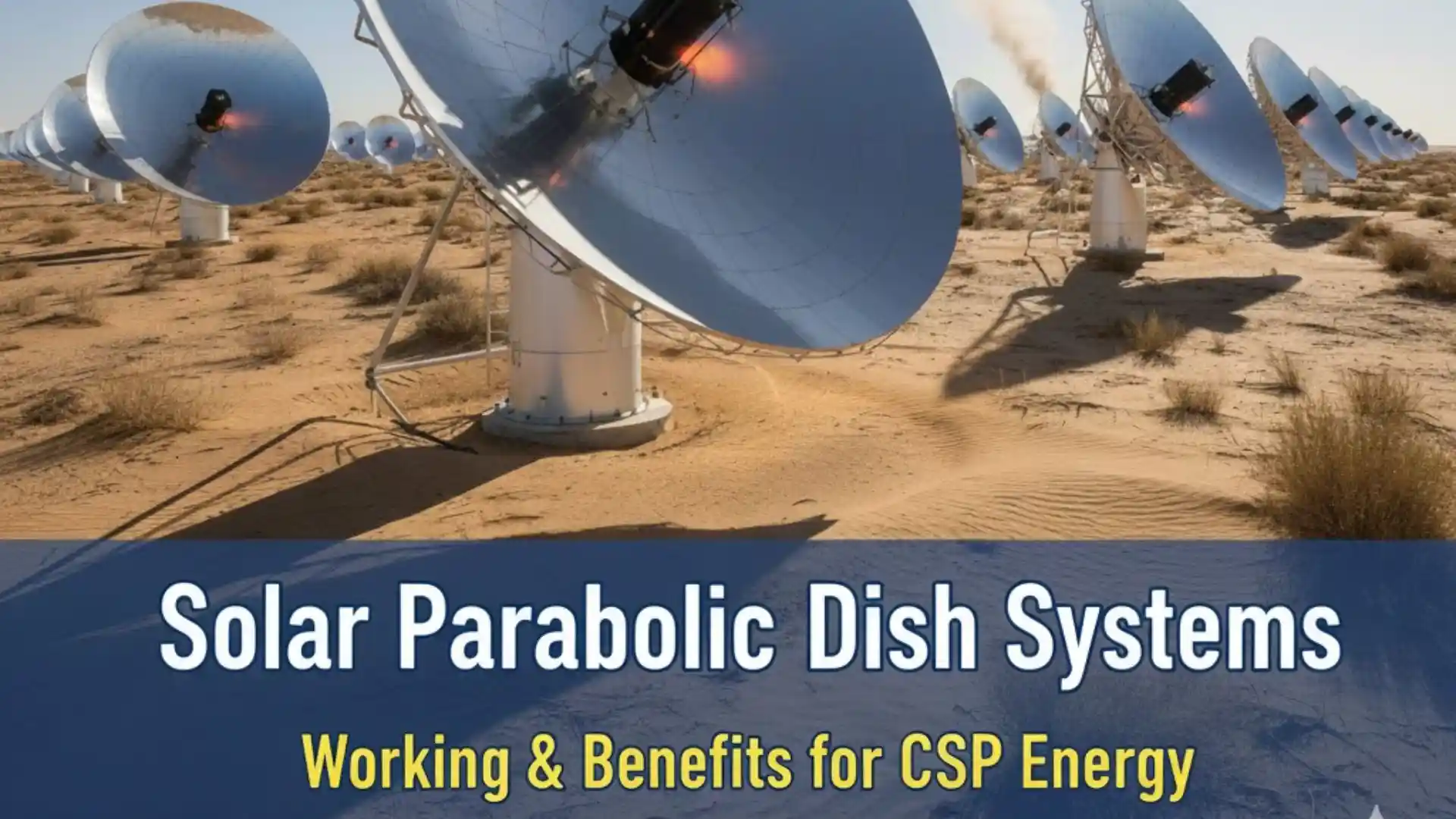
Solar Parabolic Dish Systems: Working & Benefits for CSP Energy
A solar parabolic dish (or "solar dish") is a concentrated solar power (CSP) device that uses a precision-engineered, dish-shaped reflector to focus direct solar radiation onto a single focal point — generating temperatures between 500°C and 1000°C and concentration ratios of over 1,000 suns. The concentrated heat is then converted into mechanical or electrical energy using a Stirling engine, Organic Rankine Cycle (ORC), or thermoelectric module.
Among all four CSP technologies (parabolic trough, power tower, linear Fresnel, and dish), the parabolic dish achieves the highest concentration ratio and the highest theoretical efficiency — up to 23% solar-to-electric conversion at the system level. Compact, modular, and capable of operating without cooling water, dish systems are particularly suited to small-scale (3–25 kW per unit), distributed deployment in high-DNI regions like Rajasthan, Gujarat, and Ladakh.
What is a Solar Parabolic Dish?
A Solar Parabolic Dish is a rotationally symmetric, concave mirror that focuses sunlight onto a receiver at its focal point. The receiver converts this concentrated energy into heat or electrical energy, depending on the system configuration.
The system operates on the principle of geometric optics — parallel solar rays reflect off the parabolic surface and converge precisely at a focal point. With optical efficiencies between 85–92%, and achievable temperatures in the range of 500°C to 1000°C, the dish becomes ideal for CSP laboratories, thermal engine studies, and hybrid solar-thermal applications.
Solar Dish vs Other CSP Technologies
Concentrated Solar Power (CSP) consists of four distinct optical configurations. Each has different geometry, scale, and use case:
Parabolic Dish
Temp: 500–1,200 °C
Scale: 3–25 kW per dish
Cooling water: Not required
Highest concentration. Modular. Best for distributed power, research labs, industrial heat.
Parabolic Trough
Temp: 150–400 °C
Scale: 50–250 MW plants
Cooling water: Required
Most installed CSP capacity globally. Best for utility-scale steam-turbine plants.
Power Tower
Temp: 500–1,000 °C
Scale: 100–600 MW
Cooling water: Required
Heliostats focus light on a central tower. Best for utility-scale + 15+ hour molten-salt storage.
Linear Fresnel
Temp: 250–500 °C
Scale: 5–125 MW
Cooling water: Required
Flat mirrors instead of curved. Cheapest CSP. Best for industrial process heat.
Quick Comparison: Solar Dish Wins on These Metrics
For research, distributed power generation, and industrial process heat in remote or water-constrained sites, the parabolic dish is the most efficient and flexible option among CSP technologies.
Components of a Solar Parabolic Dish
A typical solar parabolic dish consists of:
- Parabolic Reflector: Constructed using lightweight aluminum, glass mirrors, or silver-coated composite materials, designed for high reflectivity (≥94%). The paraboloid geometry ensures all incident rays are directed toward a single point focus.
- Receiver/Absorber: Mounted at the focal point; it captures concentrated solar radiation. It may use a cavity receiver or tubular absorber, made from materials like stainless steel or copper with a selective coating to maximize absorption and minimize radiative losses.
- Heat Transfer System: Transfers the absorbed energy to a working medium — air, pressurized water, molten salt, or thermal oil — for storage or mechanical work. In research systems, direct coupling with a Stirling engine or thermoelectric module is used to convert heat into electricity.
- Dual-Axis Tracking Mechanism: The dish continuously follows the Sun’s path using azimuth and elevation control driven by servo motors or microprocessor-based controllers. This maintains the optical focus within ±0.1° accuracy.
- Support and Mounting Structure: A steel or composite frame providing structural rigidity against wind loads, designed with bearings and counterweights for smooth tracking movement.
- Instrumentation & Data Interface:Equipped with pyranometers, thermocouples, flow meters, and data loggers, it enables real-time performance analysis and research-level experimentation.
How Does a Solar Concentrator Dish Work?
- Solar Radiation Capture: The parabolic mirror captures direct normal irradiance (DNI) and reflects the sunlight onto the focal receiver. Only direct sunlight contributes effectively; hence, dishes perform best in clear-sky regions.
- Concentration of Heat: The reflected rays converge at the focal point, creating an intense heat flux — up to 60–80 kW/m² — depending on the dish size and mirror accuracy.
- Thermal Absorption and Transfer: The receiver surface absorbs the concentrated radiation, converting it into heat. This energy is transferred to a heat transfer fluid (HTF) or working gas like air, nitrogen, or hydrogen.
- Power Generation: The thermal energy is used to run a Stirling engine, Organic Rankine Cycle (ORC), or thermoelectric system. In Stirling configurations, the working gas expands under high heat, driving the piston to generate mechanical and electrical power.
- Monitoring and Control: The system continuously monitors solar flux, receiver temperature, tracking accuracy, and thermal output using sensors and a control unit to optimize efficiency and safety.
This multi-step conversion — from solar radiation → thermal energy → mechanical/electrical power — highlights the precision and efficiency of dish-type CSP systems in both academic and experimental setups.

Fig. Components and Working of Solar Parabolic Dish
Receiver Geometries & Thermal Performance
The receiver is the most performance-critical component of a solar parabolic dish. Different cavity geometries deliver different thermal efficiencies. Recent peer-reviewed studies have benchmarked four primary configurations:
Conical Cavity
Tapered cavity geometry minimises radiative losses. Best for moderate temperatures with thermal oil HTF.
Cylindrical Cavity
Most common geometry. Performance peaks with nanofluid HTFs at solar irradiance 300–1100 W/m².
Hemispherical Cavity
Spherical absorber surface. Recent studies show best results with novel soybean oil-based MXene nanofluid.
Spiral Flow Path
Finned spiral receiver studied in 16 m² parabolic dish. Best at 0.12 kg/s mass flow rate.
What Affects Solar Dish Thermal Efficiency?
Beyond receiver geometry, four parameters dominate thermal performance:
- Heat Transfer Fluid (HTF) selection — water, thermal oil, molten salt, or nanofluids. Nanofluid additions can boost cavity receiver efficiency by 10–15% over base fluids.
- Absorber surface coatings — black oxides like Co₃O₄ achieve ~88% absorption efficiency at high temperatures with minimal degradation.
- Geometric concentration ratio — varies between 1,000 and 3,000 for commercial dishes; ScienceDirect-published benchmarks show ratios above 2,000 for premium systems.
- Aperture area & rim angle — larger aperture increases capture; rim angle (typically 45-60°) optimises focal-point intensity vs blockage.
Applications & Use Cases of Solar Parabolic Dishes
Solar parabolic dishes are remarkably versatile because the high-temperature thermal output (500–1,000+ °C) can be applied to many end-use sectors — far beyond electricity generation:
Electricity Generation
Stirling engine, ORC, or thermoelectric — 3 to 25 kW per dish
Industrial Process Heat
Drying, melting, chemicals — clean replacement for fossil-fired boilers
Water Desalination
Concentrated heat for thermal desalination in coastal arid regions
Solar Cooking
Community kitchens, hostels, religious institutions in high-DNI areas
Hydrogen Production
Thermochemical water splitting at >800°C to produce green hydrogen
Hybrid Solar Thermal
Steam generation paired with conventional power blocks or absorption chillers
Research & Education
CSP labs, Stirling engine studies, thermal engineering experiments
HCPV Systems
High-Concentration PV with multi-junction solar cells
Benefits and Drawbacks of Solar Parabolic Dishes
Benefits:
- Achieves very high temperatures (500°C–1000°C) with superior thermal concentration.
- Dual-axis tracking ensures consistent focus throughout the day.
- High conversion efficiency (up to 30%) suitable for hybrid thermal–electric systems.
- Compact and modular — ideal for laboratories and pilot-scale CSP units.
- Environmentally sustainable with zero operational emissions.
Drawbacks:
- Requires precise dual-axis tracking and frequent calibration.
- Sensitive to dust and wind; needs periodic cleaning and alignment checks.
- Higher initial investment compared to flat-plate or trough systems.
- Best suited for high-DNI regions like Rajasthan, Gujarat, and Ladakh.
Solar Dish Outlook in India
India has among the world's highest solar irradiance, making it a natural fit for solar parabolic dish technology — particularly in three regional clusters:
- Rajasthan — DNI 5.5–6.5 kWh/m²/day. Site of the National Solar Thermal Power Plant (NSTPP). Cuts across Jaisalmer, Bikaner, Jodhpur for utility-scale CSP.
- Gujarat & Kutch — High DNI year-round. Co-located with industrial demand and existing solar parks at Charanka and Dholera.
- Ladakh — Highest DNI in India (~6.5+ kWh/m²/day) but cold ambient temperature — favourable for receiver thermal performance.
The Ministry of New and Renewable Energy (MNRE) classifies solar parabolic dish as a Concentrated Solar Thermal (CST) technology eligible for capital subsidy under various state schemes. Solar steam cooking via dish concentrators is operational at major religious institutions including Tirupati Tirumala (cooking 30,000+ meals/day) and Shirdi Sai Baba Sansthan — proving real-world viability beyond research labs.
For research and education, parabolic dish modules are increasingly part of CST and renewable-energy curricula at IITs, NITs, and engineering institutions across India.
Comparison: Parabolic Trough vs. Parabolic Dish Collector
| Parameter | Parabolic Trough Collector | Parabolic Dish Collector |
| Design | Cylindrical shape focusing sunlight onto a linear receiver tube | Parabolic dish shape focusing sunlight on a single focal point |
| Tracking System | Single-axis is sufficient | Dual-axis is required |
| Concentration Ratio | Moderate | Very High |
| Operating Temp. Range | 150 - 400 deg. C | 500 - 1000 deg. C |
| Heat Transfer medium | Therm-oil, molten salts or pressurized steam | Usually air,hydrogen, or direct coupling with stirling engine |
| Power Conversion system | Generates steam to drive a Rankine cycle turbine | Often coupled with Stirling engine or high-temperature receiver |
| System Efficiency | Around 15-20% | Around 25-30% |
| Scale of Installation | Suitable for large scale solar thermal power plants | Ideal for distributed, modular, or off-grid power generation |
| Maintenance Requirements | Easier maintenance due to simpler tracking and cleaning | More complex maintenance due to precise alignment and dual tracking |
| Land Requirement | Large area needed; linear array setup | Compact installation; smaller footprint per dish |
| Cost | Lower per-unit cost due to scalability | Higher cost due to advanced optics and tracking system |
| Typical Applications | Industrial process heat, solar thermal power generation, research labs | High-temperature research, Stirling engine generation, space applications |
| Example Ecosense Solution | Solar Concentrator Training system | Parabolic Dish Training System |
Advancing Solar Concentration Efficiency with Ecosense
At Ecosense, we design Solar Concentrator Training Systems that help students and researchers understand the engineering principles behind solar parabolic dishes. The system enables experimentation with parameters such as dish geometry, receiver design, and heat transfer efficiency. Equipped with temperature sensors, data logging, and manual or automatic tracking options, Ecosense systems provide a hands-on platform to study CSP fundamentals, validate theoretical models, and develop new solar concentration technologies for sustainable energy research.
Conclusion
Solar Parabolic Dish Systems play a critical role in harnessing concentrated solar energy for clean power generation and research. Their compact design, high efficiency, and adaptability make them ideal for academic and experimental solar laboratories. As CSP technologies continue to evolve, systems like these will help drive innovation toward a more sustainable, energy-secure future.