
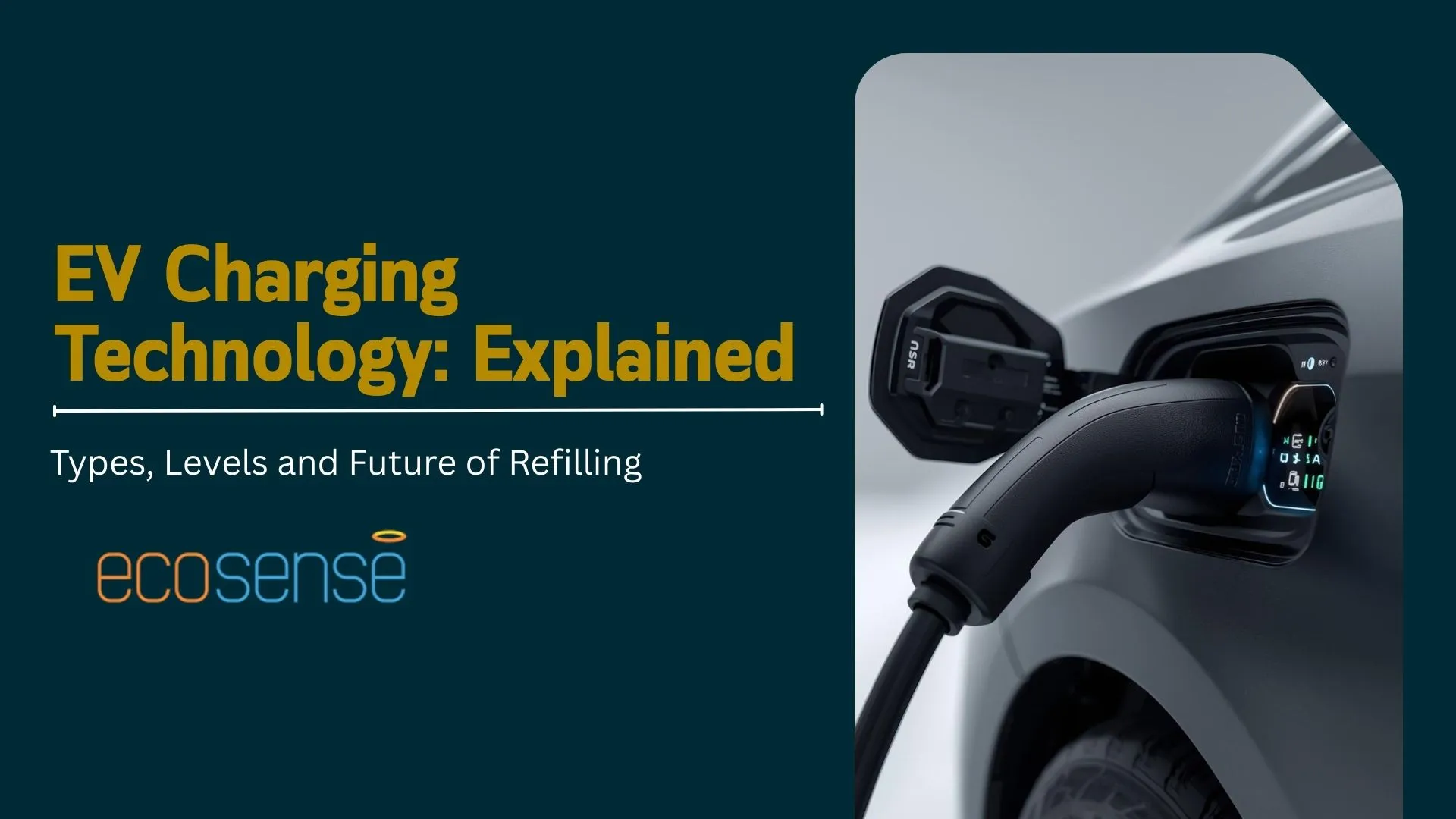
EV Charging Technology: Types & Working
EV charging technology is the system of chargers, cables, connectors, communication protocols, and onboard vehicle electronics that move electrical energy from the grid into an electric vehicle's battery. Modern EV charging spans four main types — AC Level 1 (120V), AC Level 2 (240V), DC Fast Charging (50-150 kW), and Ultra-Fast Charging (350+ kW) — using connectors like Type 2, CCS2, CHAdeMO, NACS, and India's Bharat AC-001/DC-001 standards.
In India, public charging networks are governed by Bharat DC-001 (15 kW DC) and Type 2 AC (22 kW) standards, with CCS Combo 2 (50-150 kW) gaining traction in premium fast-charging deployments. Communication protocols like OCPP (Open Charge Point Protocol) 1.6/2.0.1 and ISO 15118 enable smart features such as Plug & Charge, dynamic load management, Vehicle-to-Grid (V2G), and remote diagnostics — making EV charging far more than just a power transfer.
What Is EV Charging Technology?
EV charging technology is about how power is allowed into an EV battery, not just how it is connected. The system includes the charger, the cable, simple control signalling, and the vehicle’s onboard charging circuits. When a plug is inserted, the charger waits. The vehicle sets limits first. Voltage rises gradually, current follows. As temperature increases or the battery fills up, current is pulled back. These decisions come from the Battery Management System and are necessary to limit heat, reduce electrical stress, and slow long-term cell ageing.
Types of EV Charging Technologies
AC Charging – Level 1 and Level 2
Standard Alternating Current (AC) is the bread and butter of daily charging. Since your car's battery stores Direct Current (DC), the vehicle has an "onboard charger" that acts as a translator. It’s a slow, gentle way to top off while you’re sleeping or working.
DC Fast Charging – CCS, CHAdeMO and Others
DC charging hits the fast lane by moving that "translation" equipment out of the car and into the station itself. By feeding Direct Current straight into the battery, it skips the vehicle’s internal bottlenecks. This is why public fast chargers are so much larger—they house massive power converters.
Ultra-Fast and High-Power Charging
The new frontier is Ultra-Fast charging, pushing outputs of 350 kW or more. These are designed for the latest 800-volt car architectures. We're talking about adding hundreds of miles of range in roughly the time it takes to grab a sandwich and use the restroom.
Wireless / Inductive EV Charging
Forget the cables. This tech uses electromagnetic fields to transfer power between a pad on the ground and a receiver on the car’s underbelly. It’s still a niche premium feature, but it’s a game-changer for autonomous fleets and hands-free home setups.
Main Connector types for AC and DC Charging
- Type 1 (SAE J1772): The North American go-to for AC. It’s a 5-pin plug you’ll see on most non-Tesla home chargers and public Level 2 stations.
- Type 2 (IEC 62196): Common in Europe and India, this 7-pin design handles "three-phase" power, making it way faster than its Type 1 cousin for office charging.
- CHAdeMO: A Japanese-developed DC plug known for bidirectional capability—meaning it can technically power your house from your car—though it’s becoming less common in the West.
- CCS (Combined Charging System): The industry heavyweight. It "combines" an AC plug with two extra DC pins at the bottom, offering a single port that does everything.
- Tesla Supercharger Connector: Slim, sleek, and reliable. Now officially called NACS, it’s being adopted by almost every major automaker in North America to ensure universal access.
Understanding Charging Levels
There are different levels of charging.
Level 1 Charging
This is your standard 120V household outlet. It’s painfully slow—adding maybe 4 miles of range per hour. It’s fine for plug-in hybrids or people who rarely drive, but for most EV owners, it’s a backup of last resort.
Level 2 Charging
Running on 240V (the same power your dryer uses), Level 2 is the sweet spot. It adds 12–80 miles of range per hour. It’s the standard for home and those chargers you see at the mall or hotel.
DC Fast Charging
The "high-speed" tier. These are high-voltage machines that can surge a battery from 10% to 80% in about 20–40 minutes. It’s the only way to realistically tackle long-distance road trips.
Differences between AC and DC Charging Methods
The core secret is where the power conversion happens. Grid power is always AC, but your car's battery only "speaks" DC.
| Features | AC Charging | DC Fast Charging |
| Where is the converter? | Built into the car (onboard) | Built into the station (offboard) |
| Typical Speed | Slow | Fast |
| Average Wait Time | 4 to 10 hours | 20 to 50 minutes |
| Best Locations | Homes, hotels, workplaces | Highway stops, commercial hubs |
| System Cost | Affordable/Residential | Expensive/High-Voltage |
How Electric Vehicles Process These Charging Methods?
When you plug into an AC source, your car’s Onboard Charger (OBC) acts as the translator. It pulls the AC electricity and converts it into DC so the battery can store it. This creates a bottleneck because the OBC is limited by its physical size. But when you switch to a DC Fast Charger, the "translator" is inside that massive box on the curb. It sends DC energy straight to the battery terminals, bypassing the car's internal limits. Throughout this, the car's Battery Management System (BMS) acts as a safety guard. It tells the station to slow down as the battery gets full or hot—which is exactly why your charging speed drops off a cliff once you hit that 80% mark.

Fig. Infographics showing difference between AC and DC Charging
Smart Charging & Vehicle-to-Grid (V2G)
Modern EV charging technology goes far beyond raw power transfer. Smart charging adds a data layer between the vehicle, charger, and cloud — enabling features like remote diagnostics, dynamic load balancing, and bi-directional energy flow:
What Makes Charging "Smart"?
Dynamic Load Management
Automatically distributes available power between building load and EVs charging simultaneously. Prevents grid overload without infrastructure upgrades.
Plug & Charge (ISO 15118)
Vehicle authenticates automatically when plugged in. No card, no app — just plug in and charging begins. Tesla, Ford, GM all support.
Real-Time Diagnostics
AI-powered fault prediction, uptime optimization, and remote troubleshooting. Critical for fleet operators and high-volume public stations.
Dynamic Pricing
Time-of-use pricing adjusts charging cost based on grid load. Off-peak charging cheaper; peak hours more expensive — incentivising demand shaping.
Vehicle-to-X (V2X) Energy Flow
EV batteries can flow energy both ways — turning every parked EV into a mobile energy storage unit. Three V2X variants matter:
- V2G (Vehicle-to-Grid): EV exports stored energy back to the public grid during peak demand. Owners can earn from energy arbitrage or grid-support credits. ISO 15118 compliance required.
- V2H (Vehicle-to-Home): EV powers your house during outages — a 75 kWh EV battery can run an average home for 2-3 days. CHAdeMO and now CCS support this.
- V2L (Vehicle-to-Load): EV powers external appliances (camping equipment, tools, emergency loads) directly through onboard 230V/110V outlets. Common in newer Hyundai, Kia, and BYD models.
For grid operators, V2G aggregated across thousands of EVs becomes a virtual power plant — stabilising grid frequency, balancing renewable variability, and deferring expensive grid upgrades.
EV Charging Networks in India
India's EV charging network landscape has expanded rapidly since 2022. Five Indian Charge Point Operators (CPOs) lead the public charging space:
Tata Power EZ Charge
Stations: 5,500+ across 470+ cities
Types: AC + DC fast
Strength: Tata vehicle integration
Pan-India network. Bundled with Tata EV ownership. Strong urban + highway corridor coverage.
Statiq
Stations: 7,000+ chargers
Types: AC L2 + DC
Strength: RWA/society coverage
Strong in residential and societal complexes. Bharat AC-001 + Type 2 + CCS Combo 2 supported.
Ather Grid
Stations: 3,000+ fast chargers
Types: Light EV-focused
Strength: 2W/3W EV ecosystem
Originally for Ather scooters; now open to all light EVs. Free charging in many locations.
Charge+Zone
Stations: 4,500+ chargers
Types: Highway DC fast
Strength: Highway corridors
Highway-focused. Strong on Mumbai–Delhi, Mumbai–Bangalore, Delhi–Chandigarh corridors.
ChargeZone
Stations: 3,500+ chargers
Types: AC + DC
Strength: Fleet partnerships
Strong fleet-operator partnerships. OCPP-compliant infrastructure with multi-network roaming.
Pulse Energy (CPO Aggregator)
Reach: 35+ CPO integrations
Compliance: OCPP 1.6J + OCPI 2.2
Apps: Pulse + InstaCharge
Aggregator providing single-integration access to 35+ Indian CPOs, 40,000+ transactions, 97+ fleet operators.
Together these networks cover most major Indian metros and highway corridors. ~65% of EV charging installations are in metros (Delhi, Mumbai, Bengaluru), with Tier-2 cities emerging as the next deployment frontier.
Cost to Set Up an EV Charging Station in India
Setting up an EV charging station in India varies widely by charger type, location, and infrastructure already in place. Approximate CAPEX (capital expenditure) ranges:
Beyond the Charger: Site Costs
For commercial deployments, additional CAPEX components include:
- Transformer / power upgrade: ₹2-15 lakh depending on existing connection capacity. DC fast charging often requires HT (High Tension) connection.
- Civil work: ₹50,000-₹3 lakh per bay (foundation, cable trenching, signage, weather protection).
- Software / CMS subscription: ₹500-₹3,000 per charger per month (OCPP-compliant management platform like Pulse Energy or proprietary).
- Land lease (commercial): Variable; often revenue-share with property owner instead of fixed lease.
Government support: Capital subsidies under the FAME II scheme (now succeeded by PM E-Drive, May 2024-March 2026) and various state EV policies offer up to 25% CAPEX reimbursement on qualifying public charging infrastructure.
EV Charging Policy & Standards in India
India's EV charging policy landscape is governed by a stack of national and state-level frameworks. Here's what shapes deployment today:
National Schemes & Mandates
- PM E-Drive (May 2024–Mar 2026): Successor to FAME II. ₹10,900 crore allocated. Includes capital support for public EV charging infrastructure across cities and highway corridors.
- FAME II (2019–2024, succeeded by PM E-Drive): Initial scheme that subsidised public charging deployment. Many existing networks built under FAME II support.
- MoP Charging Infrastructure Guidelines (Revised 2022): Ministry of Power mandates minimum specs for public chargers — Bharat AC-001/DC-001 OR Type 2 + CCS Combo 2 connectivity, OCPP-compliant software, accessible 24×7.
- BEE / ARAI Standards: Bureau of Energy Efficiency oversees energy-performance specs; ARAI/IS 17017 governs connector and safety standards (based on IEC 61851-1).
State-Level EV Policies
- Delhi EV Policy 2.0: Targets 25% of new vehicle sales to be EVs by 2025. Capital subsidy on public chargers up to ₹6,000 per port.
- Maharashtra EV Policy 2025: Charging station capital subsidy up to ₹15 lakh for Highway corridor stations. 1 charging point per 3 km in metros.
- Karnataka, Tamil Nadu, Telangana, Gujarat: Each has independent EV policy with deployment targets and CAPEX support.
Connector & Compliance Standards
- BIS Certification: All connectors must meet Bureau of Indian Standards specifications.
- IS 17017 / IEC 61851-1: Safety standards for AC + DC charging systems.
- Bharat AC-001 / DC-001: Indian-developed standards for early EV deployment, mandated for FAME II / PM E-Drive subsidy eligibility.
- OCPP compliance: Mandatory for all public chargers per MoP guidelines. Versions in use: OCPP 1.5/1.6J/2.0.1.
Pros & Cons of EV Charging Technology
✅ Advantages
- Lower running cost — ₹1–1.5/km vs ₹6–10/km for petrol vehicles in India
- Zero tailpipe emissions — significant urban air quality benefit
- Smart features — remote monitoring, dynamic pricing, automated billing via OCPP-compliant infrastructure
- V2G & V2H capability — turns parked EVs into grid assets and home backup
- Plug & Charge — no apps or cards once ISO 15118 enabled
- Multiple charging speeds — from 4 mi/hr Level 1 to 350+ kW ultra-fast options
- Interoperability — open OCPP/OCPI standards prevent vendor lock-in
- Government incentives — PM E-Drive, FAME II legacy, state EV policies
⚠️ Disadvantages
- Range anxiety — public charging density still developing outside metros
- High CAPEX — ₹30–50 lakh for 150 kW DC fast charger station
- Charging time vs refuelling — even ultra-fast (15–30 min) lags petrol refilling
- Connector fragmentation — Type 2, CCS2, CHAdeMO, Bharat AC/DC, NACS all coexist
- Grid strain — high concentration of fast chargers stresses local distribution
- Cold-weather performance — battery efficiency drops 20–30% below 0°C
- Battery degradation — repeated DC fast charging accelerates capacity fade
- Software dependence — chargers offline if CMS network or authentication fails
Challenges and Future Trends in EV Charging Technology
EV charging still runs into everyday friction. Local grids weren’t built for several high-power chargers firing up at the same time, especially in the early evening. Reliability is another sore point. Drivers often arrive to find a charger offline, slow, or locked behind yet another app.
At the same time, the direction is shifting. Some newer systems are beginning to treat parked EVs as energy storage rather than just loads. Heavy-duty transport is pushing charging power far beyond passenger-car levels. Solar-backed sites are reducing grid dependence, and behind the scenes, software is starting to flag failing hardware before users ever see an error screen.
Conclusion
EV charging no longer feels like a technical add-on. It quietly dictates how electric vehicles are used in the real world. Some charging happens slowly in the background, some happens quickly on the road, and both matter. As connectors standardise and infrastructure improves, charging stops being something drivers plan around. It just happens. When that becomes normal, electric vehicles stop feeling new—and that’s when adoption really accelerates.