
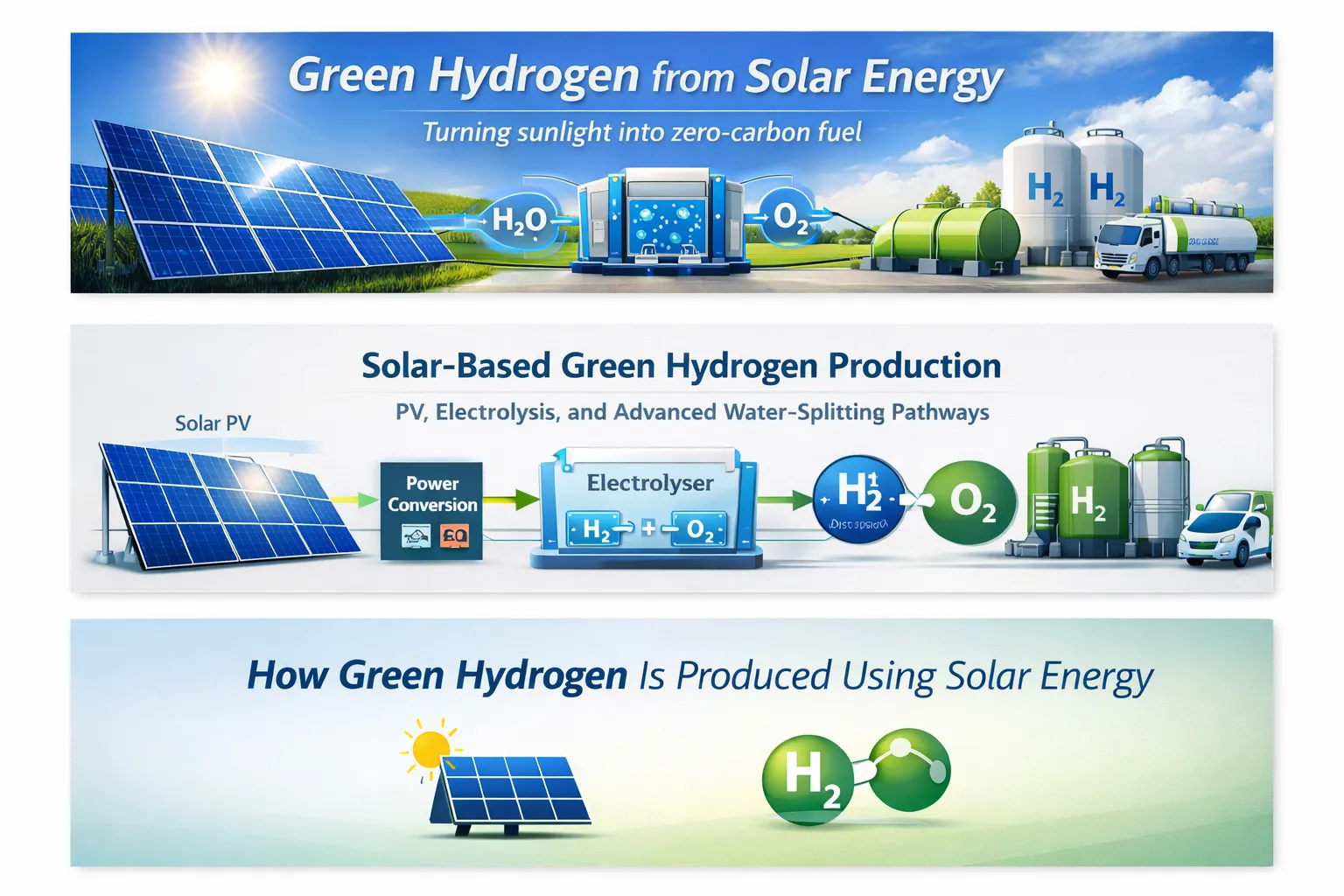
Green Hydrogen Production From Solar Energy
Introduction
Solar hydrogen production uses sunlight and water as the only inputs to generate green hydrogen via three main pathways: (1) Solar PV + Electrolysis — 10–18% real-world efficiency, current commercial standard; (2) Solar-Thermal water splitting — uses focused sunlight above 1,000°C, >30% theoretical efficiency; (3) Photoelectrochemical (PEC) water splitting — "artificial photosynthesis," lab-stage with 16.4% kW-scale demonstration (Nature Energy, 2023).
Highest demonstrated solar-to-hydrogen (STH) efficiency: 24.4% using GaInP/GaAs/Ge multi-junction PV + electrolysis (Nakamura). Current Levelised Cost of Hydrogen (LCOH): $3–7/kg green H₂ vs $1–2/kg grey H₂ — projected to reach $1.5–2.5/kg by 2030. India's National Green Hydrogen Mission targets 5 MMT/year by 2030 with ₹19,744 crore outlay.
Producing hydrogen from solar energy starts with a straightforward idea: use sunlight to split water. There are a couple of ways to do this. In some systems, solar panels generate electricity that powers conventional electrolysers. In others, photoelectrochemical cells combine light absorption and water splitting in a single step, closer to an engineered version of photosynthesis. The ingredients are simple—sunlight and water—but the execution is not. Most of today’s effort is focused on making these systems cheaper, tougher, and reliable enough to operate outside the lab and at meaningful scale.
Main Methods of Hydrogen Production Using Solar Energy
While most people think of solar panels, there are actually several ways to achieve solar powered hydrogen production.
1. Solar PV + Electrolysis for Hydrogen Production
This is often described as a “plug-and-play” method and is already used in many commercial plants today. Solar Photovoltaic (PV) panels, when placed in sunlight, convert solar irradiation into DC electricity. This power is utilized by an electrolyzer to split water into hydrogen and oxygen.
- PEM Electrolyzers: These are the current favourites because they can ramp up or down instantly as clouds pass over a solar farm, preventing energy waste.
- Alkaline Systems: These are the "old reliable" of the industry—cheaper and highly durable for massive, steady-state solar arrays.
2. Solar-Thermal Systems for High-Temperature Water Splitting
This method uses mirrors to focus sunlight onto a single point, creating temperatures above 1,000°C. This intense heat triggers thermochemical cycles that break the bonds of water molecules to generate hydrogen and oxygen. It skips the "electricity step" entirely, which can be more efficient for massive industrial applications.
In theory, this approach allows solar energy to hydrogen production at higher efficiencies. In reality, it introduces engineering challenges. Materials must tolerate extreme thermal stress. Systems must maintain stable temperatures despite changing sunlight conditions. Because of these limitations, solar-thermal hydrogen systems are typically large, centralised installations. Most remain at pilot scale, serving as testbeds rather than commercial workhorses.
That said, higher efficiency does not always translate into lower costs or simpler operation.
3. Photoelectrochemical (PEC) Water Splitting and Solar-to-Hydrogen Devices
Often called "artificial photosynthesis," PEC is the frontier of the industry. It uses specialized semiconductor materials that absorb sunlight and split water in a single integrated device. It’s essentially a "solar cell that leaks hydrogen," and while still scaling up in labs. Whether it becomes the future or just one part of it is still an open question.
Solar-to-Hydrogen Efficiency and Performance
3 Solar Hydrogen Methods Side-by-Side
Example Projects Using Solar Energy for Hydrogen Production
Real-world deployment of solar powered hydrogen production is steadily increasing. Large solar installations are now paired with electrolysers to supply hydrogen for refining, fertiliser manufacturing, and chemical processing. These projects demonstrate how solar energy and hydrogen production can integrate with existing industrial demand rather than replacing it overnight.
- The NEOM Project (Saudi Arabia): Now over 90% complete, this $8.4 billion facility will use 4GW of solar and wind to produce 600 tonnes of green hydrogen daily. It’s the world's first true "Export Hub" for green ammonia.
- The Pilbara Link (Australia): In Western Australia’s "sun-belt," projects like the Western Green Energy Hub are utilizing 25 million solar panels. Their goal? To replace coal in Asian steel mills with Australian sunshine.
- European Hydrogen Valleys: In Spain and the Netherlands, they aren't building anything new; they are blending solar hydrogen directly into existing gas grids to decarbonize home heating and heavy trucking.
Over the past five to seven years, these projects have moved from feasibility studies to early deployment.
Benefits of Hydrogen Production from Solar Energy
Zero-Carbon Fuel from Sunlight and Water
Hydrogen is hailed as the cleanest and zero carbon emissions fuel when produced using renewable sources. Solar Panels absorb solar energy to produce electricity. This electricity is further used by water purification systems, pumps and electrolyzers to split water into hydrogen and oxygen leaving only heat and water as residue and no carbon footprints.
Integration with Solar Farms and Energy Storage
Converting solar energy into hydrogen provides a useful outlet for surplus generation. Instead of curtailing excess power, it can be stored in the form of hydrogen and later used for energy or industrial applications, improving the overall utilisation of solar installations.
Role in Decarbonising Transport and Industry
Some industries simply cannot run on electricity or battery storage alone. In those cases, solar-produced hydrogen becomes essential—particularly in steelmaking, fertiliser production, and heavy-duty transport, where energy density matters more than efficiency on paper.
Cost of Solar Hydrogen (LCOH): Today vs 2030
Cost Breakdown — Solar PV + Alkaline Electrolysis (per $/kg H₂)
- Electricity (60–70% of LCOH): Solar LCOE in India is now ~₹2.5–3/kWh ($30–35/MWh) — the biggest single cost driver
- Electrolyzer CAPEX amortisation (15–25%): $500–1,000/kW alkaline; declining 25–30% per doubling of capacity
- Water (~1–2%): 9–11 litres of pure water per kg H₂ — small but non-zero in arid regions
- O&M, replacement, balance-of-plant (10–15%): Stack replacement every 60,000–90,000 hours
Conclusion
We are moving away from an era of "extracting" energy from the ground and into an era of "manufacturing" it from the sky. Hydrogen production from solar energy is the bridge that allows us to take clean electricity and move it into heavy industry, shipping, and long-term storage. That won’t happen overnight—but the direction is now difficult to ignore.