
Setting Up a Green Hydrogen Lab: What Colleges and Universities Need to Know
Hydrogen gas is prepared in the laboratory by 4 main classical methods: (1) Reaction of zinc with dilute hydrochloric acid — Zn + 2HCl → ZnCl₂ + H₂↑ (most common school/JEE method); (2) Reaction of zinc with dilute sulphuric acid — Zn + H₂SO₄ → ZnSO₄ + H₂↑; (3) Electrolysis of acidulated water — splits H₂O into H₂ (cathode) + O₂ (anode); (4) Reaction of active metals with water — sodium, potassium, calcium release H₂ on contact with water.
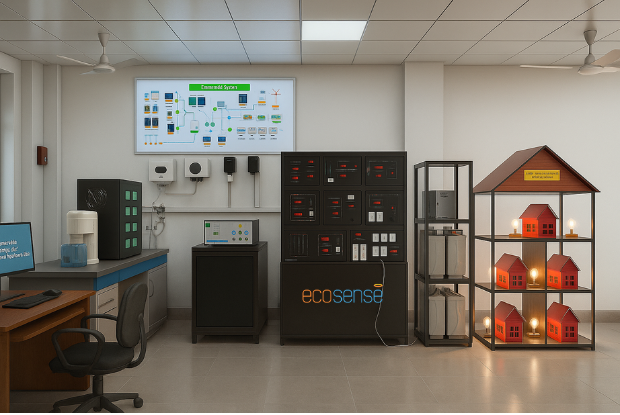
For engineering-grade green hydrogen production, modern Green Hydrogen Labs use PEM and Alkaline electrolyzers — splitting purified water with electricity from solar PV or wind. These labs include water purification, electrolyzer stacks, gas handling, fuel cells, and safety systems. Setup cost in India ranges ₹15–₹50 lakh depending on scale. Aligned with India's National Green Hydrogen Mission (5 MMT/year by 2030).As global momentum builds around clean energy transitions, green hydrogen has emerged as a key pillar of the sustainable energy ecosystem. With governments, industries, and research institutions investing heavily in hydrogen technologies, the demand for a skilled workforce is rising rapidly. Academic institutions in India and beyond now face a timely opportunity—and responsibility—to integrate hydrogen education into their engineering and science curricula.
One of the most effective ways to build this capacity is
through a dedicated Green Hydrogen Lab. But setting one up involves more
than procuring a few devices. It requires a thoughtful blend of technology,
pedagogy, and safety standards tailored to academic environments.
In this blog, we explore what colleges and universities need to consider before establishing a green hydrogen laboratory and how doing so can position them at the forefront of clean energy education.
Why a Green Hydrogen Lab?
The green hydrogen generation process involves producing hydrogen by splitting water into hydrogen and oxygen through electrolysis using renewable energy sources such as solar and wind power. Unlike conventional hydrogen production methods, the green hydrogen generation process does not produce harmful carbon emissions, making it an environmentally sustainable solution. The generated hydrogen can be stored and later used for fuel cells, industrial applications, transportation, and clean energy systems, supporting the global transition toward a low-carbon future.
Hydrogen education is not just theoretical anymore. With national policies like the National Green Hydrogen Mission in India, the ecosystem is evolving quickly. Companies, startups, and research agencies are all looking for graduates who understand the hydrogen value chain.
- Equip students with hands-on skills across electrolysis, storage, and fuel cells
- Support R&D and innovation in hydrogen technologies
- Align with future-ready curricula in sustainable energy
- Strengthen partnerships with government and industry
A dedicated lab helps institutions:
In short, a green hydrogen lab turns students from passive learners into active contributors to India’s clean energy future.
Key elements of a Green Hydrogen Lab
While each lab should be tailored to its objectives and budget, here are the foundational components that most institutions require:
1. Water Purification Module
High-purity water is a must for electrolyzers. A robust
purification unit filters and deionizes water, ensuring long-term electrolyzer
performance and experiment accuracy.
2. Electrolyzer System
The heart of the lab, an electrolyzer splits water into
hydrogen and oxygen using electricity. Institutions may start with compact
educational-grade electrolyzers before scaling up to research-grade systems.
3. Gas Handling & Storage Units
Once generated, hydrogen and oxygen need to be safely
handled, measured, and optionally stored. Labs often include visible flow
meters and gas collection systems with safety valves.
4. Fuel Cell Stack
A fuel cell closes the loop by converting hydrogen back to
electricity. This allows students to explore real applications like powering
LEDs, motors, or small circuits.
5. Control & Monitoring Panel
Modern labs incorporate sensor-based monitoring to observe
gas flows, voltage, current, and system efficiencies—offering a rich learning
experience through data.
6. Safety and Compliance Systems
Hydrogen is flammable and must be managed with care. A well-designed lab includes leak detectors, ventilation systems, and safety interlocks as per relevant standards.
How to Prepare Hydrogen Gas in Laboratory: 4 Classical Methods
For chemistry students (Class 9–12, JEE/NEET preparation) and college freshmen, hydrogen gas is most commonly prepared in the laboratory using simple reactions between metals and acids, or by electrolysis of water. These methods are part of every standard chemistry curriculum and form the foundation before progressing to modern industrial green hydrogen technologies.
Method 1: Reaction of Zinc with Dilute Hydrochloric Acid (Most Common Lab Method)
The Reaction:
Zn (s) + 2HCl (aq) → ZnCl₂ (aq) + H₂↑ (g)
Granulated zinc (Zn) reacts with dilute hydrochloric acid (HCl) at room temperature to produce zinc chloride and hydrogen gas. The reaction is exothermic and proceeds at observable rate — making it ideal for demonstration. This is the standard lab preparation method taught in CBSE, ICSE, state boards, JEE Main, and undergraduate chemistry programmes.
Procedure:
- Place granulated zinc (about 5g) in a flat-bottom or round-bottom flask fitted with a thistle funnel and a delivery tube.
- Add dilute hydrochloric acid (about 50 mL, 6M) through the thistle funnel — the funnel's tip should dip below acid level.
- Hydrogen gas evolves immediately. Collect the gas by downward displacement of water (since H₂ is insoluble in water and lighter than air).
- Discard the first collection (mixed with air); collect subsequent jars of pure hydrogen.
Why Pure Zinc Is Avoided:
Pure zinc reacts very slowly with dilute HCl. Commercial granulated zinc contains impurities (mainly copper) that form local galvanic cells with zinc, accelerating the reaction. A few drops of copper sulphate solution can also be added to catalyse the reaction if the zinc is too pure.
Safety note: Hydrogen forms explosive mixtures with air across a wide range (4–75% v/v). Never test for H₂ purity with an open flame on the first collection. Use the "pop test" only on a small sample once steady evolution is confirmed.
Method 2: Reaction of Zinc with Dilute Sulphuric Acid
The Reaction:
Zn (s) + H₂SO₄ (aq, dilute) → ZnSO₄ (aq) + H₂↑ (g)
Zinc reacts with dilute sulphuric acid to give zinc sulphate and hydrogen gas. Use dilute acid only — concentrated H₂SO₄ acts as an oxidising agent and gives SO₂ instead of H₂. This is a second commonly accepted preparation method in JEE/NEET syllabus.
Procedure mirrors Method 1
- replace HCl with dilute H₂SO₄ (about 4M)
- ZnSO₄ remains dissolved in solution — useful when later use of the by-product is needed
- Reaction rate similar to Method 1; slightly slower at room temperature
- Method 3: Electrolysis of Acidulated Water (Bridge to Green Hydrogen)
The Reaction (Overall):
2H₂O (l) → 2H₂ (g) + O₂ (g)
Half-reactions:
At Cathode (reduction): 4H⁺ + 4e⁻ → 2H₂↑
At Anode (oxidation): 2H₂O → O₂↑ + 4H⁺ + 4e⁻
Water with a few drops of dilute H₂SO₄ (to increase conductivity) is electrolysed using inert platinum electrodes in a Hofmann voltameter apparatus. Hydrogen collects at the cathode at twice the volume of oxygen at the anode — directly demonstrating water's H₂O stoichiometry.
This is the bridge method between classroom chemistry and modern green hydrogen production. Industrial green hydrogen uses the same fundamental reaction — but with PEM or alkaline membrane electrolyzers, purified deionised water (no acid), and renewable electricity input. Understanding electrolysis at the bench level is the foundational step toward understanding industrial electrolyzers covered later in this guide.
Method 4: Reaction of Active Metals with Water
Common Reactions:
Sodium (cold water): 2Na + 2H₂O → 2NaOH + H₂↑
Potassium (cold water): 2K + 2H₂O → 2KOH + H₂↑
Calcium (cold water): Ca + 2H₂O → Ca(OH)₂ + H₂↑
Magnesium (hot water/steam): Mg + H₂O → MgO + H₂↑
Highly electropositive metals (Group 1 and reactive Group 2) displace hydrogen from water. Sodium and potassium react vigorously with cold water — these are typically demonstrated, not prepared by students. Calcium reacts gently. Magnesium requires hot water or steam. This method demonstrates the reactivity series of metals but is not used for routine bulk preparation due to safety and cost.
Why this method is not used industrially: Active metals are far more expensive than hydrogen — using sodium to make hydrogen would cost ~$100+/kg H₂ versus $1–7/kg for electrolysis. Useful as a demonstration of metal reactivity; not practical for hydrogen production.
Classical Lab Preparation vs Modern Green Hydrogen Lab Equipment
What can students learn?
A green hydrogen lab isn’t just about showcasing hardware. It’s a complete learning environment. With the right experiments and training programs, students and researchers can:
- Understand core concepts like electrolysis efficiency, fuel cell dynamics, and hydrogen storage
- Gain practical experience operating real hydrogen systems
- Conduct data analysis and performance comparisons
- Learn safety protocols and emergency procedures
- Simulate clean energy systems using hydrogen as a storage or transport medium
Such labs are also ideal platforms for minor and major student projects, MTech dissertations, and doctoral research.
Suggested Experiments
- Analyze Faraday and energy efficiency of an electrolyzer
- Observe the effect of temperature and pressure on hydrogen generation
- Study the I-V and P-V curves of a PEM fuel cell
- Design and operate a basic hydrogen-powered DC microgrid
- Detect and respond to simulated hydrogen leaks
- Compare different water purification methods for electrolysis input
Labs can be scaled modularly to accommodate undergraduate teaching, advanced research, and industry training.
Institutional Benefits
By setting up a hydrogen lab, your institution gains much more than new equipment. It creates a competitive edge in education, research, and reputation.
Academic:
- Integrate with AICTE-recommended curricula
- Boost your NAAC/NBA rankings by enhancing practical learning infrastructure
- Enable faculty-led research projects and publications
Industry:
- Encourage startup incubation and tech transfer
- Serve as a training hub for technicians and engineers
- Provide pilot testing facilities for hydrogen-based solutions
Societal:
- Partner with government and private sector on skill development initiatives
- Promote clean energy awareness and job readiness
- Contribute to India’s net-zero and energy independence goals
Cost of setting up a Green Hydrogen Lab in India
Choosing the Right Technology Partner
A successful hydrogen lab setup requires more than just sourcing equipment. You need a partner that understands:
- The academic learning environment
- Scalable lab design with curriculum alignment
- Integration of safety protocols
- Post-installation training, documentation, and support
Look for solution providers with a track record in
educational technology, relevant certifications, and a collaborative
approach to project execution.
The Future is Hydrogen Ready
With growing support for hydrogen across policies, investments, and innovation, institutions that adopt hydrogen education today will lead the talent pipeline tomorrow. A thoughtfully planned Green Hydrogen Lab not only empowers students with emerging skills but also amplifies your institution’s role in shaping a low-carbon economy.
As green hydrogen gains ground in mobility, industry, and
energy storage, your lab becomes a critical launchpad for the future of
clean tech.
Ready to Get Started?
If you’re planning to set up a green hydrogen lab or want to explore how your college or university can take the lead in clean energy education, we are here to help. From lab design and component integration to custom training programs and long-term support, our team brings deep experience in academic clean-tech infrastructure.
Let us build the future of hydrogen—together.
Frequently Asked Questions (FAQs)
Q1: What equipment is required to set up a green hydrogen lab?
Q2: What safety measures are critical for hydrogen labs in colleges and universities?
Q3: How can students learn hydrogen production, storage, and usage?
Q4: What are the challenges in maintaining a hydrogen lab?