
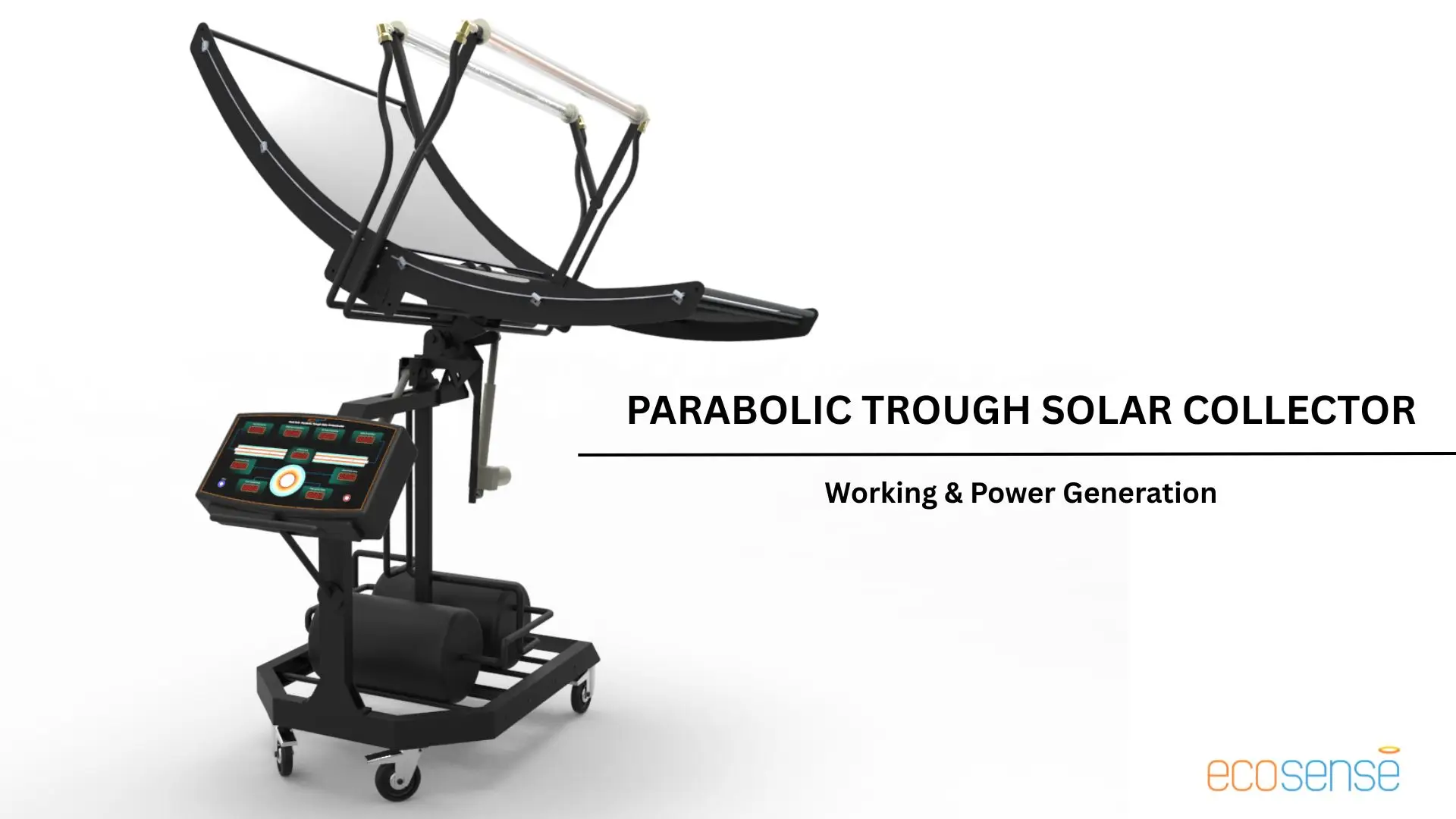
Parabolic Trough Solar Collector: Working & Power Generation
A parabolic trough solar collector (PTC) — often called simply a "parabolic collector" — is a Concentrating Solar Power (CSP) device that uses long, curved parabolic mirrors to focus sunlight onto a linear receiver tube running along the focal line. A heat transfer fluid inside the tube is heated to 300–550°C, generating thermal energy used for steam-based power generation, industrial process heat, or research training.
Parabolic trough collectors deliver thermal efficiency of 50–80% with concentration ratios of 70–80 suns, are paired with 6–16 hours of molten salt thermal energy storage system for dispatchable power, and have powered the world's largest CSP plants — including the 354 MW SEGS facility in California, 280 MW Solana in Arizona, and Andasol-1 in Spain. With 20+ year operational lifespans and proven reliability, PTCs remain the most mature CSP technology globally.
Introduction
The parabolic trough solar collector (PTC) is one of the most proven and efficient solar thermal technologies for medium- to high-temperature applications. Using a precisely curved mirror to focus sunlight onto a receiver tube, it converts solar radiation into usable heat energy. This heat can be used for power generation, process heating, or research and training in solar thermal systems. As the demand for sustainable power rises, PTCs play a vital role in demonstrating how concentrated solar energy can be harnessed effectively and efficiently.
What is a Parabolic Trough Collector?
A parabolic trough solar collector (PTC) is a type of solar thermal collector that's straight in one dimension and curved as a parabola in the other two. Sunlight entering parallel to its plane of symmetry gets focused along a focal line where a receiver tube — containing a circulating heat transfer fluid — captures and converts the concentrated solar radiation into usable heat.
The technology is also known simply as a "parabolic collector" or "solar trough collector". Unlike point-focus designs (parabolic dish, power tower), parabolic troughs use line-focus geometry — making them well-suited for utility-scale deployment where many troughs operate in parallel rows. Among the four CSP technologies, parabolic trough is the most mature, most commercially deployed, and most cost-proven — accounting for roughly two-thirds of installed CSP capacity globally.
PTCs achieve a concentration ratio of 70–80 suns and heat working fluids to 300–550°C, suitable for both medium-temperature industrial process heat and high-temperature steam generation for electricity.
Key Features of Solar Trough Collectors
- Concentrated Solar Heating: Uses parabolic mirrors to focus sunlight on a single line, generating high thermal energy.
- High Thermal Efficiency: Capable of achieving working fluid temperatures up to 400°C.
- Scalability: Modular design suitable for laboratory training, industrial heating, or solar power plants.
- Reliability: Proven technology with simple mechanical components and long operational life.
What Are the Components of a Parabolic Trough Collector?
A typical parabolic trough collector consists of several critical components that work in harmony to capture and convert solar energy:
- Parabolic Reflector: The main optical element shaped like a parabola to focus sunlight onto the receiver tube. Made from polished aluminum or glass mirrors for maximum reflectivity.
- Receiver Tube (Absorber): Positioned along the focal line of the trough, it contains a heat transfer fluid (HTF) that absorbs concentrated heat. The tube is enclosed in a glass envelope to minimize heat loss.
- Heat Transfer Fluid (HTF): Carries the thermal energy from the collector to a heat exchanger or storage system. Common HTFs include synthetic oils or molten salts.
- Support Structure and Tracking System: Holds the mirror assembly and adjusts its angle to follow the sun’s path, ensuring optimal focus throughout the day.
- Control and Instrumentation: Monitors temperature, flow rate, and efficiency parameters for performance evaluation.
How Does a Parabolic Trough Collector Work?
The working principle of a parabolic trough collector revolves around the conversion of solar radiation into heat energy through concentrated reflection. Here is the step-by-step process:
1. Solar Concentration: The parabolic mirrors are aligned to face the sun, focusing incoming solar rays onto a linear receiver tube at the focal line.
2. Heat Absorption: The receiver tube, coated with a selective surface, absorbs the concentrated heat while minimizing radiative losses.
3. Heat Transfer: A heat transfer fluid circulates through the receiver tube, carrying the absorbed energy to a heat exchanger or storage system.
4. Energy Utilization: The thermal energy can be used to produce steam for power generation, drive industrial processes, or support research in renewable energy.
5. Tracking System: A single-axis solar tracking mechanism continuously adjusts the mirror orientation to maintain maximum concentration throughout the day.
This process allows PTCs to achieve high energy density and efficiency, making them a preferred choice for solar thermal applications.

Fig. Working of Parabolic Trough Collector
Types of Heat Transfer Fluids Used in Solar Trough Collectors
The choice of heat transfer fluid directly influences system performance, safety, and temperature range. Commonly used HTFs include:
- Synthetic Oils: Widely used due to stability at high temperatures (up to 400°C) and good thermal conductivity.
- Molten Salts: Offer excellent heat storage capacity but require freeze protection at low temperatures.
- Water or Steam: Suitable for small-scale or experimental systems; simple but limited to moderate temperatures.
- Nanofluids (Emerging): Enhanced with nanoparticles to improve heat absorption and conductivity for research and next-gen systems.
PTC vs Other CSP Technologies
Concentrated Solar Power (CSP) consists of four distinct optical configurations. Parabolic trough is the most commercially mature; each has different geometry, scale, and use case:
Parabolic Trough
Temp: 300–550 °C
Scale: 50–500 MW plants
Storage: 6–16 hrs molten salt
Two-thirds of installed CSP capacity globally. Best for utility-scale dispatchable power + industrial heat.
Parabolic Dish
Temp: 500–1,200 °C
Scale: 3–25 kW per dish
Storage: Limited
Highest concentration. Modular point-focus. Best for distributed power and research labs.
Power Tower
Temp: 500–1,000 °C
Scale: 100–600 MW
Storage: 15+ hrs
Heliostats focus on central tower. Best for utility-scale + long-duration molten salt storage.
Linear Fresnel
Temp: 250–500 °C
Scale: 5–125 MW
Storage: Limited
Flat mirrors approximate parabolic geometry. Lower cost but lower efficiency than PTC.
PTC Comparison Table
Parabolic Trough Collector vs Solar PV Panels
Parabolic trough collectors and solar PV panels both harvest sunlight, but they operate on fundamentally different physics and serve different use cases:
Why PTCs Are Not Suitable for Homes
Despite their efficiency, parabolic trough collectors are not appropriate for residential rooftop installation. Three reasons:
- Size requirements: Each Solar Collector Module (SCM) is 6 m × 2.5 m or larger. A Solar Collector Assembly (SCA) reaches up to 200 metres in length — far beyond rooftop scale.
- Technical complexity: Tracking systems, high-temperature HTF circuits, and steam-cycle integration require specialist operation and maintenance.
- Economics: CapEx and balance-of-plant costs make PTCs viable only at MW-plus scale. For residential and small commercial, rooftop solar PV remains the practical choice.
Applications & Use Cases of Parabolic Trough Collectors
Parabolic trough collectors are versatile because their thermal output (300-550°C) maps to many end-use sectors — far beyond just utility-scale electricity:
Utility-Scale Power
50–500 MW concentrating solar power plants with grid connection
Industrial Process Heat
Steam, hot water, and high-temp heat for textiles, food, chemicals, dairy
Solar Desalination
Thermal desalination for coastal arid regions; converts seawater to freshwater
Solar Cooling
Absorption chiller systems for air conditioning in sunny climates
District Heating
Community-scale hot water and space-heating networks
Enhanced Oil Recovery
Steam injection for heavy oil extraction; deployed at GlassPoint Mirah, Oman
Research & Education
Solar thermal labs for engineering training and experimental research
Hybrid Solar-Fossil
ISCC plants pairing PTC steam with natural gas for higher overall efficiency (up to 60.9%)
Advantages and Disadvantages of Parabolic Trough Collectors
Empowering Solar Thermal Research with Ecosense
Parabolic Trough Collector Outlook in India
- Rajasthan (Jaisalmer, Bikaner, Jodhpur): DNI 5.5-6.5 kWh/m²/day. Site of the National Solar Thermal Power Plant (NSTPP) at Gurgaon and various MNRE-supported CSP demonstrations.
- Gujarat (Kutch, Charanka): High DNI year-round combined with industrial demand. Co-located with major solar parks.
- Ladakh: Highest DNI in India (6.5+ kWh/m²/day) plus cold ambient temperature — favourable for receiver thermal performance.
- Industrial process heat — pilot plants in Rajasthan textile and dairy operations
- Solar steam cooking — community kitchens at Tirupati Tirumala and Shirdi Sai Baba Sansthan use Scheffler-dish concentrators with similar working principles to PTCs
- Hybrid solar-thermal applications — proposed integration with existing thermal power plants under MNRE schemes
- Research & education — IITs, NITs, and engineering colleges using lab-scale PTC modules for CSP curriculum