
Molten Salt Storage: Thermal Tech, Cost Savings & Future
Molten salt storage is a thermal energy storage technology that stores heat in liquid nitrate salts (typically a 60% NaNO₃ + 40% KNO₃ eutectic mix called Solar Salt) at temperatures between 290°C and 565°C. Used primarily in Concentrated Solar Power (CSP) plants, it can deliver 10–24 hours of dispatchable power on demand and is approximately 33 times cheaper per kWh than lithium-ion batteries for long-duration storage. As India targets 500 GW of renewable capacity by 2030 and net-zero by 2070, molten salt thermal storage has become a critical enabler of round-the-clock solar power generation.
Cheaper than lithium-ion batteries (per kWh stored)
Molten salt costs €25–70 per kWh-thermal vs €833–1,400 per kWh-electric for lithium-ion battery systems — making it the most economical long-duration storage option for utility-scale CSP plants.
Source: BVES (German Energy Storage Association)
What is Molten Salt Storage?
Molten Salt Energy Storage (MSES) is a thermal energy storage system that uses liquid nitrate salts to store heat at high temperatures (290°C–565°C). The salt is most commonly Solar Salt — a eutectic mixture of:
- 60% Sodium Nitrate (NaNO₃)
- 40% Potassium Nitrate (KNO₃)
In CSP systems, molten salt acts as both a heat transfer fluid (HTF) and a thermal reservoir — storing solar heat collected by concentrators and releasing it on demand to produce superheated steam for electricity generation.
Most modern CSP plants — including Ivanpah (USA), Andasol (Spain), and Noor (Morocco) — rely on molten salt storage to extend solar generation into the evening and night, enabling truly dispatchable renewable power.
How Molten Salt Storage Works?
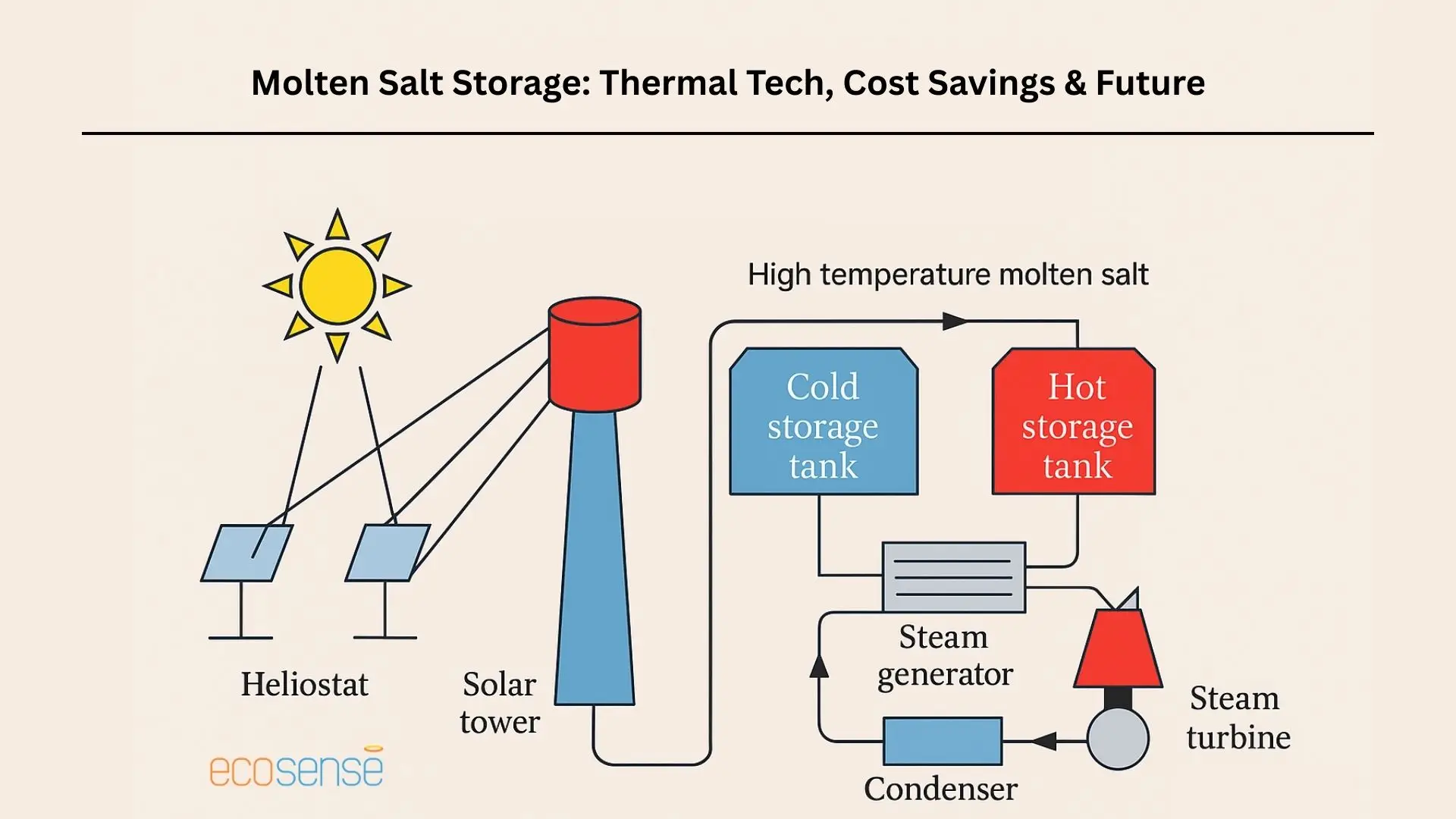
Molten salt storage typically uses a two-tank indirect system, comprising a Cold Tank (≈290°C) and a Hot Tank (≈565°C) connected through a heat exchanger network.
Here is how the system operates step-by-step:
- Solar Energy Collection: A parabolic trough, solar tower, or linear Fresnel collector focuses sunlight onto a receiver. Among these, solar parabolic dish systems achieve the highest concentration ratios, making them ideal for high-temperature experimental and industrial thermal storage applications.
- Heat Exchange: The hot HTF passes through a shell-and-tube heat exchanger, transferring thermal energy to the molten salt in the hot tank.
- Thermal Storage: The hot tank, insulated with ceramic fiber or mineral wool and lined with stainless steel (SS 316L), stores the molten salt at high temperature and pressure.
- Power Generation: When electricity is needed, molten salt flows through another heat exchanger that generates superheated steam (≈540°C, 100 bar) to drive a Rankine cycle turbine.
- Recirculation: After energy extraction, the cooler molten salt returns to the cold tank, ready for reheating — ensuring a continuous, closed-loop operation.

Fig. Molten Salt energy Storage
The Thermal Technology Behind Molten Salt Storage
Molten salt systems operate on the principle of sensible heat storage — thermal energy is stored by raising the temperature of the molten medium without phase change. Six engineering parameters define system performance:
⚗️ Salt Composition
Binary NaNO₃–KNO₃ mixtures or ternary salts with Ca(NO₃)₂ for lower melting points (down to 130°C).
🌡️ Operating Range
290–565°C
Standard window. Advanced salts now reaching 600°C+ for higher Carnot efficiency.
🛡️ Tank Material
Austenitic stainless steel (SS 316L) or Inconel 625 — corrosion-resistant under hot nitrate environments.
🌡️ Heat Loss
< 1% / day
Multi-layer insulation (ceramic fiber + mineral wool) keeps daily losses minimal.
🔄 Pump & Flow
10–20 m³/h
Centrifugal pumps designed for high-viscosity hot salt fluids maintain steady transfer rates.
⚡ Round-Trip Efficiency
90–95%
Depends on tank insulation, ambient conditions, and HX design. Among the highest in long-duration storage.
Molten Salt Storage vs Lithium-Ion Batteries: Cost & Performance
For long-duration energy storage (4+ hours), molten salt thermal storage is dramatically cheaper than lithium-ion battery systems. Here's a side-by-side comparison based on data from BVES (German Energy Storage Association) and the German Aerospace Center (DLR):
| Parameter | Molten Salt Storage | Lithium-Ion Battery | Pumped Hydro |
| Capital Cost (per kWh) | €25–70 / kWh-th (₹2,200–6,200) | €833–1,400 / kWh-el (₹74,000–1,24,000) | €60–150 / kWh-el |
| Storage Duration | 10-24 hours | 2-6 hours | 8-20 hours |
| Operating Temperature | 290-565 deg. Celcius | 15-35 deg. Celcius | Ambient |
| Round-trip efficiency | 90-95% | 90-95% | 70-85% |
| Lifecycle | 25-35 years / 10000+ cycles | 10-15 years / 3000-6000 cycles | 50+ years |
| Geographic flexibility | Limited (needs CSP) | Anywhere | Needs elevation + water |
| Best use case | CSP plants, inductrial heat | Short-duration grid balancing, EVs | Bulk grid storage |
Cost Savings: Economic Edge Over Conventional Storage
Molten salt storage provides a cost-effective solution for long-duration energy storage, especially for utility-scale solar projects.
Compared to lithium-ion batteries or mechanical systems, the advantages include:
- Lower Levelized Cost of Storage (LCOS): Around ₹4–6 per kWh-thermal, significantly cheaper than chemical batteries.
- High Energy Density: Enables 10–15 hours of full-load energy dispatch.
- Long Operational Life: More than 30 years with minimal capacity loss.
- Local Availability: India has domestic sources of nitrate salts, reducing import dependency.
- Reduced CapEx per kWh: Especially beneficial for CSP plants above 50 MW capacity.
For India’s economics, this technology supports grid stability, reduces diesel-based backup, and complements National Solar Mission goals through reliable thermal storage.
Why Choose Molten Salt Over Other Storage Technologies?
Compared to other long-duration storage options, molten salt offers a unique combination of cost, scalability, and operational maturity:
- Lowest capital cost per kWh-thermal among proven storage techs (€25–70/kWh vs €833–1,400 for batteries).
- Long operational life — 25–35 years with minimal degradation, 2–3× longer than lithium-ion.
- High energy density — 75–200 kWh per cubic metre of salt, enables compact storage at gigawatt scale.
- Native compatibility with CSP — no conversion losses; thermal energy stored as thermal energy.
- Domestic supply chain in India — nitrate salts produced locally, reducing import dependency unlike lithium-ion (China-dominant supply).
- Non-flammable, non-toxic, recyclable — significantly safer than lithium-ion at scale (no thermal runaway risk).
- Mature technology — first commercial deployment in 2008 (Andasol, Spain), 17+ years of operational track record.
How Ecosense is Advancing Molten Salt Storage Innovation?
Ecosense Sustainable Solutions develops Solar Thermal Energy Storage System integrated with Solar FPC/ Solar ETC/ Solar PTC or CSP system that allow academic and R&D institutions to simulate molten salt storage and analyze thermal performance parameters such as:
- Heat transfer coefficient variation with flow rate
- Temperature distribution within the storage medium
- Thermal efficiency and exergy analysis
- Salt degradation studies under cyclic heating
Our Solar Thermal Lab Systems are built for real-time experimentation, equipping engineers to design and optimize future CSP-integrated storage systems for industrial and utility applications.
Shaping the Solar Future: Applications and Transformative Impact
Molten salt storage is rapidly transforming India’s renewable infrastructure, particularly in solar-rich regions like Rajasthan, Gujarat, and Ladakh. Key applications include:
- Concentrated Solar Power (CSP) plants — dispatchable energy for 24×7 generation
- Industrial heating — for metallurgy, chemical processing, and desalination
- Green hydrogen generation — thermal coupling with electrolyzers for efficient hydrogen production
- Hybrid renewable grids — integrating wind and solar with thermal buffering
- District heating and cooling — especially in smart city infrastructure
These applications highlight how molten salt technology bridges the gap between solar energy availability and grid demand, supporting India’s march toward 500 GW of renewable capacity by 2030.
Conclusion
Molten salt thermal storage is more than just a storage medium—it’s the backbone of next-generation solar power systems. By combining thermal stability, scalability, and low lifecycle cost, it enables renewable energy to be as reliable as conventional power. Ecosense continues to champion this evolution, empowering engineers, and researchers to drive innovation in sustainable solar thermal technologies.