
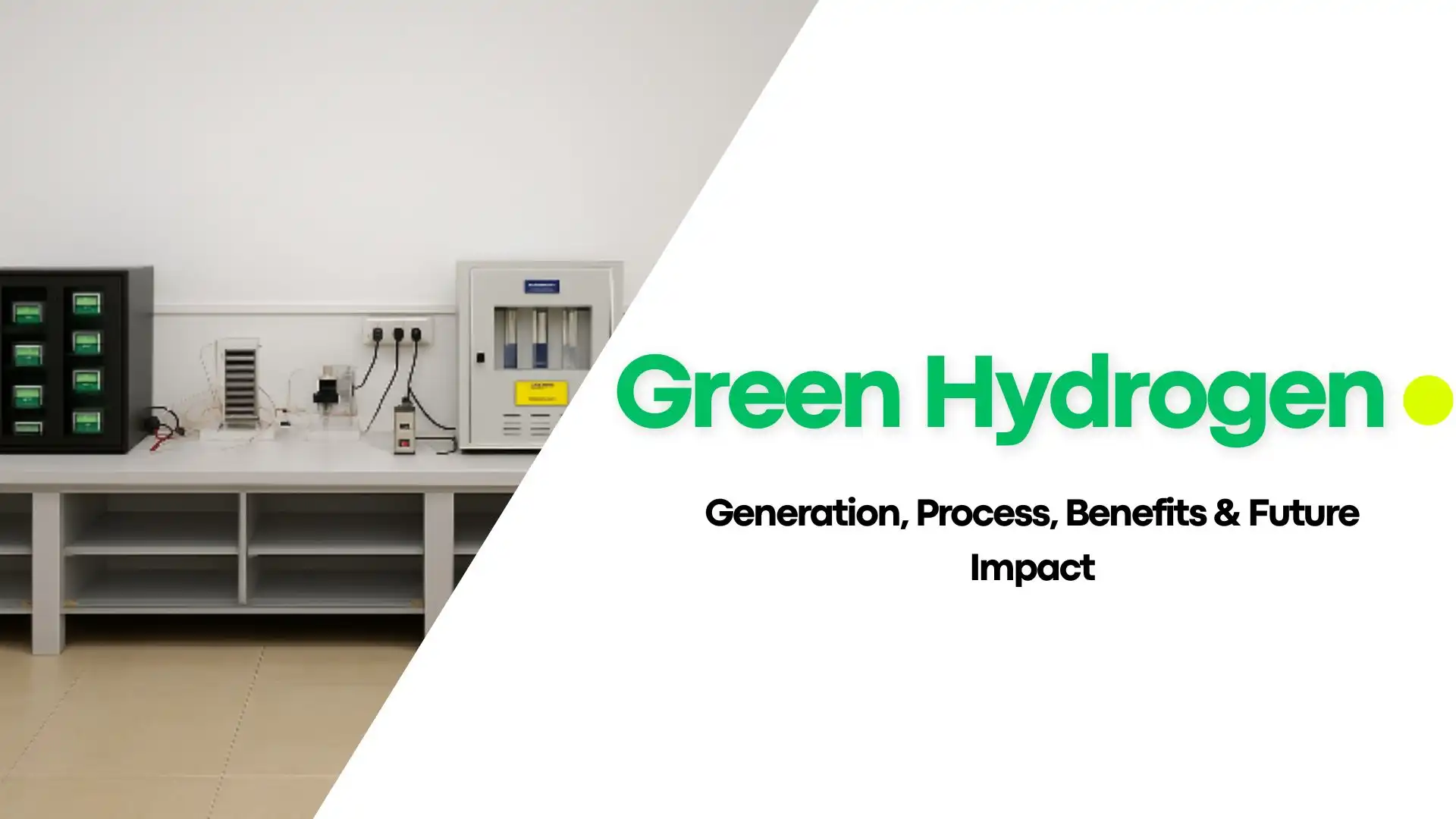
Green Hydrogen Generation: Process, Benefits & Future Impact
Introduction
Green hydrogen is hydrogen gas produced by splitting water (H₂O) into hydrogen (H₂) and oxygen (O₂) using electricity from renewable sources such as solar and wind. The process — called electrolysis — produces zero carbon emissions, making green hydrogen the cleanest form of hydrogen available today.
Unlike grey hydrogen (made from natural gas) or blue hydrogen (grey + carbon capture), green hydrogen is the only fully decarbonised hydrogen pathway. It is positioned as a critical fuel for industries that cannot easily be electrified — steel, ammonia, refining, heavy transport, shipping, and aviation.
India's National Green Hydrogen Mission targets 5 million tonnes of green hydrogen production per year by 2030, requiring approximately 60–125 GW of electrolyser capacity and ~₹8 lakh crore in investment.
What is Green Hydrogen and How is it Obtained?
Green hydrogen is hydrogen gas produced through the electrolysis of water using electricity sourced exclusively from renewable energy — solar photovoltaic (PV), wind, hydropower, or any other carbon-free source. Because no fossil fuels are burnt at any stage of production, green hydrogen carries effectively zero CO₂ emissions over its lifecycle.
The reaction itself is simple. An electrolyser passes a direct electric current through purified water (H₂O), splitting each molecule into hydrogen (H₂) at one electrode and oxygen (O₂) at the other. The fundamental chemical equation across all electrolysis types is:
OVERALL REACTION : 2H₂O(l) → 2H₂(g) + O₂(g)
Inside the electrolyser, two half-reactions occur simultaneously at the electrodes:
CATHODE (reduction): 4H⁺ + 4e⁻ → 2H₂
ANODE (oxidation): 2H₂O → O₂ + 4H⁺ + 4e⁻
Hydrogen forms at the cathode; oxygen forms at the anode. A membrane or diaphragm keeps the two gases physically separated, ensuring high-purity hydrogen output. The energy required to drive the reaction is roughly 50 kWh of electricity per kilogram of hydrogen for commercial systems — equivalent to about 9 litres of water consumed per kg of H₂ produced.
Process Overview:
- Water Demineralization: The water used in electrolysis must be purified or demineralized to remove minerals and impurities that can affect the electrolyzer’s performance.
- Electrolysis: In the electrolyzer, electric current from renewable energy sources splits water into hydrogen and oxygen gases.
- Hydrogen Drying: The generated hydrogen is passed through drying systems to remove residual moisture and ensure gas purity.
- Hydrogen Storage: The purified hydrogen is then compressed and stored in high-pressure cylinders or tanks for later use.
- End Use: Green hydrogen serves as a clean fuel for fuel cells, industrial applications, and transportation systems, providing an efficient and emission-free power source.

This closed-loop process allows green hydrogen to act as both a clean fuel and an energy carrier, bridging the gap between renewable energy generation and reliable energy supply.
Key Stats
| Global H2 Market | 155 Billion USD (2022) |
| 2023-2030 Growth | 9.3% CAGR |
| India 2030 Target | 5MT/year |
| Energy to make 1kg. H2 | ~ 50kWh/kg |
What is Green Hydrogen as per the Government of India?
According to the Ministry of New and Renewable Energy (MNRE), Government of India, under the Green Hydrogen Standard for India (August 2023):
Green Hydrogen is defined as hydrogen produced using renewable energy, with well-to-gate greenhouse gas (GHG) emissions not exceeding 2 kg CO₂ equivalent per kg H₂.
Note:
The “Well-to-Gate” boundary includes all emissions from water treatment, electrolysis, gas purification, drying, and compression — up to the point of hydrogen output from the production facility.
The standard ensures that only hydrogen produced through renewable or biomass-based energy with verified low emissions qualifies as green.
This definition sets a clear and measurable benchmark for producers, investors, and policymakers, helping align India’s hydrogen ecosystem with international sustainability norms. It also supports the National Green Hydrogen Mission (NGHM), which aims to make India a global hub for green hydrogen production, usage, and export.
Green vs Grey vs Blue Hydrogen : What is the difference?
Hydrogen is classified by colour based on the energy source and emissions profile of its production. Five colour categories dominate industry discussion:
Green Hydrogen (Zero Emissons) | Renewable Electricity + Electrolysis The cleanest pathway. Solar/wind powers electrolysis to split water. Zero CO₂ emissions over lifecycle. |
Blue Hydrogen (Low Emissions) | Natural Gas + Carbon Capture (CCS) Made from natural gas via steam methane reforming, but CO₂ is captured and stored. Lower emissions than grey but not zero. |
Grey Hydrogen (High Emissions) | Natural Gas (No carbon capture) Today's dominant production method (~76% of global supply). Emits 8–12 kg of CO₂ per kg of hydrogen. |
Turqouise Hydrogen (Solid Carbon By-product) | Methane Pyrolysis Methane is split thermally into hydrogen and solid carbon (no CO₂ released). Emerging at pilot scale. |
Pink Hydrogen (Zero Emissions) | Nuclear Electricity + Electrolysis Same electrolysis process for green hydrogen, but powered by nuclear instead of renewables. Zero emissions. |
As of 2024, ~99% of global hydrogen production is grey or brown (coal-derived), with green hydrogen accounting for less than 1% — but green hydrogen has the steepest growth trajectory. [Source: Wikipedia / IEA Global Hydrogen Review].
Type of Electrolysis used in Green Hydrogen Generation
| Type | Electrolyte | Operating Temp. | Best For | Maturity |
Alkaline (ALK) | Liquid KOH | 60-90 deg. Celsius | Large industrial-scale, steady power | Fully Mature |
| PEM | Solid Polymer | 50-90 deg. Celsius | Solar/wind-paired, fast response | Commercial |
| AEM | Solid anion membrane | 40-70 deg. Celsius | Modular, distributed projects | Emerging |
| SOEC | Solid Ceramic | 650-1000 deg. Celsius | Industrial waste-heat sites | Pre- Commercial |
Hydrogen as Clean Energy
Hydrogen is often referred to as the “fuel of the future” because of its unique ability to store, transport, and deliver energy efficiently without releasing greenhouse gases. When used in fuel cells, hydrogen combines with oxygen to generate electricity, producing only water vapor and heat as byproducts.
This property makes it particularly suitable for decarbonizing hard-to-abate sectors such as steel, cement, fertilizers, and long-distance transportation—sectors that are challenging to electrify using batteries alone.
Moreover, hydrogen plays a vital role in enhancing the flexibility of renewable energy systems. It can store excess electricity generated from solar and wind power and reconvert it to electricity when demand is high, helping stabilize energy grids. By integrating hydrogen into national clean energy frameworks, countries can significantly reduce fossil fuel dependence and build resilient, low-carbon energy infrastructures.
Advantages and Disadvantages of Green Hydrogen
Advantages
- Zero Carbon Emissions: When powered by renewables, the production and use of hydrogen generate no greenhouse gas emissions.
- Energy Storage Solution: Enables storage of surplus renewable energy for future use, bridging supply-demand gaps.
- Versatile Applications: Can be used for transportation, power generation, industrial heating, and as a feedstock in chemical processes.
- Decentralized Production: Can be generated locally, reducing dependence on imported fuels and enhancing energy security.
Disadvantages
- High Production Costs: Electrolyzers and renewable energy systems still involve high capital expenditure compared to conventional hydrogen production methods.
- Infrastructure Challenges: Requires new infrastructure for storage, transportation, and distribution, including pipelines and refueling stations.
- Energy Efficiency Losses: Conversion inefficiencies occur during both electrolysis and fuel cell operations, reducing overall energy output.
Despite these challenges, advancements in electrolyzer efficiency, economies of scale, and supportive policy measures are driving costs down. The global momentum toward carbon neutrality is steadily positioning green hydrogen as a key enabler of clean energy transformation.
Applications & Use Cases of Green Hydrogen
Green Hydrogen is most valuable in sectors where direct electrification is impractical - high - temperature industrial heat, heavy transport, and chemical feedstocks:
Steel Production
Replaces coking coal in DRI; cuts steel emissions by 95%
Ammonia & Fertilizers
Replaces grey H₂ in Haber–Bosch process
Heavy Transport
Trucks, buses, trains where batteries are impractical
Shipping & Aviation
Via green ammonia and synthetic e-fuels
Refineries
Decarbonises hydrocracking and desulphurisation
Energy Storage
Long-duration storage for grid balancing
Power Generation
Hydrogen turbines and fuel cells
Domestic Heat
Hydrogen blending in natural gas networks
In India specifically, the largest near-term green hydrogen demand is expected from refineries (replacing grey H₂ feedstock) and fertilizer manufacturing (green ammonia for urea production), followed by long-haul trucking and steelmaking by the late 2020s.
Future Impact and Challenges
The future of green hydrogen appears exceptionally promising, backed by strong policy support, global investments, and technological innovation. As the world seeks alternatives to fossil fuels, green hydrogen can revolutionize industries, powering zero-emission transportation, decarbonizing industrial manufacturing, and supporting renewable energy storage.
However, several challenges must be addressed to unlock its full potential:
- Cost Reduction: Production costs must continue to fall through innovation and scale.
- Electrolyzer Manufacturing: India and other countries must enhance local manufacturing capacities.
- Infrastructure Development: Robust hydrogen transport, storage, and refueling networks are essential.
In the long term, continued research and innovation, along with declining renewable energy costs and favorable policies, will make green hydrogen a mainstream energy carrier. It has the potential to fundamentally reshape the way the world produces, stores, and consumes energy — paving the way for a cleaner, self-sustaining future.
How Ecosense is Driving Green Hydrogen Innovation
At Ecosense Sustainable Solutions, we are committed to accelerating hydrogen education and research through our advanced Green Hydrogen Laboratory Systems. These hands-on training platforms enable students and researchers to explore the full spectrum of hydrogen technology — from electrolysis and hydrogen storage to fuel cell operation and safety management — all within a safe, controlled environment.
Our laboratory setups feature PEM, AEM, and Alkaline electrolyzers, multiple storage and safety modules, PEM fuel cells, and real-time data monitoring systems. By integrating renewable energy sources and hydrogen generation components, Ecosense empowers academic institutions to build practical understanding and nurture innovation.
Through these initiatives, Ecosense supports India’s vision of becoming a global leader in green hydrogen technology and contributes to the creation of a skilled clean energy workforce.
Conclusion
Green hydrogen stands at the forefront of the global energy revolution. Its potential to replace fossil fuels, enable large-scale energy storage, and decarbonize critical sectors makes it indispensable for a sustainable future. While challenges such as cost and infrastructure remain, continuous innovation and collaboration are driving progress faster than ever before.
With cutting-edge solutions like Ecosense’s Green Hydrogen Lab, academia and industry are joining forces to build a cleaner, hydrogen-powered world for generations to come.
Share this article: