Green Hydrogen Lab Installation at IIT Delhi
Ecosense installs a Green Hydrogen Generation and Utilization System at IIT Delhi, enabling PEM electrolysis, fuel cell research, and hydrogen energy lab experiments.

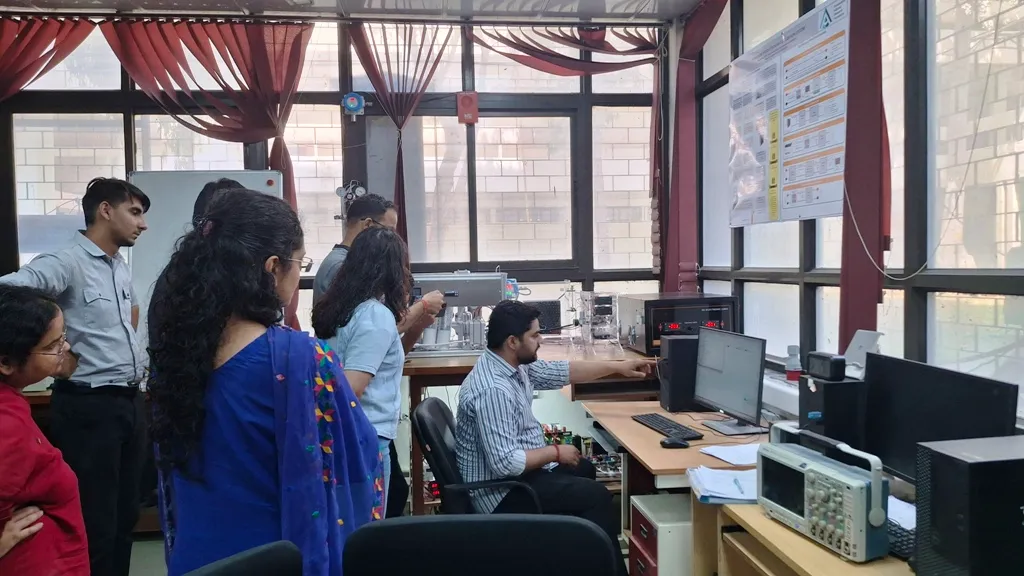
Ecosense installs a Green Hydrogen Generation and Utilization System at IIT Delhi, enabling PEM electrolysis, fuel cell research, and hydrogen energy lab experiments.
IIT Delhi has commissioned a Green Hydrogen Generation and Utilization System (GHGUS) from Ecosense Sustainable Solutions Pvt. Ltd., establishing one of India's most complete hydrogen energy research labs within its engineering curriculum. The system integrates PEM water electrolysis, hydrogen storage, PEM fuel cell power generation, battery storage, and a single-phase inverter into a single, self-contained laboratory platform. Designed for both undergraduate and postgraduate research, this green hydrogen lab gives IIT Delhi students and faculty hands-on access to the full hydrogen energy chain — from water splitting to grid-compatible AC power output.
Ecosense delivered and commissioned the Green Hydrogen Generation, Storage and Utilization System at IIT Delhi as a turnkey laboratory solution for advanced research in clean energy systems. The system is housed within IIT Delhi's electrical engineering and energy research facilities and is fully operational for student experiments, faculty-led investigations, and sponsored research programmes.
The installation brings together PEM electrolyser technology, compressed hydrogen handling, fuel cell power conversion, and programmable power electronics under one roof — a combination that mirrors the architecture of real-world hydrogen energy systems being deployed across industrial and utility sectors globally.
The GHGUS at IIT Delhi was designed to the exact specifications of the institute's research requirements, incorporating a distributed STM32-based control architecture, four LabVIEW virtual instrument interfaces, and an independent Arduino Minima safety controller for hydrogen leak protection. Every sub-system is instrumented with LEM sensors and feeds real-time data to LabVIEW VIs running on the host PC, enabling research-grade measurements from day one.
The Green Hydrogen Generation and Utilization System is Ecosense's flagship hydrogen energy research platform, purpose-built for Indian engineering institutions at the frontier of clean energy education. It covers the complete hydrogen energy value chain in a single integrated unit:
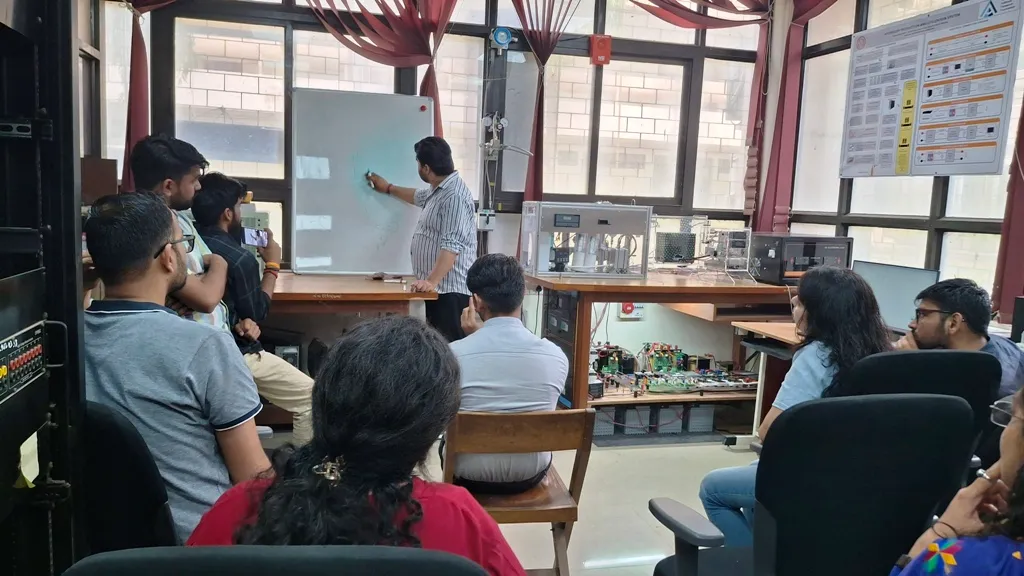
The green hydrogen lab at IIT Delhi supports a comprehensive range of experiments spanning electrochemistry, power electronics, control systems, energy management, and safety engineering.
PEM Electrolyser Characterisation: Students measure the electrolyser V-I polarisation curve by sweeping the SMPS current set-point via STM-1 DAC and recording stack voltage, current, and hydrogen mass flow rate in real time. Faradaic efficiency and specific energy consumption (kWh/Nm³ H₂) are calculated from the acquired data, giving direct insight into the electrolytic efficiency of the PEM stack.
Fuel Cell V-I Curve and Power Characterisation: The fuel cell polarisation curve experiment involves stepping the DC electronic load current in 2 A increments while recording FC Voltage and FC Current via Fuel_Cell.vi and STM-2. Students identify the three loss regions (activation, ohmic, mass-transport), determine maximum power point, and benchmark hydrogen utilisation efficiency across operating conditions.
Boost Converter Duty Cycle and MPPT Studies: With the boost converter duty cycle fully controllable via STM-2 PWM-1, students can verify the ideal voltage gain equation V_out = V_in / (1 − D), measure inductor current ripple on an oscilloscope, calculate converter efficiency, and implement maximum power point tracking algorithms in LabVIEW — connecting power electronics theory directly to experimental hardware.
Inverter Harmonic Analysis and SPWM Modulation: Using the single-phase Power Analyser at the inverter AC output, students quantify THD as a function of modulation index and load, observe the harmonic spectrum with energy concentrated at 2 × f_sw (20 kHz), and verify the mathematical relationship between modulation index and output voltage — providing a research-grade platform for modulation strategy comparison.
Battery State-of-Charge and Hybridisation Research: The 48 V battery bank enables C-rate characterisation, Coulomb-counting SoC estimation, and hybrid fuel cell + battery energy management algorithm development. Faculty can design and test energy dispatch strategies in LabVIEW that prioritise fuel cell output and use the battery for load transient buffering — directly applicable to hydrogen microgrid research.
Full Hydrogen Energy Chain Efficiency Benchmarking: By simultaneously recording SMPS AC input power (Power Analyser), electrolyser stack power (STM-1), fuel cell power (STM-2), DC link power, and AC output power (Power Analyser), students can map the complete water-to-AC-power round-trip efficiency — a benchmark measurement that is central to evaluating real-world hydrogen energy systems.
Safety Engineering and Leak Response Studies: The three-point HLD system and Arduino Minima controller provide a live, fully functional hydrogen safety interlock for study. Students can observe the relay de-energisation sequence, measure system response time from HLD trigger to full electrical shutdown, and understand the design principles behind hardware-guaranteed safety systems in hydrogen facilities.
Research-Grade Instrumentation Out of the Box: Every sub-system in the GHGUS is instrumented with LEM sensors (LV 20P, LA 100P, LA 55P, LA 25P) and connects to a calibrated LabVIEW data acquisition interface. There is no integration work required — students begin acquiring data from the first session.
Open Architecture for Custom Algorithm Development: The LabVIEW VIs expose all DAC, ADC, and PWM channels to users, enabling IIT Delhi faculty to implement custom PID controllers, MPPT algorithms, energy management strategies, or modulation techniques without hardware modification. The STM32 firmware source is provided for full programmability.
Interdisciplinary Coverage Across Departments: The GHGUS platform is relevant to Electrical Engineering (power electronics, control, energy storage), Chemical Engineering (electrochemistry, membrane science), Mechanical Engineering (thermodynamics, hydrogen compression), and Systems Engineering (safety, automation) — making it a shared research asset across multiple IIT Delhi departments.
Industry-Aligned Technology Stack: PEM electrolysis, PEM fuel cells, IGBT-based power converters, Modbus-based inverter control, and LabVIEW SCADA are all technologies actively used in industrial hydrogen plants, EV charging infrastructure, and grid-scale energy storage. IIT Delhi graduates trained on the GHGUS enter industry with direct, hands-on experience on commercially relevant platforms.
Comprehensive Safety Compliance: The independent Arduino Minima safety controller, three HLD nodes, dual solenoid valve shutoff, 35 bar pressure relief, and full MCB and relay protection chain meet the safety requirements expected in a Tier-1 research institution. The system is designed to operate safely in IIT Delhi's laboratory environment without requiring additional safety infrastructure.
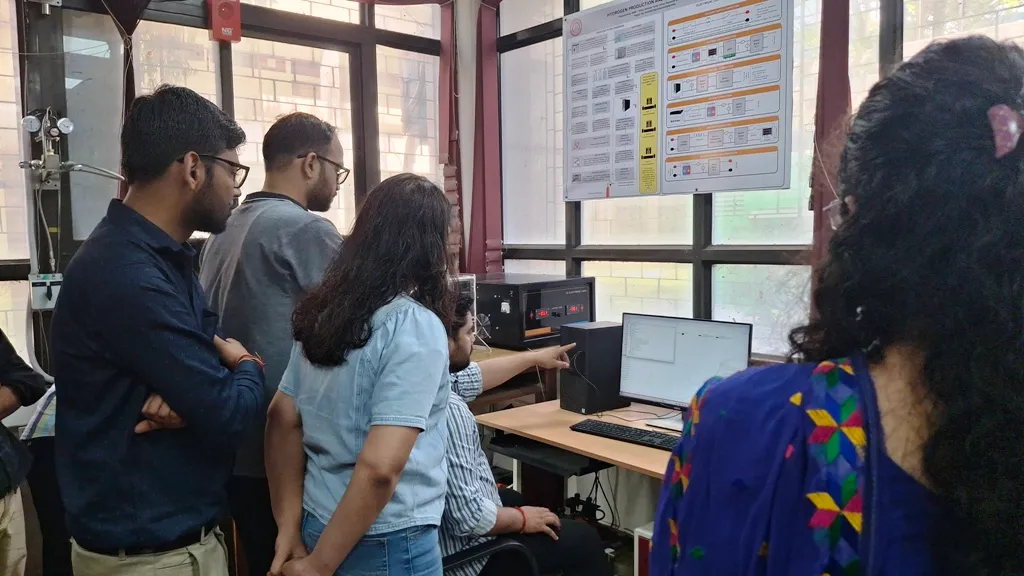
Ecosense Sustainable Solutions Pvt. Ltd. is a New Delhi-based manufacturer and exporter of renewable energy and hydrogen laboratory systems for engineering institutions across India and internationally. Ecosense designs, manufactures, installs, and supports its systems in-house, with no reliance on third-party integrators for core technical functions.
The GHGUS reflects Ecosense's approach to laboratory design: every component serves an educational purpose, every signal is instrumented and accessible, and every safety function is hardware-guaranteed rather than software-dependent. From the Nafion PEM electrolyser to the unipolar SPWM inverter, the platform is engineered to the depth that IIT Delhi's research community demands.
Ecosense has supplied renewable energy and hydrogen laboratory systems to IITs, NITs, and research institutions across India, with each installation customised to the institution's specific academic and research objectives.