DFIG Wind Turbine Emulator Installation at Gati Shakti Vishwavidyalaya
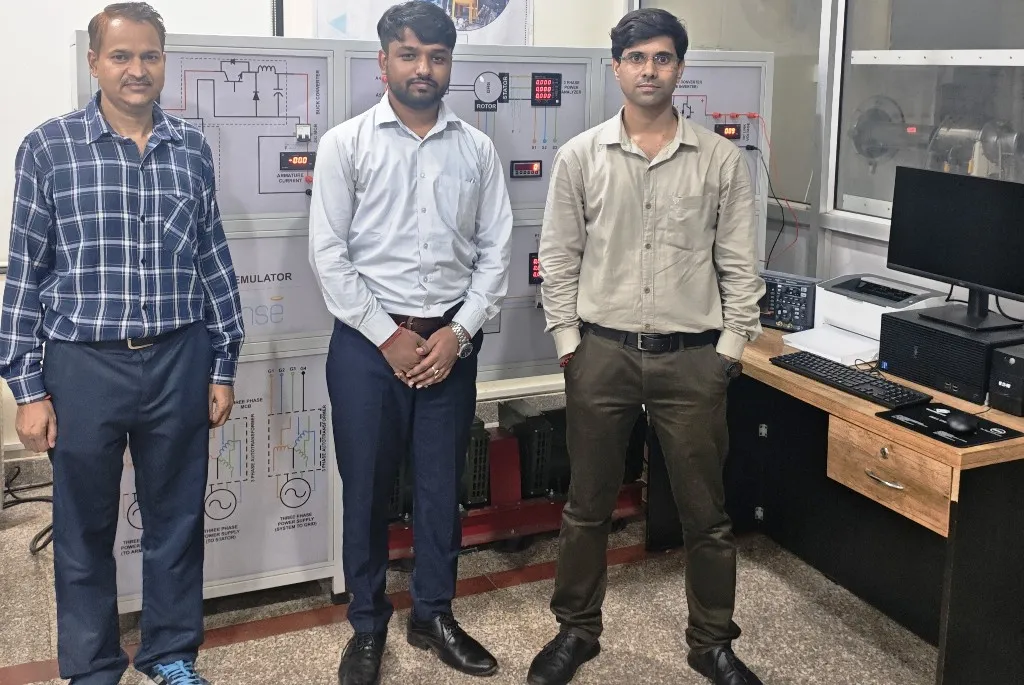
DFIG Wind Turbine Emulator installed at Gati Shakti Vishwavidyalaya for practical study of wind energy conversion, DFIG operation, and grid integration.

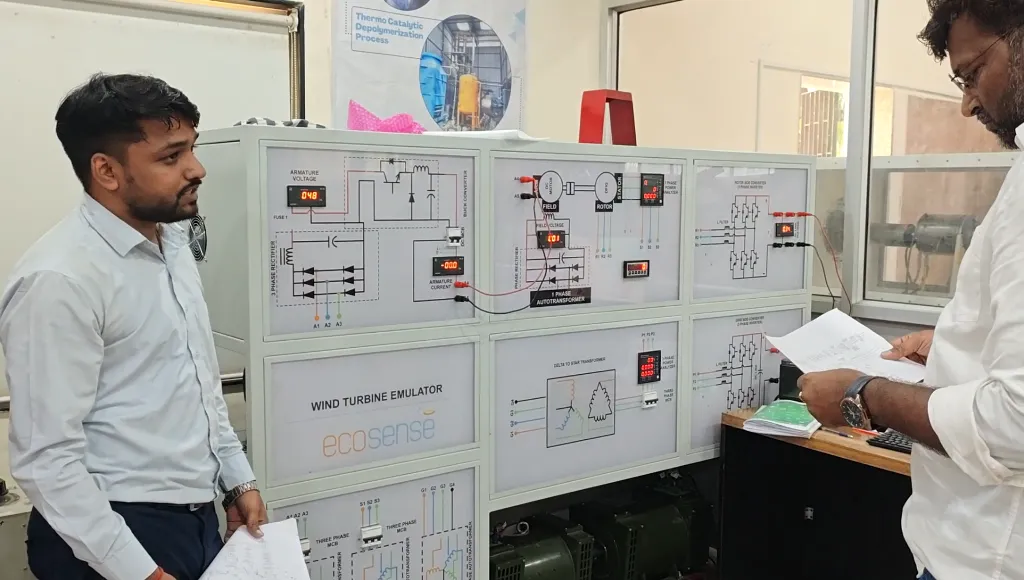
DFIG Wind Turbine Emulator installed at Gati Shakti Vishwavidyalaya for practical study of wind energy conversion, DFIG operation, and grid integration.
Ecosense Sustainable Solutions Pvt. Ltd. has successfully installed a DFIG-Based Wind Turbine Emulator at Gati Shakti Vishwavidyalaya. The laboratory system provides a controlled platform for studying variable-speed wind energy conversion, doubly fed induction generator operation, power electronics, and grid-connected wind power systems.
The DFIG Wind Turbine Emulator installed at Gati Shakti Vishwavidyalaya is designed to provide hands-on exposure to the electrical and control aspects of modern wind energy conversion systems. The system emulates the behaviour of a wind turbine and DFIG-based generation system under controlled laboratory conditions.
A Doubly Fed Induction Generator is widely used in variable-speed wind turbines because it allows the generator to operate over a range of speeds while enabling control of electrical power through power electronic converters. Studying such a system requires practical understanding of electrical machines, converters, control systems, and grid interaction.
The installed emulator brings these concepts together in a laboratory environment where different operating conditions can be reproduced and analysed. Students and researchers can therefore study wind energy conversion without depending on the availability or variability of actual wind conditions.
A wind turbine converts the kinetic energy available in moving air into mechanical rotational energy, which is then converted into electrical energy by a generator. In a DFIG-based wind energy conversion system, the generator operates at variable speed while power electronic converters provide control over the electrical characteristics of the system.
The
DFIG Wind Turbine Emulator reproduces the operating behaviour of this system in
a controlled laboratory setup. Simulated wind conditions can be varied to study
corresponding changes in turbine speed, generator operation, and electrical
power generation.
This
approach makes it possible to perform repeatable experiments and investigate
different operating points that may be difficult to reproduce using a physical
wind turbine.
One of the key advantages of an emulator-based laboratory system is the ability to reproduce operating conditions in a controlled manner. Actual wind turbines are influenced by continuously changing wind speed and environmental conditions, making some experiments difficult to repeat under identical conditions.
A wind turbine emulator addresses this challenge by allowing defined operating conditions to be introduced into the system. Students can therefore compare system responses under different conditions and relate theoretical concepts to measurable electrical and mechanical parameters.
This makes the platform suitable for structured laboratory experiments as well as open-ended research work where different control approaches or operating conditions need to be investigated.
Modern wind energy systems increasingly use variable-speed operation to improve energy capture and provide greater control over generator operation. The DFIG is an important generator configuration used for this purpose.
The laboratory emulator provides an opportunity to examine this technology at an engineering-system level. Students can study how the simulated turbine input affects generator speed and how the electrical conversion system manages power exchange with the grid.
Such practical experimentation helps connect subjects that are often taught separately, including electrical machines, power electronics, control engineering, renewable energy systems, and power systems.
Ecosense Sustainable Solutions Pvt. Ltd. develops and supplies laboratory and research systems for renewable energy, electric mobility, hydrogen, energy storage, and other emerging clean-energy technologies.
Our renewable energy laboratory solutions are designed to provide educational institutions with practical platforms for understanding real-world energy conversion technologies. The systems combine physical hardware, controlled operation, measurement, and experimentation to support hands-on technical learning.
The DFIG-Based Wind Turbine Emulator installed at Gati Shakti Vishwavidyalaya represents this approach by providing a dedicated platform for practical study of variable-speed wind energy conversion and DFIG-based grid integration.
Ecosense also supports institutions with customized laboratory solutions based on their academic curriculum, research requirements, and laboratory objectives.