
Supercapacitors

Key Features

UCR Series : High-Cycle Supercapacitor Cells

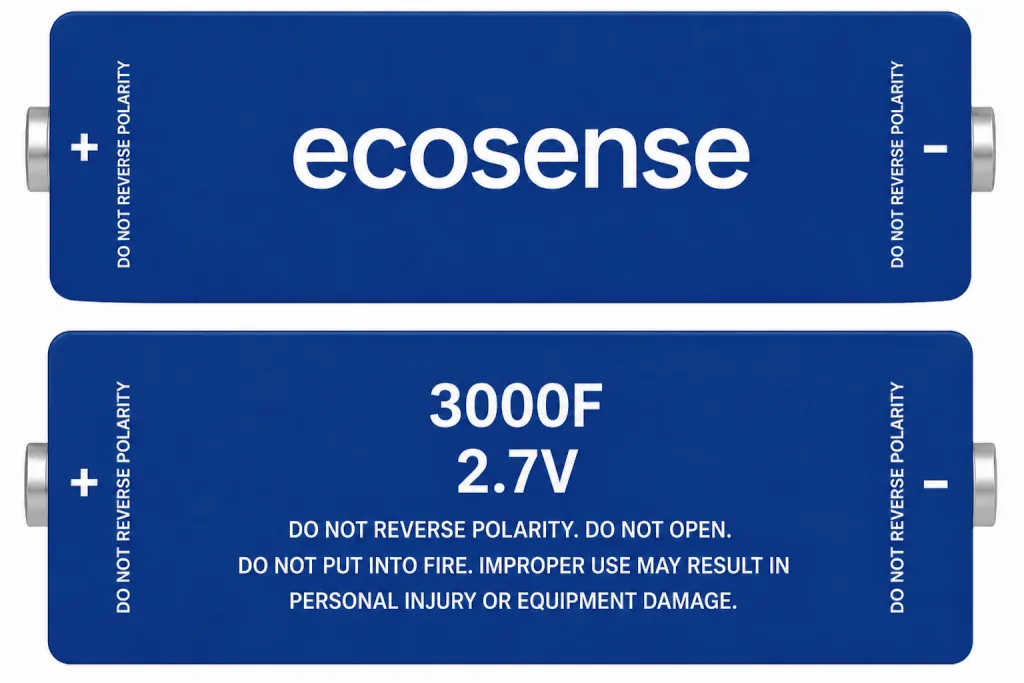
The UCR Series represents Ecosense's entry point into industrial supercapacitor cells. Built on carbon-carbon double-layer capacitor chemistry, these cells are engineered specifically for transportation and pulse power applications where cycle life and thermal stability are non-negotiable. The UCR27V3000B operates across a voltage window of 0 to 2.7V, delivers up to 2200A peak current, and holds its charge characteristics over one million cycles at reduced voltage depth (1.35V to 2.7V). Its wide operating temperature range of -40°C to +65°C makes it suitable for outdoor rail vehicles operating in both northern winters and tropical summers.

Know More
Key Features

UCK Series : Hybrid High-Energy Supercapacitor Cells

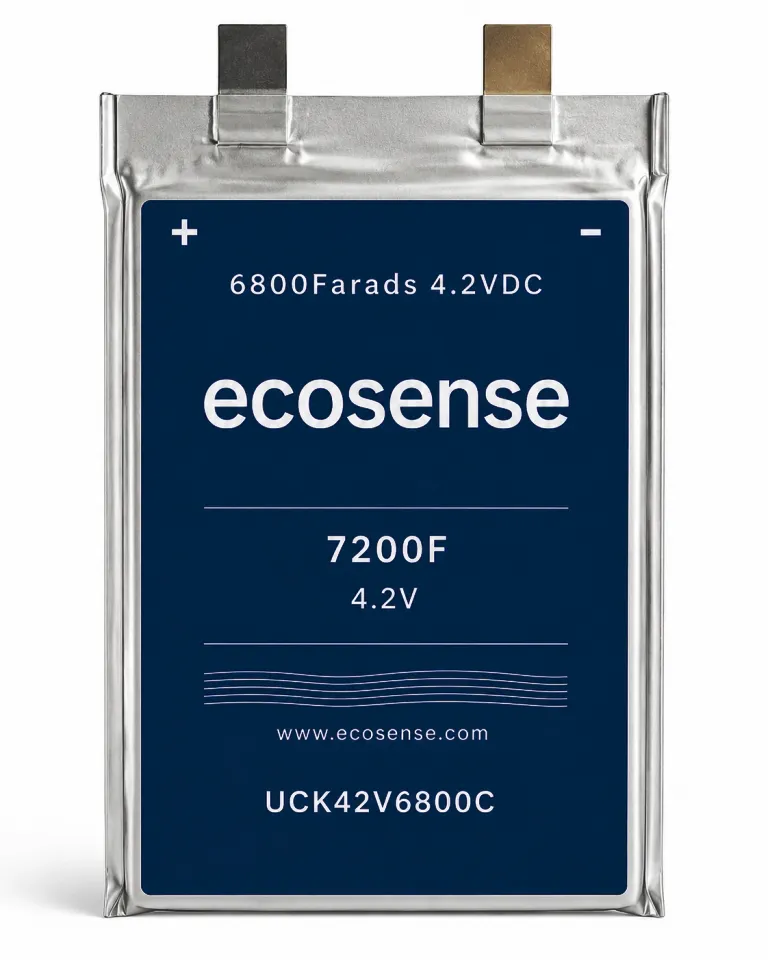
The UCK Series pushes energy density to 100 Wh/kg — roughly 18x higher than classic carbon EDLCs. These are hybrid lithium-ion capacitor (LIC) cells that combine the fast-charge capability of a supercapacitor with energy storage approaching lithium-ion battery levels.

Know More

Supercapacitors: High-Power Energy Storage Solutions for Transportation, Industrial and Renewable Energy Applications

Supercapacitors, also known as ultracapacitors or Electric Double Layer Capacitors (EDLCs), are advanced energy storage devices designed for applications requiring rapid charging, high power delivery, and exceptional cycle life. Unlike conventional batteries that store energy through chemical reactions, supercapacitors store energy electrostatically, enabling them to charge and discharge within seconds while maintaining reliable performance over hundreds of thousands of cycles.

At Ecosense Sustainable Solutions, we offer a comprehensive range of supercapacitor cells, modules, and integrated energy storage systems engineered for transportation, industrial automation, renewable energy, grid stabilization, and high-power backup applications. Our portfolio supports OEMs, system integrators, research organizations, and industrial users seeking reliable solutions for peak power management and energy recovery.


Why Choose Supercapacitors?

Supercapacitors provide unique advantages that complement or, in some cases, outperform traditional battery technologies.

  • Ultra-Fast Charging: Charge within seconds or minutes, enabling rapid energy replenishment and high-duty-cycle operation.
  • Exceptional Cycle Life: Designed to withstand 500,000 to over 1,000,000 charge-discharge cycles with minimal performance degradation.
  • High Power Density: Deliver large bursts of power instantly, making them ideal for acceleration support, regenerative braking, and peak load management.
  • Wide Operating Temperature Range: Reliable operation from -40°C to +65°C for demanding industrial and transportation environments.
  • High Efficiency: Round-trip efficiencies exceeding conventional battery systems help reduce energy losses and improve overall system performance.
  • Maintenance-Free Operation: No complex maintenance requirements and excellent operational reliability throughout the product lifecycle.
  • Enhanced Safety: Low thermal runaway risk and robust construction for safe deployment in commercial and industrial systems.
  • Intelligent Monitoring: Available with CAN communication, Cell Management Systems (CMS), voltage balancing, and real-time diagnostics.

Applications Across Industries:

  • Public Transportation: Supercapacitors capture and reuse braking energy, reducing operational costs and improving energy efficiency in buses, trams, and rail systems.
  • Electric Mobility: Provide rapid power delivery for acceleration support while extending battery life in EVs and hybrid vehicles.
  • Renewable Energy Systems: Buffer intermittent solar and wind power, improving power quality and system stability.
  • Industrial Automation: Support high-power loads, voltage stabilization, and uninterrupted operation of critical industrial equipment.
  • Logistics & Material Handling: Widely used in AGVs, automated warehouses, forklifts, and industrial transport systems requiring frequent charge-discharge cycles.
  • Smart Grid & Utility Infrastructure: Enable fast-response energy storage for grid balancing, power quality improvement, and ancillary services.

Frequently Asked Questions

A supercapacitor is an advanced energy storage device that stores electrical energy electrostatically rather than through chemical reactions. This enables extremely fast charging and discharging while maintaining excellent efficiency and long service life. Supercapacitors are designed for high-power applications where rapid energy delivery, regenerative energy capture, and frequent cycling are required. They are commonly used alongside batteries to improve overall system performance and reliability.

The primary difference lies in power delivery and cycle life. Lithium-ion batteries are optimized for storing large amounts of energy, while supercapacitors are designed to deliver and absorb power very quickly. Supercapacitors can be charged in seconds and can withstand hundreds of thousands of cycles with minimal degradation. In many applications, they complement batteries by handling peak power demands and reducing stress on the battery pack.

Supercapacitors are widely used in transportation, renewable energy, industrial automation, smart grids, logistics, and backup power systems. Typical applications include electric buses, trams, railways, automated guided vehicles (AGVs), cranes, wind turbines, solar energy systems, and industrial machinery. Their ability to provide high burst power and recover braking energy makes them particularly valuable in electrified transportation and energy management systems.

Yes. Supercapacitors are frequently integrated with battery systems to create hybrid energy storage solutions. In such configurations, the supercapacitor handles sudden power demands and regenerative energy capture, while the battery provides sustained energy. This approach improves system efficiency, reduces battery stress, extends battery lifespan, and enhances overall performance in electric vehicles, renewable energy installations, and industrial power applications.

Depending on operating conditions and application requirements, industrial-grade supercapacitors can achieve more than 500,000 to 1,000,000 charge-discharge cycles. Unlike conventional batteries, they experience very little performance degradation over time. Their long operational life significantly reduces replacement costs and maintenance requirements, making them a cost-effective solution for applications involving frequent cycling, high power demand, and continuous operation.

Yes. Supercapacitors are increasingly used in electric buses, hybrid vehicles, trams, and rail transportation systems. They are particularly effective for regenerative braking energy recovery, acceleration assistance, and peak power support. By rapidly absorbing and delivering energy, they improve vehicle efficiency, reduce battery loading, and extend battery life. Many modern public transportation systems use supercapacitor technology to enhance overall energy management.

Industrial supercapacitors are designed to operate reliably across a wide temperature range, typically from -40°C to +65°C. This makes them suitable for demanding environments where conventional batteries may experience performance limitations. Their ability to function efficiently in extreme temperatures makes them ideal for outdoor infrastructure, transportation systems, renewable energy installations, and industrial applications exposed to varying climatic conditions.

Selecting the appropriate supercapacitor depends on factors such as voltage, capacitance, power requirements, charge-discharge frequency, operating environment, and system integration needs. Ecosense provides technical consultation to evaluate application requirements and recommend suitable products. Our team assists with system sizing, module selection, thermal considerations, communication interfaces, and performance optimization to ensure reliable and efficient operation.