Solar PV Emulator 

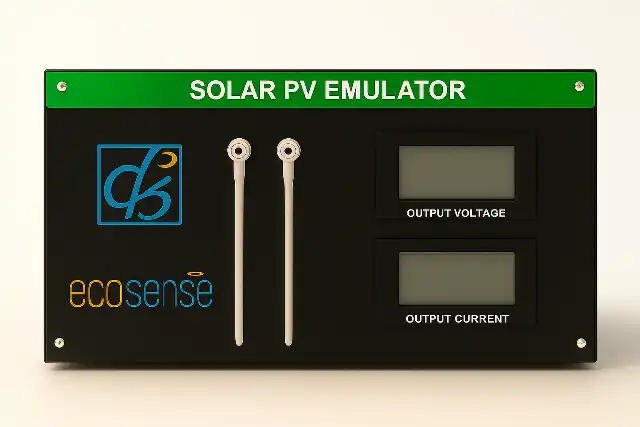
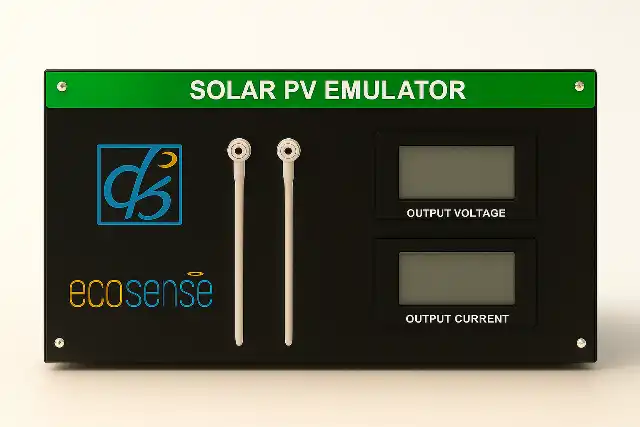
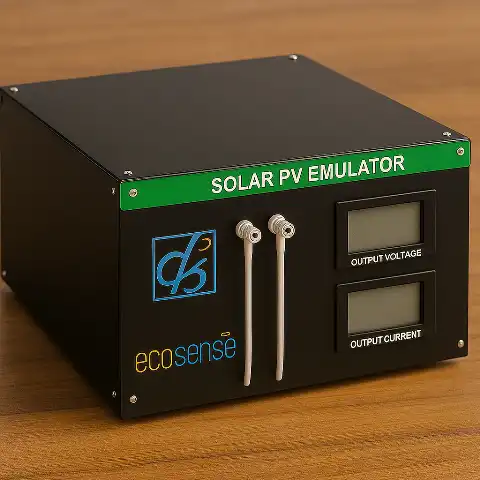
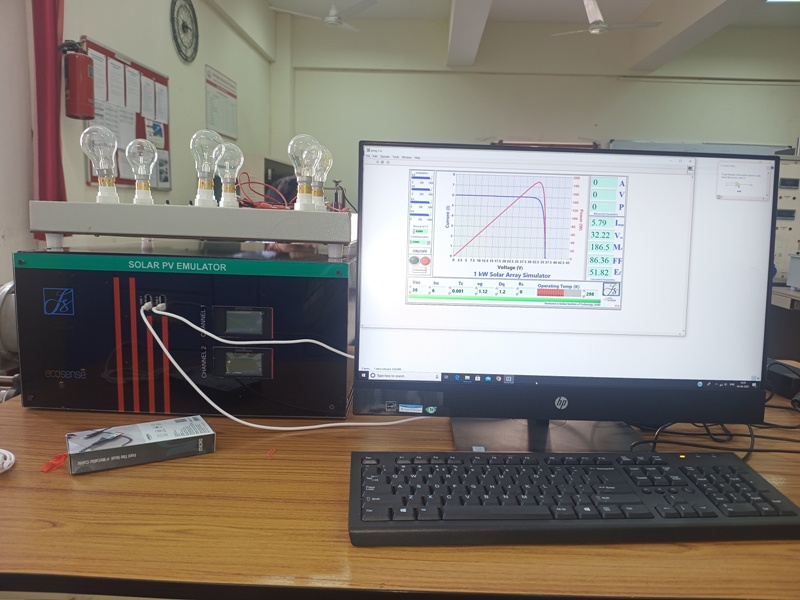
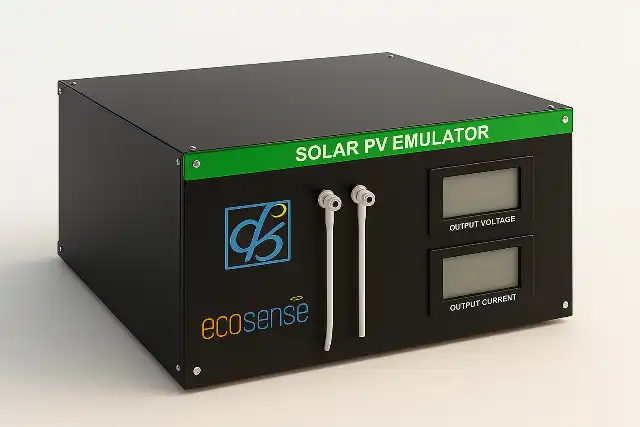
Ecosense’s Solar PV Emulator is a versatile experimental tool designed to replicate the characteristics of solar panels, enabling users to simulate various environmental conditions without relying on actual sunlight. Ideal for educational institutions and research labs, it offers a controlled environment to study and analyze solar photovoltaic systems. The emulator can visualize up to four peaks of shading, allowing detailed examination of partial shading effects on solar panel performance. 
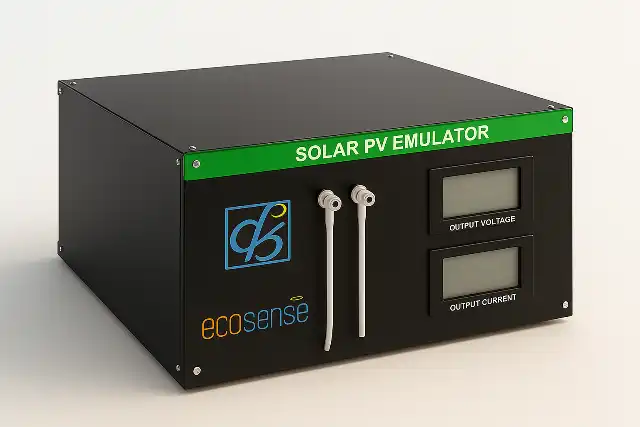
Key Features

  • Available in Single Channel and Dual Channel Models: Choose between a single channel emulator or a dual channel model for flexible testing needs.
  • Dual Channel Parallel Operation: The dual channel model supports parallel operation of channels to simulate higher power or complex configurations.
  • Programmable Output: Emulates solar panel characteristics with adjustable parameters such as open-circuit voltage (Voc), short-circuit current (Isc), temperature coefficient, and shading effects.
  • Partial Shading Simulation: Visualize and analyze up to four peaks of partial shading to study its impact on solar panel output and performance.
  • Real-Time Simulation: Utilizes an internal algorithm to adjust Voc and Isc based on user-defined parameters, ensuring accurate replication of solar panel behavior under varying conditions.
  • Comprehensive Software Interface: The LabVIEW-based software provides real-time visualization of I-V and P-V curves, with options to simulate partial shading effects and track load points.
  • Data Logging and Export: Save simulation data as CSV files and export graphs as images for detailed analysis and reporting.
  • User-Friendly Controls: Equipped with an active measurement panel to monitor voltage, current, power, and energy, facilitating hands-on learning and experimentation.
Ecosense

Learning Module 

Ecosense

PV Characteristics, Modelling & Performance Analysis

  • Generation and analysis of I–V and P–V characteristics of solar PV panels.
  • Study of irradiance variation and its impact on current, voltage, and power output.
  • Analysis of temperature effects on PV performance and efficiency.
  • Identification of open-circuit voltage, short-circuit current, and maximum power point.
  • Comparison of ideal PV models with practical operating behaviour.

Power Electronics Interface and MPPT Control

  • Interfacing the PV emulator with DC–DC power electronic converters.
  • Implementation of MPPT algorithms such as Perturb & Observe and Incremental Conductance.
  • Evaluation of MPPT tracking accuracy, convergence speed, and steady-state oscillations.
  • Analysis of PV–converter interaction during rapid irradiance and load changes.
  • Efficiency and dynamic performance assessment of power electronic stages.

Grid Integration, Shading Effects and Advanced Studies

  • Integration of the PV emulator with grid-tied inverters for power injection studies.
  • Simulation of partial shading and mismatch conditions producing multi-peak P–V curves.
  • Evaluation of inverter response under varying PV and grid conditions.
  • Study of fault, abnormal, and transient operating scenarios in a controlled environment.
  • Long-duration performance analysis and research-oriented experimentation.

Technical Description

  • Solar PV Emulator operates as a controlled DC source governed by a real-time two-diode PV mathematical model for high-fidelity panel behaviour.
  • User-defined parameters such as open-circuit voltage (Voc), short-circuit current (Isc), irradiance, temperature, and panel ratings precisely shape the output I–V and P–V curves.
  • Internal control algorithms continuously regulate output voltage and current to maintain the selected PV characteristic across all operating regions.
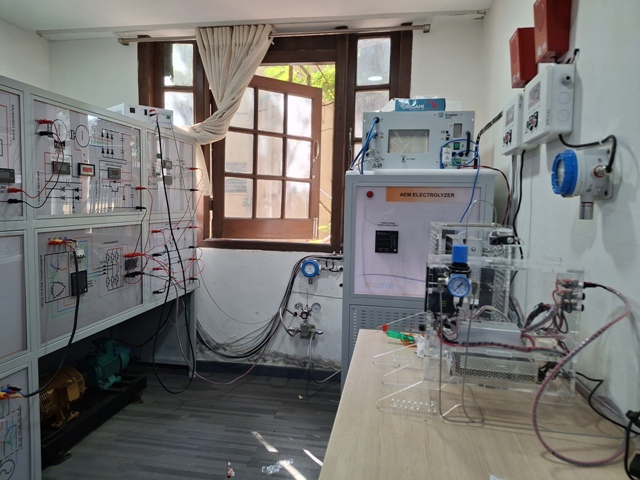
  • When connected to DC–DC converters or grid-tied inverters, the emulator dynamically responds to load variations and control actions, closely replicating real PV source behaviour.
  • Partial shading, mismatch, and fault conditions are introduced through software, enabling safe stress testing of power electronic converters and control algorithms.
  • Rapid transient response allows accurate evaluation of MPPT performance during fast irradiance changes and dynamic operating conditions.
  • Long-duration stable operation supports endurance testing, efficiency analysis, and repeatable validation of solar power conversion systems.
Ecosense

Technical Specifications 

Ecosense

Electrical and Performance Specifications


ParametersSpecifications
Total System Capacity2kW
Max. Output Power per channel1kW
No. of Output Channels2
Open Circuit Voltage (Voc) / Channel0 – 50 V DC
Short Circuit Current (Isc) / Channel0 – 20 A

*specifications can be customized as per user requirements.

Input, Control and Modelling Specifications


ParameterSpecifications
Input Supply Voltage230 V AC, 50 Hz
PV ModelReal-time two-diode PV Mathematical model
User Defined ParametersVoc, Isc, Irradiance, Temperature, Diode quality factor etc.
Shading simulationsComplete and Partial Shading
Control PlatformPC-based control software
Data OutputTables, Plots, exportable data

*specifications can be customized as per user requirements.

Physical, Interface and Operating Specifications


ParametersSpecifications
Output Connector TypeBanana
Form FactorTable-top
Operating EnvironmentIndoors only
Multi-User OperationTwo users in independent 1kW mode
Data ExportCSV, image

*specifications can be customized as per user requirements.

Related Products

Frequently Asked Questions

The emulator allows users to adjust key PV parameters including open-circuit voltage (Voc), short-circuit current (Isc), solar irradiance, operating temperature, temperature coefficient, series resistance, diode quality factor, panel area, and panel power rating. These parameters shape the real-time I–V and P–V characteristics of the emulated PV module.

Partial shading is simulated through software by introducing multiple local maxima in the P–V curve. This enables realistic emulation of mismatch and shading effects seen in PV arrays. The system can emulate up to four distinct power peaks, making it suitable for advanced MPPT algorithm testing.

Yes. The dual-channel configuration allows channels to be operated independently or connected in parallel. This enables higher power operation, array-level behaviour emulation, and comparative studies, making it suitable for simulating scaled PV array conditions in a laboratory environment.

The emulator supports exporting measured and simulated data in Excel-compatible formats for numerical analysis. In addition, I–V and P–V plots can be saved as image files, allowing easy inclusion in lab reports, research documentation, and presentations.

Get in Touch

Ready to transform your labs?

Contact Now